For decades, a crucial piece of ancient history, a missing page from the legendary Archimedes Palimpsest, was simply… gone. Vanished. Poof. Scholars sighed, historians despaired, and the rest of us probably didn't even know it was missing. But good news: it's been found, tucked away in the Musée des Beaux-Arts in Blois, France. Apparently, sometimes the universe just puts things back where they belong.
This isn't just any old scrap of parchment. This is page 123 of the Palimpsest, containing sections of Archimedes' own mathematical treatise, On the Sphere and the Cylinder. Specifically, Propositions 39–41 from Book I. Let that satisfyingly specific number sink in. The discovery, confirmed by early checks, was recently announced in the Zeitschrift für Papyrologie und Epigraphik. Because apparently, ancient math mysteries are still breaking news in 2026.
The Ultimate Recycle Job
For those not fluent in ancient manuscript drama, the Archimedes Palimpsest is a Greek manuscript from the 10th century, containing several works by Archimedes of Syracuse. But here's the kicker: in the Middle Ages, some clever (or incredibly annoying, depending on your perspective) monk decided that parchment was too expensive to waste. So, they scraped off Archimedes' original writing and reused the pages for other texts. Because, why not overwrite the greatest mathematician of antiquity with, say, a prayer book? Priorities.
We're a new kind of news feed.
Regular news is designed to drain you. We're a non-profit built to restore you. Every story we publish is scored for impact, progress, and hope.
Start Your News DetoxThe manuscript bounced around a bit – Jerusalem, Constantinople. In 1906, a Danish scholar named Johan Ludvig Heiberg photographed it, preserving its contents just before it disappeared into a private collection in France. Fast forward to 1996, and the French Ministry of Culture allowed it to be sold at auction. To a private collector. Who still owns it. Which, if you think about it, is both impressive and slightly terrifying.
The main bulk of the Palimpsest now resides at the Walters Art Museum in Baltimore. For years, Heiberg's 1906 photos were all scholars had. Then, in the early 2000s, advanced imaging techniques started revealing Archimedes' original genius beneath the medieval overwriting. But alas, three leaves seen in Heiberg's photos had gone missing during the manuscript's various ownership changes. Lost in the shuffle, presumed gone forever.
The Detective Work of Ancient Texts
Enter Victor Gysembergh, a researcher with the French National Centre for Scientific Research (CNRS). He's the one who identified the Blois leaf as one of those long-lost pages. How? By comparing it to Heiberg's original 1906 photographs, now housed at the Royal Danish Library. It's like finding a missing piece of a jigsaw puzzle that someone took a picture of a century ago.
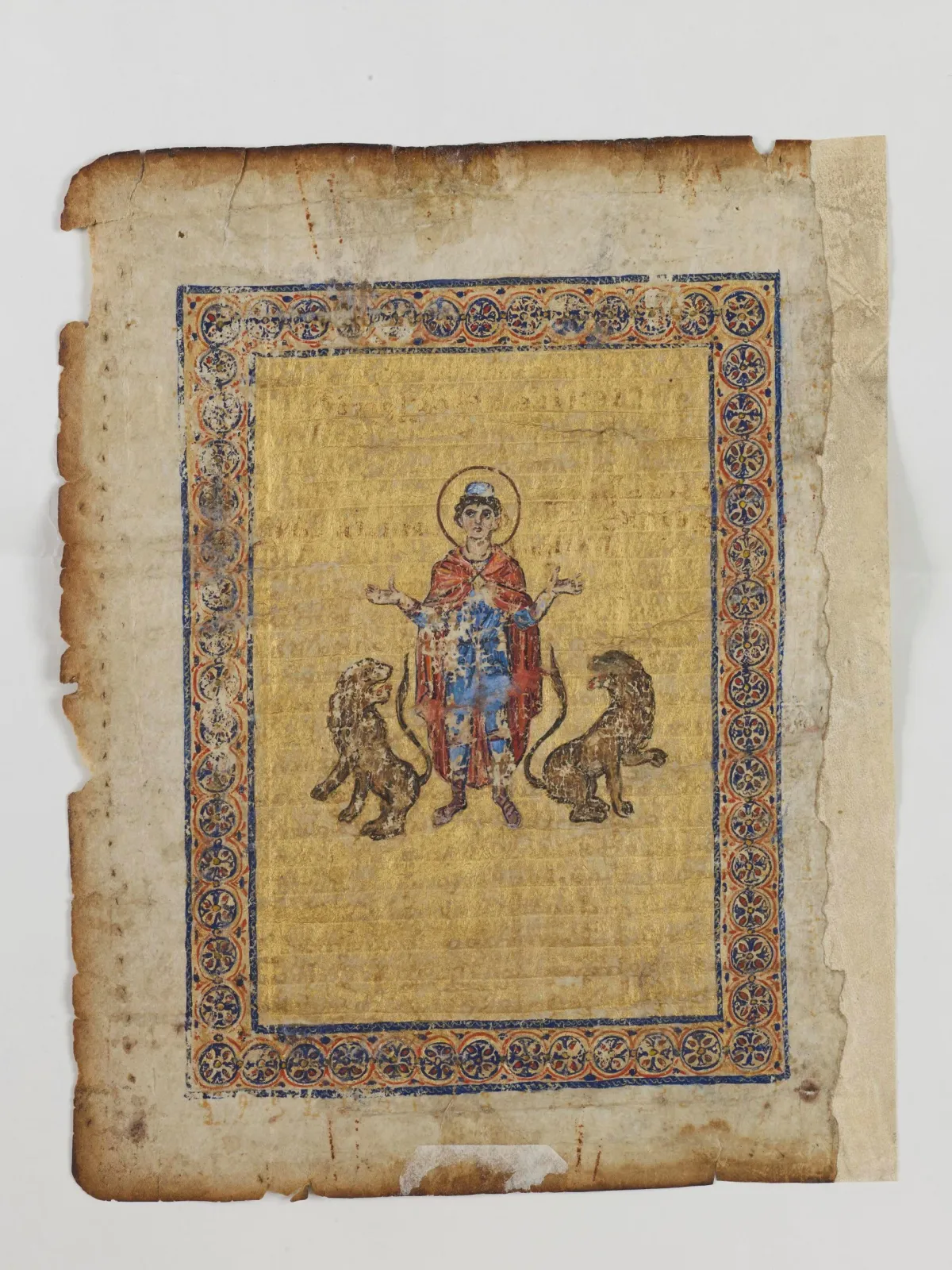
One side of the leaf reveals a medieval prayer written directly over Archimedes' geometric drawings and that On the Sphere and the Cylinder passage. Much of that older, original writing is still readable. The other side? A 20th-century picture of the Prophet Daniel chilling with two lions. Because, of course. The ancient text beneath that picture is currently invisible using normal methods. It's always something, isn't it?
So, what's next for this newly found piece of history? Researchers are planning to image the leaf within a year, using multispectral imaging and X-ray fluorescence analysis. The goal is to peel back those layers of paint and prayer to finally read what Archimedes had to say. This discovery has also reignited interest in re-examining the entire Palimpsest with even more powerful techniques. Because if one page can hide for decades, who knows what other secrets are still lurking in plain sight?