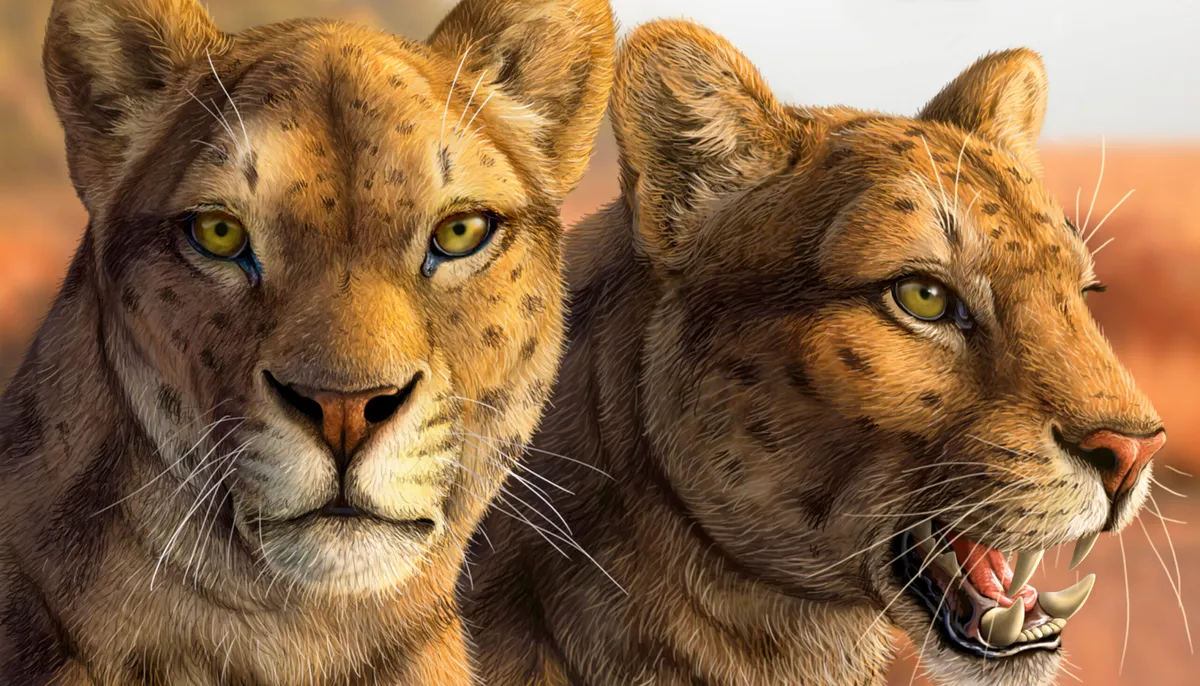
A skull misidentified in a museum collection turned out to be a very early saber-toothed cat. This discovery highlights how these animals evolved longer and longer fangs over time.
An Ancient Saber-Toothed Cat Revealed
Fossils stored in a museum drawer, simply labeled "feline," are actually from a very old and mysterious saber-toothed cat. This cat lived in North America over five million years ago. A UC Berkeley paleontologist recently identified the nearly complete skull. This find helps explain how these large-fanged felines evolved over millions of years before dying out about 10,000 years ago.
One clear lesson is that these cats started with smaller upper canines, or fangs. They then evolved increasingly longer ones. This trend might have led to their eventual extinction. California's state fossil, Smilodon fatalis, was the peak of this trend. It had some of the longest upper canines of any saber-toothed animal, up to seven inches long. Yet, it was the last saber-toothed animal to survive.
We're a new kind of news feed.
Regular news is designed to drain you. We're a non-profit built to restore you. Every story we publish is scored for impact, progress, and hope.
Start Your News DetoxNarimane Chatar, a Berkeley postdoctoral fellow, found the cranium, teeth, and lower jaw in the American Museum of Natural History in New York. These belonged to the species Adelphailurus kansensis. This species was first found in Kansas and was only known from jaw fragments and teeth. With this first complete skull, Chatar could tentatively place the animal in the saber-toothed carnivore family tree. She could also compare it to the well-known Smilodon, which lived across the Americas.
Chatar explained that people used to think all saber-toothed species hunted and behaved like Smilodon. Now, scientists are seeing a lot more variety among these animals, especially in the earlier species like Adelphailurus kansensis.
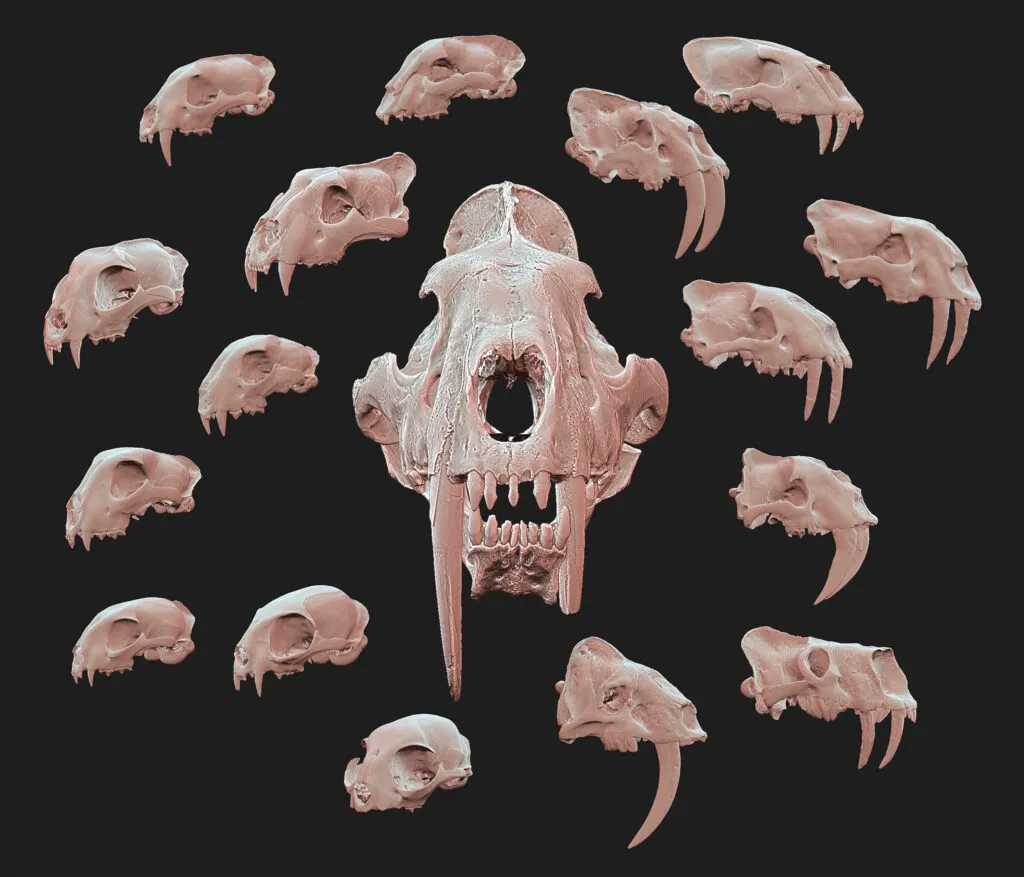
The upper canines of these cats were flat like a knife, unlike the round canines of modern lions or house cats. They were good for slicing flesh and cutting arteries. Their premolars were also knife-like, perfect for chopping meat.
However, saber-shaped teeth are more fragile than the stronger teeth of today's felines. Chatar's research showed this. She tested how sturdy and efficient saber-tooth upper canines were. In simulations, 3D-printed saber teeth were great at piercing soft flesh but broke easily against simulated bone. Smilodon performed best at piercing flesh but worst against bone.
This fragility might explain why these fierce meat-eaters died out. When their main food source, large plant-eaters like bison and camels, disappeared after the last Ice Age, saber-toothed cats couldn't compete. Carnivores with rounder, stronger teeth and bone-crushing molars outcompeted them. Chatar noted that saber-toothed animals had a clear trade-off: their upper canines were very efficient but broke easily.
The Evolutionary Ratchet of Fangs
Saber-like teeth were common for tens of millions of years, appearing in different groups. These included two groups of felids (saber-toothed cats like Smilodon and scimitar-toothed cats called Homotherini). They also appeared in marsupials called Thylacosmilids in South America and an ancient group of cat-like carnivores called Nimravids. Thylacosmilus, which died out millions of years ago, had continuously growing saber teeth as long as Smilodon's.
The skulls from older lineages have shorter upper canines than those from newer ones. This shows a trend towards longer canines in all types of sabertooths. Chatar explained that there was a huge variety of saber-toothed cats. While species like Smilodon with very long canines get a lot of attention, most early species had shorter upper canines.
Chatar's PhD thesis focused on the evolution of saber-toothed animals. She visited museums worldwide, using a portable laser scanner to get detailed scans of fossils. She then combined these scans to create precise 3D images. At the American Museum, she looked through every drawer labeled "felids" or "cats." She noticed a skull from Arizona labeled Pseudaelurus that didn't look like modern cats.
Pseudaelurus is a general term for any unidentified cat-like fossil. Chatar was curious because the skull was quite complete, with a partial jaw and all its teeth. She also found upper canines in the drawer. When she saw they were flat on the sides, she knew it wasn't a modern cat or tiger.
She scanned it but didn't think about it again until she saw a cast of the original Adelphailurus kansensis fossil at the Yale Peabody Museum. The cast looked very similar to the fossils at the American Museum.
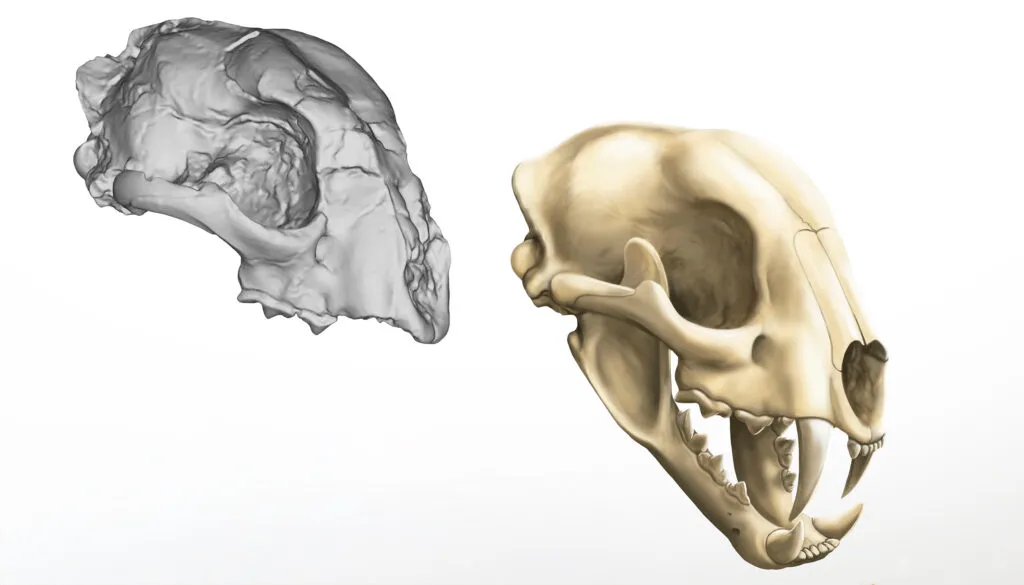
After finishing her thesis, Chatar moved to Berkeley. She then started analyzing the Pseudaelurus skull. In a new paper, co-authored with Jack Tseng, Chatar describes how the American Museum fossil matches the original Adelphailurus fragments from Kansas and similar fossils from Nebraska, Texas, and Mexico.
One difference is that Adelphailurus had a narrow, long snout, unlike other saber-toothed cats from the same time. Its teeth also had slight serrations, like a serrated knife, which are found in some but not all sabertooths.
The shorter upper canines of ancestral saber-toothed animals, including Adelphailurus, support Chatar's idea. Once these specialized carnivores started growing longer fangs, they couldn't stop. Chatar calls this the "macroevolutionary ratchet." She explained that once a group develops a super-specialized feature, they become very efficient at one thing. But if the environment changes and makes that thing harder, they are more likely to die out.
Chatar's discovery of Adelphailurus shows that other important fossils might be hidden in museums. She emphasizes the need to revisit old collections and examine every specimen. There could be amazing fossils waiting to be described, mislabeled as something else.
Deep Dive & References
Newly identified fossil sheds light on evolutionary history of saber-toothed cats - Journal of Vertebrate Paleontology, 2026 Sabertooth upper canines - Current Biology, 2024