For years, Saturn seemed to be doing something impossible. Measurements suggested the giant planet's rotation rate was changing over time. This made it seem as if Saturn were speeding up or slowing down.
Scientists using the James Webb Space Telescope (JWST) have now solved this mystery. They found that Saturn's northern lights are key to understanding the phenomenon.
Saturn's Rotation Mystery Solved
The puzzle began decades ago. It gained attention after NASA's Cassini spacecraft observed in 2004 that Saturn's rotation rate appeared to change. This was hard to explain because planets do not simply alter their spin rates quickly.
We're a new kind of news feed.
Regular news is designed to drain you. We're a non-profit built to restore you. Every story we publish is scored for impact, progress, and hope.
Start Your News DetoxIn 2021, Professor Tom Stallard and his team proposed a different idea. They suggested Saturn's rotation was not changing. Instead, electrical signals from the planet's aurora were affected by winds in Saturn's upper atmosphere. These winds created electrical currents that changed the auroral signal. Scientists used this signal to estimate the planet's rotation.
This explained the misleading measurements. But a big question remained: What was driving these atmospheric winds?
James Webb Maps Saturn's Aurora
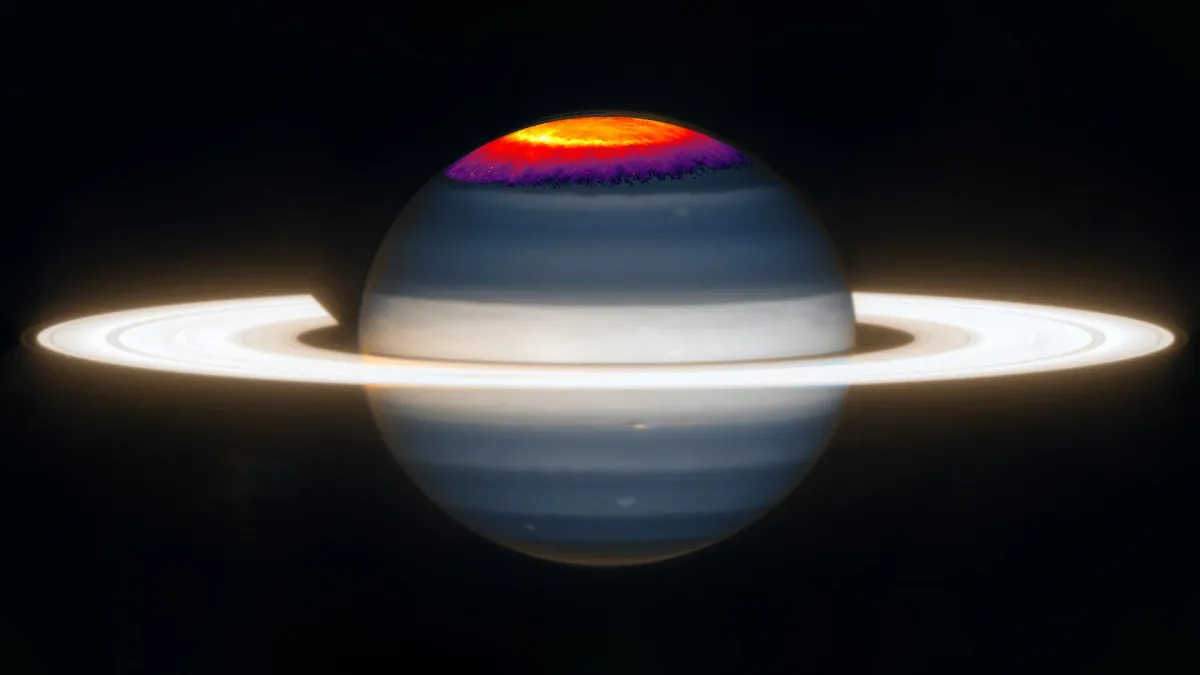
To find out, Stallard and his team used the James Webb Space Telescope. They watched Saturn's northern aurora for an entire Saturnian day. These observations gave them details that no other instruments could.
The team looked at infrared light from a molecule called trihydrogen cation. This molecule forms in Saturn's upper atmosphere and shows temperature. By studying its glow, they made the most detailed maps ever of temperatures and charged particles in Saturn's aurora.
The new measurements were much more accurate. Earlier measurements had errors of about 50 degrees Celsius. This made it hard to see small changes. JWST's observations were ten times more precise. This allowed scientists to find specific patterns of heating and cooling for the first time.
A Self-Sustaining Planetary Heat Engine
The new data matched predictions from computer models made over ten years ago. But these models only worked if the heating came from exactly where the strongest auroral particles entered Saturn's atmosphere.
The results show that Saturn's aurora does more than create a light show. The aurora's energy heats specific parts of the atmosphere. This heating creates winds, which then make electrical currents. These currents help power the aurora itself. This keeps the atmosphere hot and sustains the whole cycle.
Professor Tom Stallard, the lead researcher, called it a "planetary heat pump." He explained that Saturn's aurora heats its atmosphere, which drives winds. These winds produce currents that power the aurora, and the cycle continues.
Stallard noted that for decades, scientists knew something strange was happening with Saturn's apparent rotation. They later showed it was due to atmospheric winds, but the cause of these winds was unknown. The new JWST observations finally provided the evidence needed to understand the full cycle.
Implications Beyond Saturn
This discovery could be important for understanding other planets. Researchers found that Saturn's atmosphere and magnetosphere are closely linked. The magnetosphere is the large area of space shaped by the planet's magnetic field. Activity in the atmosphere seems to affect the magnetosphere. The magnetosphere then sends energy back into the atmosphere.
This constant exchange might explain why the process stays stable for so long. The researchers believe similar interactions could happen on other planets.
Professor Stallard added that this result changes how we think about planetary atmospheres. If a planet's atmosphere can drive currents into space, then understanding other worlds' stratospheres might reveal new interactions.
Deep Dive & References
- JWST/NIRSpec Reveals the Atmospheric Driver of Saturn's Variable Magnetospheric Rotation Rate - Journal of Geophysical Research: Space Physics, 2026