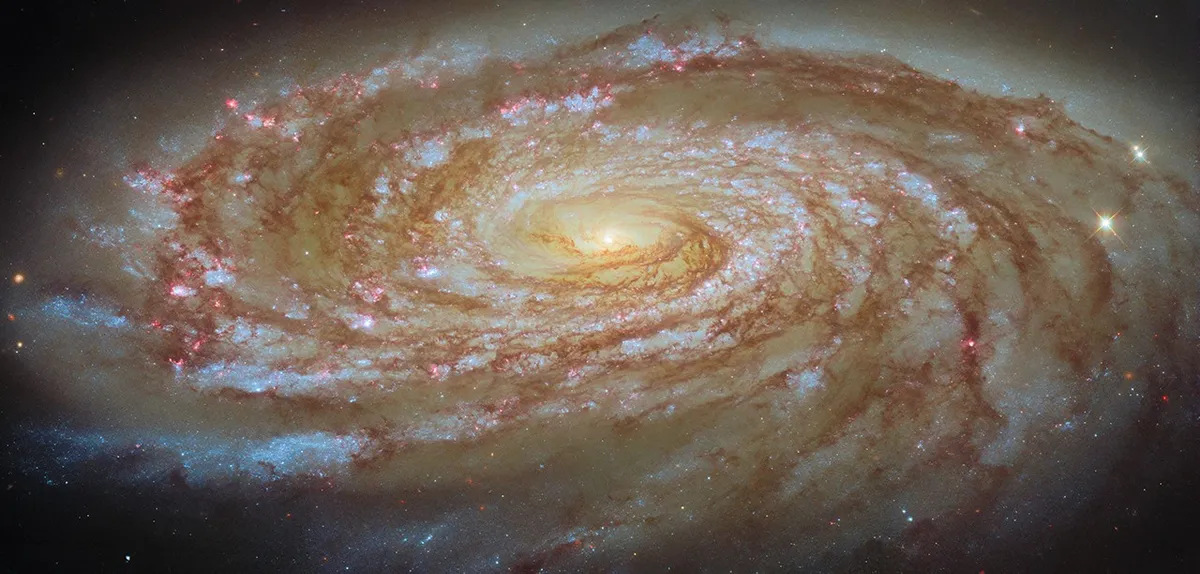
The Hubble Space Telescope, bless its ever-watchful eye, recently snapped a picture of something truly spectacular: a spiral galaxy named Messier 88. But this isn't just any galaxy. M88 is currently on a one-way trip, hurtling towards the gravitational heart of the Virgo Cluster, and it’s going to be a wild ride.
The Galaxy That's Always Hungry
M88, which sounds less like a galaxy and more like a highway exit, is about 63 million light-years away. It’s an "active galaxy," which is a polite way of saying it has a supermassive black hole at its core that's roughly 100 million times the mass of our Sun. This cosmic glutton is constantly chowing down on gas and dust, spitting out powerful outflows from the galaxy's center. Think of it as a celestial diner with a very messy eater.
Around this perpetually hungry black hole, older, reddish stars create a warm glow, while M88's tightly wound spiral arms sparkle with pink and blue star clusters and dust clouds. From our vantage point, it looks elongated, its arms dramatically fanning out as if posing for a galactic portrait.
We're a new kind of news feed.
Regular news is designed to drain you. We're a non-profit built to restore you. Every story we publish is scored for impact, progress, and hope.
Start Your News DetoxRamming Speed!
M88 is just one of over a thousand galaxies in the Virgo Cluster, all swirling around like a cosmic mosh pit. But M88 is special: it's making a beeline for the very center. In a mere 200 to 300 million years (which, in galaxy terms, is practically tomorrow), M88 will have a very close encounter with Messier 87, a colossal elliptical galaxy that pretty much runs the whole cluster show.
When M88 gets too close to this behemoth, it's going to experience something called "ram pressure stripping." This isn't some intergalactic spa treatment; it’s a brutal process where the gas that fuels new star formation gets violently swept away as the galaxy barrels through the cluster's intergalactic medium. Researchers have already spotted the early signs: M88's swirling gas disk is compressed on its leading edge, piling up gas and dust like snow on a galactic windshield.
Apparently, M88 already has less cold gas than it should for a galaxy its size, especially on its outer edges. So, its epic journey isn't just a scenic tour; it's a fundamental change that will impact its ability to form new stars and reshape its entire evolution. Hubble's Wide Field Camera 3 is keeping tabs on M88, helping scientists understand how these crowded cosmic environments fundamentally alter the galaxies within them. Which, if you think about it, is both impressive and slightly terrifying.