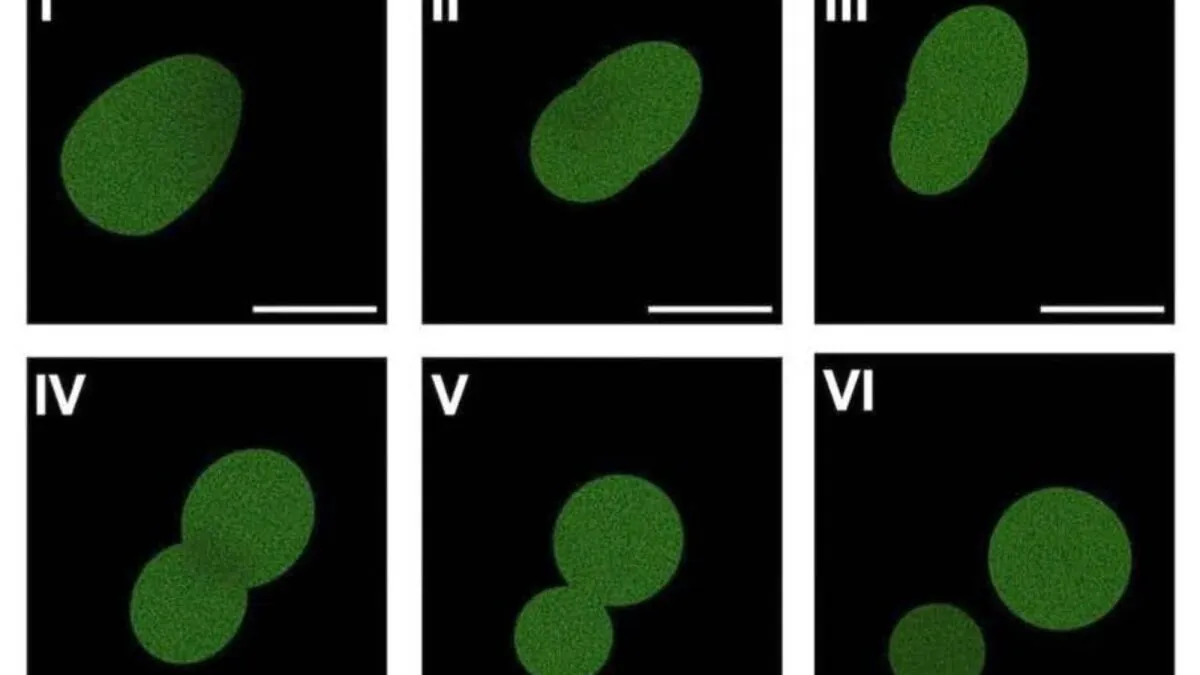
For anyone who's ever wondered how life first sparked into existence, scientists at the University of Minnesota just offered a rather compelling, if slightly unsettling, answer: they built a working, reproducing cell from the ground up.
“This is likely the most exciting project I’ve ever worked on,” said synthetic biologist Kate Adamala, who led the team. Their goal? To craft a cell that could complete a full life cycle, proving that life's basic functions don't require some sort of “mysterious magical spark.” Just a lot of very clever chemistry, apparently.
Meet SpudCell: The DIY Life Form
Now, building life isn't entirely new. Back in 2010, the J. Craig Venter Institute made waves by creating a bacterial cell with a synthetic genome. They essentially swapped out the operating system of an existing cell. Impressive, sure, but still a bit like hot-wiring a car rather than building one from scratch.
We're a new kind of news feed.
Regular news is designed to drain you. We're a non-profit built to restore you. Every story we publish is scored for impact, progress, and hope.
Start Your News DetoxAdamala’s team went a step further, creating a unique cell-like system they’ve affectionately dubbed SpudCell. And by "unique," we mean it’s got a mere 90,000 base pairs of genetic code (spread across nine DNA strips, because why make it simple?), 36 purified enzymes, all cozied up inside a tiny lipid bubble. For reference, the simplest natural free-living organism has about 580,000 base pairs. SpudCell is the minimalist of the biological world.
These little blobs "feed" by merging with even smaller bubbles, sucking in building blocks and more enzymes, all orchestrated by their genetic instructions. Which, if you think about it, is both impressive and slightly terrifying.
But here's the kicker: SpudCell can divide. Natural cells use a complex internal "skeleton" to split, which has been a major headache for synthetic biologists. SpudCell, however, has its own ingenious method: proteins building up in its membrane literally force it to cleave itself in two. Because apparently, even synthetic life finds a way.
To really push the envelope, the researchers even simulated an evolutionary step. They tweaked a gene to boost the production of feeding proteins, creating a new lineage of cells that could grow faster. Survival of the fittest, even when the fittest was just invented last Tuesday.
“This work is just the beginning,” Adamala noted. “We are showing it’s possible to engineer the basic functions of the cell.” Which means, yes, we are now officially in the era of engineering basic life functions.
While SpudCell isn't quite life as your average biologist understands it (it hasn't been peer-reviewed yet, so hold your horses on the existential dread), getting this close is a pretty significant leap. It could lead to entirely new ways of making medicines, testing treatments, and even help us figure out how that first spark of life actually happened on early Earth. Just don't ask it to do your taxes.