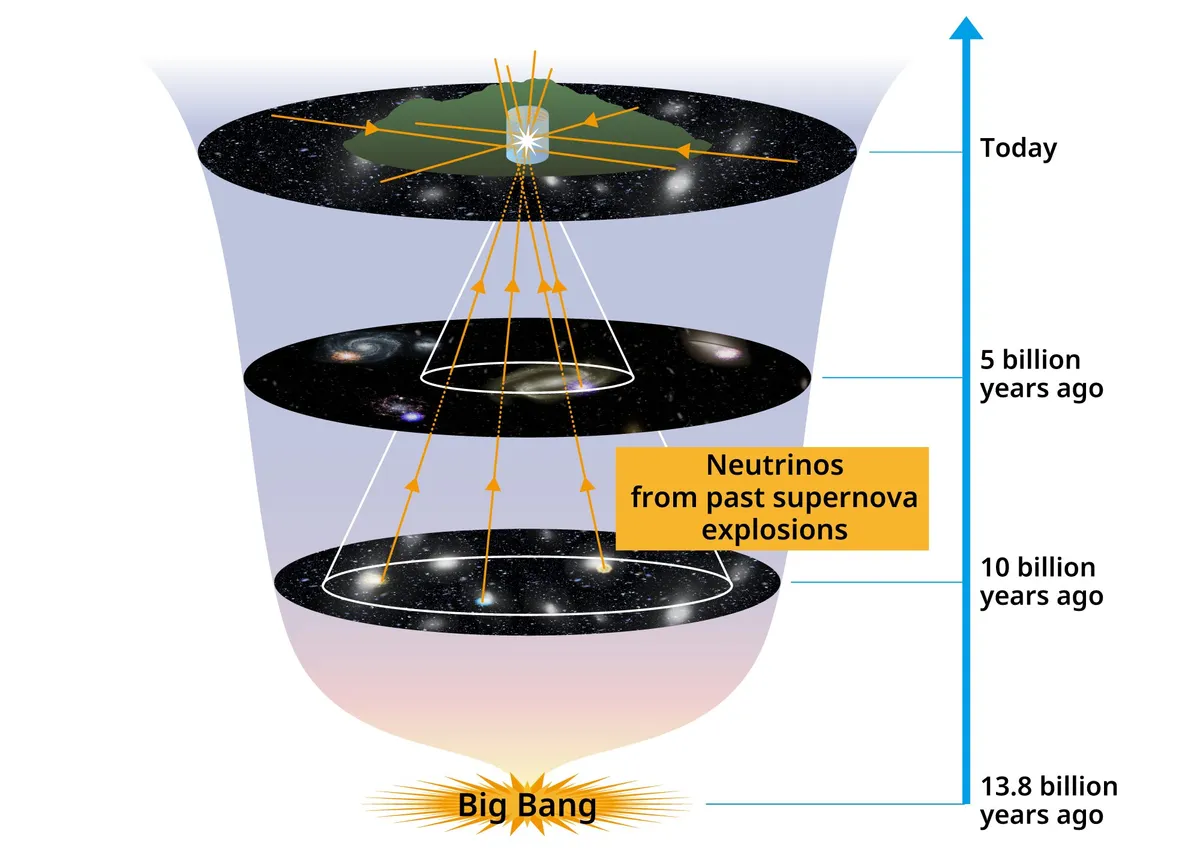
Imagine trying to hear a whisper from across the universe. Now imagine that whisper is from a star that exploded billions of years ago. That's essentially what a team of scientists in Japan just did, hinting at a cosmic soundscape that's been eluding us for decades.
Deep inside a mountain, 3,281 feet underground in Japan's Gifu Prefecture, sits the Super-Kamiokande observatory. It's a massive tank of 50,000 tonnes of ultra-pure water, lined with 13,000 light detectors. Its mission? To catch the faintest interactions of neutrinos, those ridiculously tiny, chargeless particles that zip through everything—including you—without a second thought. They're so elusive, scientists once thought they had no mass at all. Good luck finding those.
Listening for the Universe's Echoes
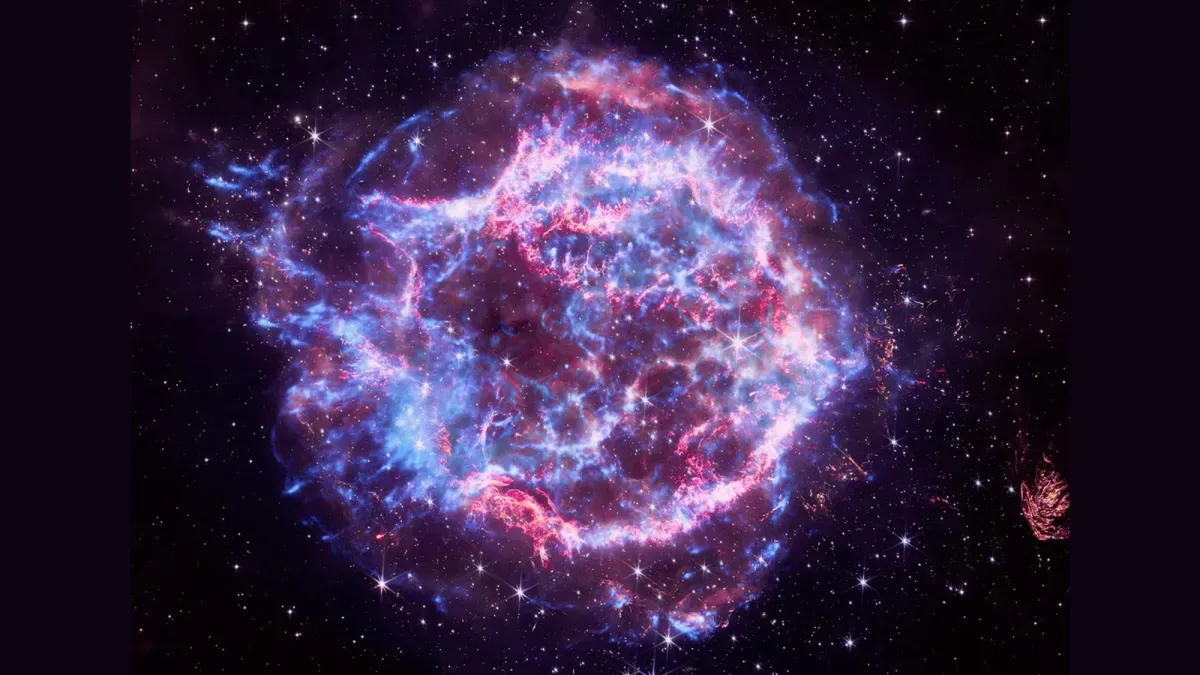
But find them they did. The Super-Kamiokande Collaboration has announced the first real "indication" of something called the Diffuse Supernova Neutrino Background (DSNB). Think of the DSNB as the universe's ambient noise: the collective, faint echo of every single core-collapse supernova that's ever happened, from the dawn of stars to now. It's a cosmic symphony of explosions, just incredibly, incredibly quiet.
We're a new kind of news feed.
Regular news is designed to drain you. We're a non-profit built to restore you. Every story we publish is scored for impact, progress, and hope.
Start Your News DetoxDetecting this DSNB is a huge deal. It's like finally getting a historical record of star formation and how all the heavy elements in the universe—you know, the stuff we're made of—actually came to be. It's a direct line to understanding the universe's past, all through these tiny, ghost-like particles.
To catch these ancient whispers, the team sifted through about 5,000 days of data. That's nearly 14 years. They even tweaked their water, adding gadolinium to improve detection, because sometimes, you just need a little extra something to hear the universe properly.
What They Heard
What they found was an extra signal in a specific energy range (13.3 to 81.3 MeV). The strength of this signal was 2.6 sigma, which, in science-speak, means there's a 99.5% chance it's not just random noise. That's pretty good, but not quite the 5-sigma "confirmed discovery" level needed to pop the champagne. So, for now, it's an "indication"—a very strong, very exciting hint.
Yosuke Ashida, an assistant professor at Tohoku University, is already looking ahead, planning to use future observations and the even more powerful Hyper-Kamiokande detector to refine these findings. Because once you hear a whisper, you want to hear the whole conversation.
This isn't just about cosmic history, either. These findings could shed new light on how neutron stars and black holes form, and how elements evolved throughout the cosmos. As Hiroyuki Sekiya, spokesperson for the Super-Kamiokande experiment, put it, this first indication is a "deeply meaningful achievement" and a long-term goal finally within reach. The universe just got a little less quiet.