Good news, science nerds: Europe just got its first super-sensitive X-ray spectrometer, and it’s basically giving scientists superpowers. We're talking about the ability to spot X-ray photons with 100 to 1,000 times more efficiency than anything before it. Suddenly, the universe of the tiny just got a whole lot bigger.
This isn't just a minor upgrade; it's like going from a magnifying glass to a microscope that sees individual atoms. Scientists can now peer into ultra-thin materials, microscopic structures, and samples so sparse they might as well be ghosts. The team behind it is practically throwing open the doors, inviting anyone with a wild idea to come play.
Peering Into the Quantum Realm
Synchrotron facilities like Germany’s BESSY II are already pretty cool, blasting materials with bright X-ray beams to figure out their secrets. But even with all that power, certain techniques, like X-ray emission spectroscopy (XES) and Resonant Inelastic X-ray Scattering (RIXS), have been limited. They needed a lot of X-rays bouncing back to get any useful data, which meant big samples or high concentrations.
We're a new kind of news feed.
Regular news is designed to drain you. We're a non-profit built to restore you. Every story we publish is scored for impact, progress, and hope.
Start Your News DetoxEnter Régis Decker and his team at HZB. Their new superconducting Transition Edge Sensor (TES) array photon detector is the game-changer. Decker explains it simply: it's 100 to 1,000 times better at catching those elusive photons. That's a sensitivity leap that lets researchers poke around in places they couldn't even dream of before.
What does that mean for us? New insights into molecular chemistry, molecular biology, and the quantum oddities of things like atomic layers, nanostructures, and even tiny impurities. Plus, experiments that used to take hours can now be done in minutes. Because apparently, even science is getting impatient.
How It Works (It's Cold, Really Cold)
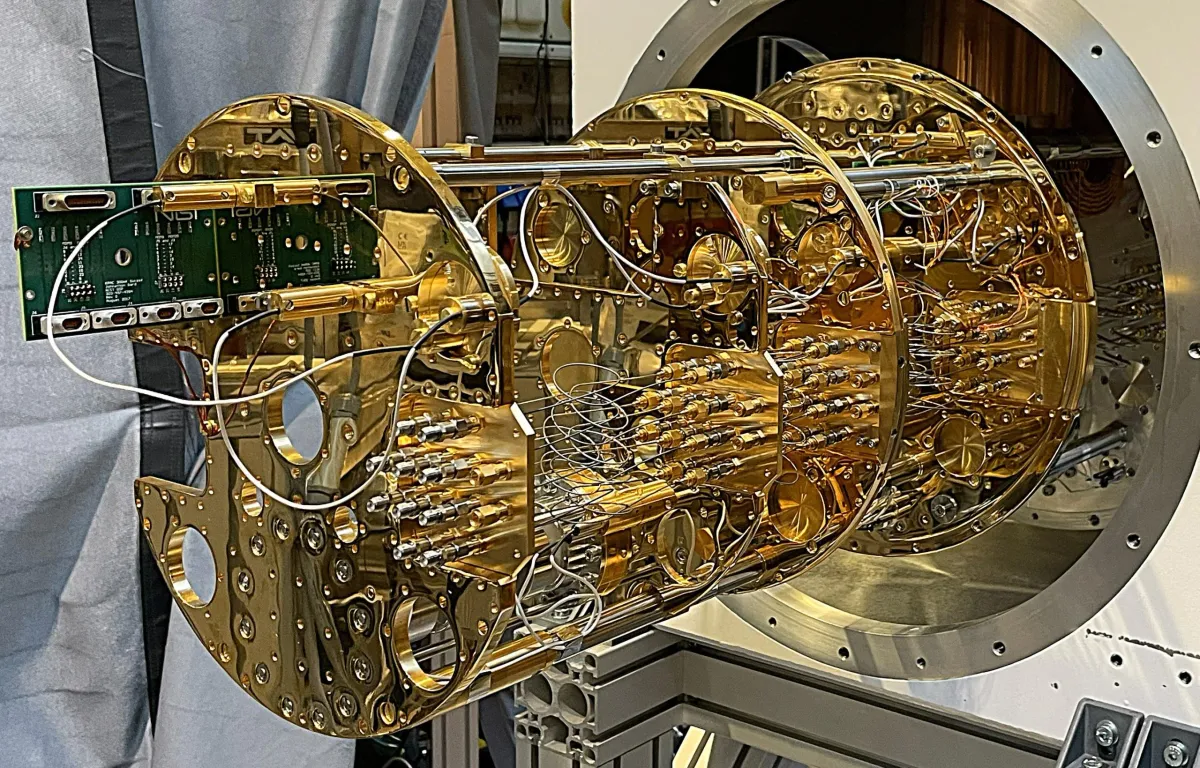
The TES spectrometer packs 248 superconducting sensors, all chilled down to a mind-boggling 25 milli-Kelvin. That’s just a hair above absolute zero, colder than deep space, and achieved with a special He4-He3 dilution refrigerator—the same tech that keeps quantum computers from overheating their existential crises. When an X-ray hits a sample, the sample spits out its own photons. Each photon gets snagged by a sensor, briefly warming it up just enough to stop being superconducting. This tiny hiccup in conductivity is measured, and voila—the energy of each photon is accurately recorded. It's like a microscopic game of hot potato, but with science.
This entire Rube Goldberg-esque setup is connected to a vacuum chamber and hooked up to the BESSY II UE52-SGM beamline, which gives scientists total control over polarization. Future plans include even more ways to prep samples and experiments in magnetic fields, which will help with X-ray Magnetic Circular Dichroism (XMCD) and RIXS-MCD.
Before BESSY II, there were only five TES spectrometers at X-ray facilities worldwide: four in the US, one in Japan. Europe was conspicuously absent from the party. Now, BESSY II is the continent's sole synchrotron TES spectrometer, ready to uncover secrets hidden in plain sight. Decker is waiting for those "exciting research proposals," and frankly, so are we.