Turns out, interstellar visitor 3I/ATLAS is basically a giant, icy methanol bomb. And no, that's not a new cocktail. Astronomers studying this comet, which hails from beyond our solar system, just found it's bursting with an unusually high amount of the organic molecule.
Every time one of these cosmic tourists swings by, it's like getting a direct mail sample from another star system. A rare peek at what's cooking out there.
Not Your Average Comet Chemistry
Using the Atacama Large Millimeter/submillimeter Array (ALMA) in Chile, scientists got a chemical readout of 3I/ATLAS. What they found was a surprising methanol richness, far beyond what's typical for comets formed in our own cosmic backyard.
We're a new kind of news feed.
Regular news is designed to drain you. We're a non-profit built to restore you. Every story we publish is scored for impact, progress, and hope.
Start Your News DetoxNathan Roth, the lead author of this research, put it perfectly: observing 3I/ATLAS is like getting a "fingerprint" from another solar system. And this particular fingerprint is practically dripping with methanol, in a way our local comets just aren't.
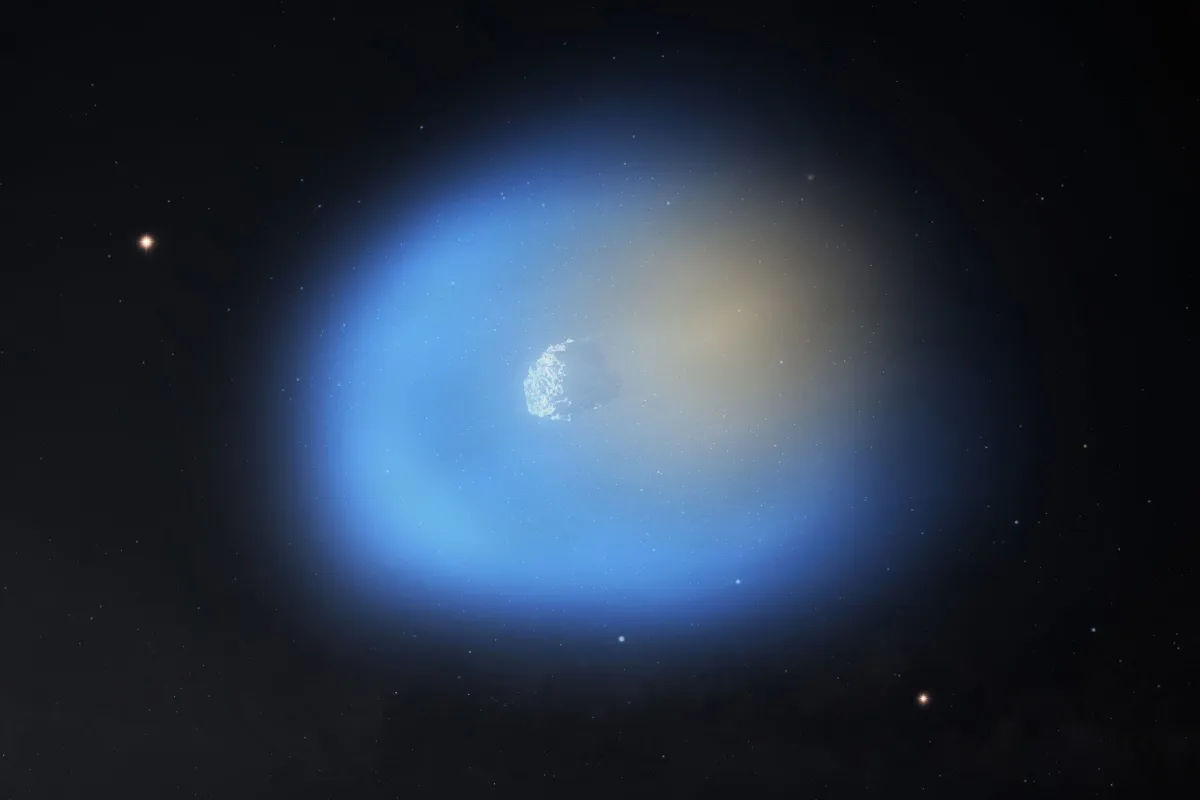
As 3I/ATLAS edged closer to the Sun, the solar heat started to vaporize its icy surface, creating a bright, fuzzy halo (the coma) around its core. By analyzing this coma, astronomers could decode the comet's chemical secrets without, you know, having to actually fly there.
ALMA focused on the faint signals from two molecules: methanol (CH₃OH) and hydrogen cyanide (HCN). While HCN is a common comet ingredient, 3I/ATLAS showed methanol-to-HCN ratios of around 70 and 120. To put that in perspective, it makes this one of the most methanol-rich comets ever observed. Let that satisfying number sink in.
This suggests the icy bits of 3I/ATLAS either formed under vastly different conditions than our local comets, or had a much wilder journey. Earlier peeks with the James Webb Space Telescope had already flagged its coma as mostly carbon dioxide when it was further out. Now, methanol joins the list of its peculiar chemical quirks.
Tiny Grains, Big Secrets
ALMA's detailed imaging also revealed something interesting about how these chemicals escape. Hydrogen cyanide mostly streams from the comet's core, which is standard procedure. But methanol? It's coming from both the nucleus and tiny icy particles floating within the coma. These little ice grains are basically mini-comets themselves, releasing methanol as they heat up.
While similar behavior has been spotted in some of our solar system's comets, this is the first time such detailed outgassing has been observed in an object from beyond our sun. Which, if you think about it, is both impressive and slightly terrifying.
3I/ATLAS is only the third confirmed interstellar object to grace our solar system, following 1I/‘Oumuamua and 2I/Borisov. Each of these visitors has brought its own set of oddities. As we continue to spot these cosmic travelers, we're slowly piecing together a clearer, stranger picture of how planets and icy bodies form around stars far, far away.