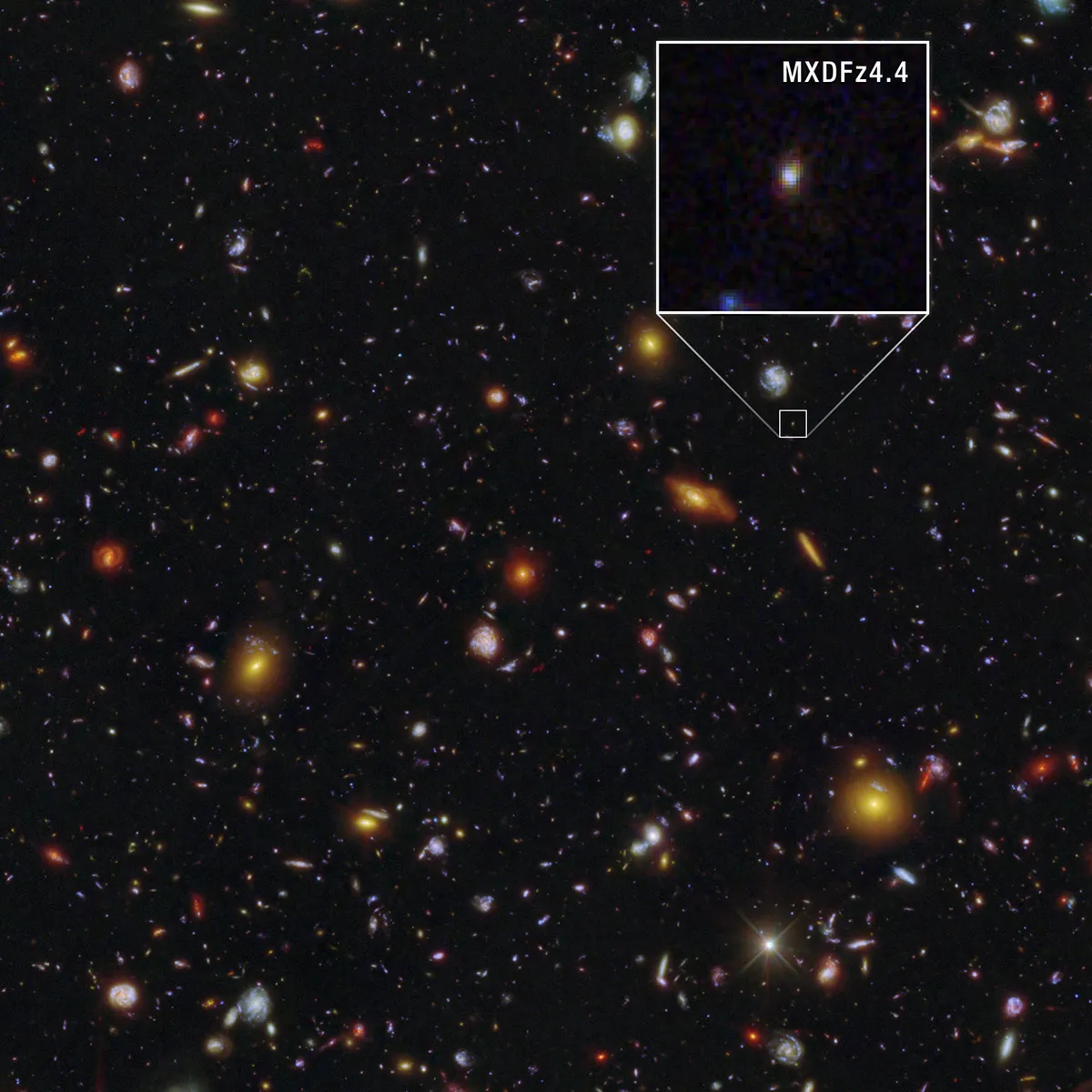
For a long time, the early universe was, well, a bit of a dense fog. Imagine trying to see across a room filled with thick, neutral hydrogen gas. Not ideal for stargazing. But then, something started to clear the air, quite literally. And now, thanks to the Hubble Space Telescope, scientists have found an unexpected culprit: a tiny galaxy named MXDFz4.4.
This isn't just any old galaxy. MXDFz4.4 existed a mere 1.4 billion years after the Big Bang, packed with young, tightly clustered stars. These stars, apparently, were not shy. They blasted out so much ultraviolet light that they ionized (read: cleared) the opaque gas around them, making their neighborhood transparent. Which, if you think about it, is both impressive and slightly terrifying for anyone who prefers a quiet existence.
The Universe's Great De-Fogging
This discovery, hot off the presses in The Astrophysical Journal, offers a crucial peek into the 'Era of Reionization' — a period when the universe went from murky to magnificent. For the first billion years, everything was pretty much a cosmic pea-souper, blocking energetic UV light. Then, over hundreds of millions of years, it gradually cleared up.
We're a new kind of news feed.
Regular news is designed to drain you. We're a non-profit built to restore you. Every story we publish is scored for impact, progress, and hope.
Start Your News DetoxAstronomers once thought observing a galaxy like MXDFz4.4 would be impossible. The early universe's "fog" of neutral hydrogen was simply too thick. But Hubble, being Hubble, not only detected the light but also gave us the juicy details. It turns out, bursts of young stars within MXDFz4.4 were doing the heavy lifting, clearing out the space within and around the galaxy itself.
These young, massive stars are UV powerhouses. As their light traveled over 12 billion years to reach Hubble, the universe expanded, stretching that light into visible wavelengths — a process called redshift. Hubble's unique capabilities, including its sensitivity and resolution from space, allowed it to capture this ancient UV glow.
MXDFz4.4 is a bit of an overachiever. It's about 100 times smaller than our Milky Way but forms stars 10 times faster. Imagine the cosmic equivalent of a tiny espresso machine churning out lattes at warp speed. Ilias Goovaerts, lead author and a postdoctoral fellow at STScI, explains that having many hot, massive stars in a small area is incredibly effective at punching through that opaque gas. In fact, an estimated 50% to 100% of that powerful ionizing light escaped.
And because massive stars have short, explosive lives (a few million years, tops, then boom as supernovae), they create huge holes in the gas, letting even more light escape. Talk about making a dramatic exit.
This wasn't a solo act, though. Hubble's findings were cross-referenced with data from NASA's James Webb Space Telescope, which helped determine the galaxy's mass and star formation history, and the European Southern Observatory's VLT, which pinpointed its age. Apparently, the older, cooler stars weren't involved in the celestial house-cleaning. They just sat back and watched the young ones do all the work.
Before MXDFz4.4, the earliest galaxy found emitting ionized light was from when the universe was 1.6 billion years old. This new discovery brings us significantly closer to understanding how the universe finally got its glorious, transparent view. It's a reminder that even the smallest, most distant corners of the cosmos can hold the biggest answers.