Researchers have created a "nanoreactor" that mimics living cells. This tiny structure efficiently produces hydrogen peroxide using visible light, much like plants use sunlight for photosynthesis.
This new nanoreactor combines design principles from living cells. It offers a way to organize and speed up chemical reactions, similar to how biological systems work.
How the Nanoreactor Works
The nanoreactor is a hollow structure. Inside, it uses two methods inspired by cells to control reactions. This work was published in the Journal of the American Chemical Society. Can Li from the Dalian Institute of Chemical Physics led the research. Jian Liu's group at Inner Mongolia University also contributed.
We're a new kind of news feed.
Regular news is designed to drain you. We're a non-profit built to restore you. Every story we publish is scored for impact, progress, and hope.
Start Your News DetoxCells manage biochemical reactions using complex structures. These structures have components arranged in specific places. Nanocell engineering applies these ideas to artificial materials. It creates cell-like nanoreactors with special surfaces and small cavities. This blends cell biology and nanotechnology to control reactions in tiny spaces.
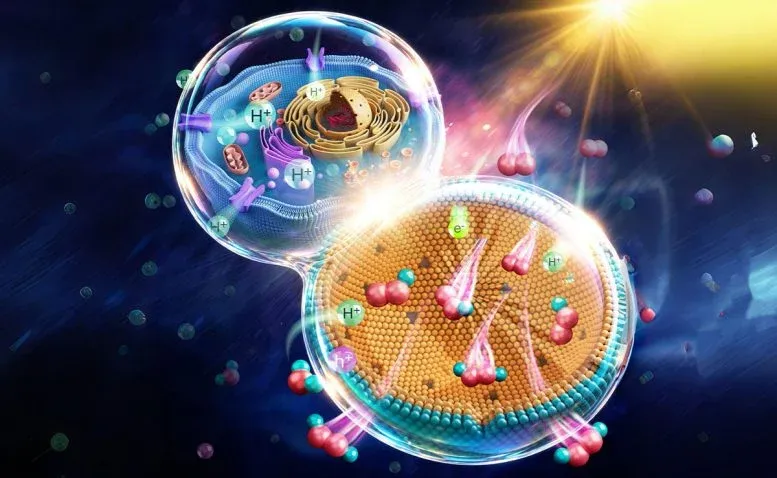
The hollow nanoreactor has two cell-inspired features:
First, its outer shell contains a dynamic "redox pair." This pair repeatedly accepts and donates protons. This process, called proton-coupled electron transfer (PCET), speeds up reactions.
Second, the nanoreactor has a compartmentalized structure. A porous outer shell surrounds a small cavity. This confined space helps gather reactants, allows materials to move, and traps light.
These features work together to balance the speeds of oxygen reduction and water oxidation. When exposed to visible light in water, the system produced hydrogen peroxide at a rate of 3.24 mmol per gram of catalyst per hour. It also achieved a solar-to-chemical conversion efficiency of 1.2%.
Reusing Sunlight with Hydrogel
The researchers used several methods to study how the nanoreactor works. These included spectroscopy, photochemical measurements, and computer simulations. Their analysis showed how the biomimetic process works. It also clarified the photocatalytic mechanism, which is based on a Z-scheme heterojunction.
They also put the material into a safe sodium alginate hydrogel. This created solid, recyclable catalysts. These catalysts could maintain stable hydrogen peroxide production under natural sunlight.
Professor Li noted that this study offers a new way to design biomimetic nanoreactors. These nanoreactors can increasingly copy the complex functions of living cells. This opens new possibilities in artificial photosynthesis, energy catalysis, and synthetic chemistry.
Deep Dive & References
Biomimetic Redox-Mediated Proton Relay in Nanoreactors for Photocatalysis - Journal of the American Chemical Society, 2026