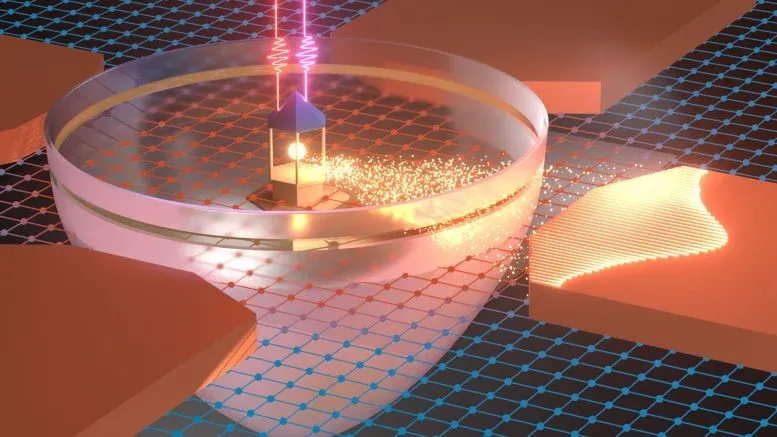
Imagine a tiny, invisible lighthouse that doesn't just beam light, but steers electrons with it. No wires, no external power, just a couple of laser beams and a semiconductor. That's essentially what researchers at the University of Michigan just pulled off.
They've created a device that uses two different colors of light to push electrons through a semiconductor in a very specific direction. It's like giving electrons a tiny, laser-powered nudge in the exact way you want them to go. This isn't just a neat parlor trick; it's a demonstration of a physical effect previously unseen, proving light can both create and guide an electronic current all on its own.
The implications? Think new technologies that fuse light and electronics in ways we haven't quite managed yet. Better sensing, sharper imaging, and telecommunications that can cram even more information into signals moving within and between devices. Because apparently that's where we are now.
We're a new kind of news feed.
Regular news is designed to drain you. We're a non-profit built to restore you. Every story we publish is scored for impact, progress, and hope.
Start Your News DetoxSteven Cundiff, a U-M physicist, dryly noted that this whole setup is a bit unusual. Normally, you need an electrical field to get electrons to hustle. Here, light just squirts them in a specific direction. Previous experiments showed light could create a current without an electric field, but this new device takes it a step further: it funnels those electrons into a narrow, directed stream.
The Quantum Interference Magic Trick
So, how does this electron-steering light show work? It all comes down to something called quantum interference. Basically, the two different colors of light create separate absorption pathways in the semiconductor, but both lead to the same final state for the electrons. Think of it like overlapping ripples in a pond.
For electrons moving in one desired direction, these ripples line up perfectly, reinforcing each other and giving them a boost. For electrons trying to go any other way, the ripples cancel each out, making movement impossible. It's an elegant, microscopic bouncer system for electrons.
This isn't a completely out-of-the-blue discovery. A scientist named J.E. Sipe from the University of Toronto had predicted such an "electron lighthouse" could exist. It just took doctoral student Yiming Gong, working with the Lurie Nanofabrication Facility, to wrestle the prediction into a working device.
Apparently, combining the necessary materials without accidentally creating unwanted electric fields was a bit of a headache. But hey, now we have a device that measures light by how it makes electrons dance to its tune. Which, if you think about it, is both impressive and slightly terrifying.