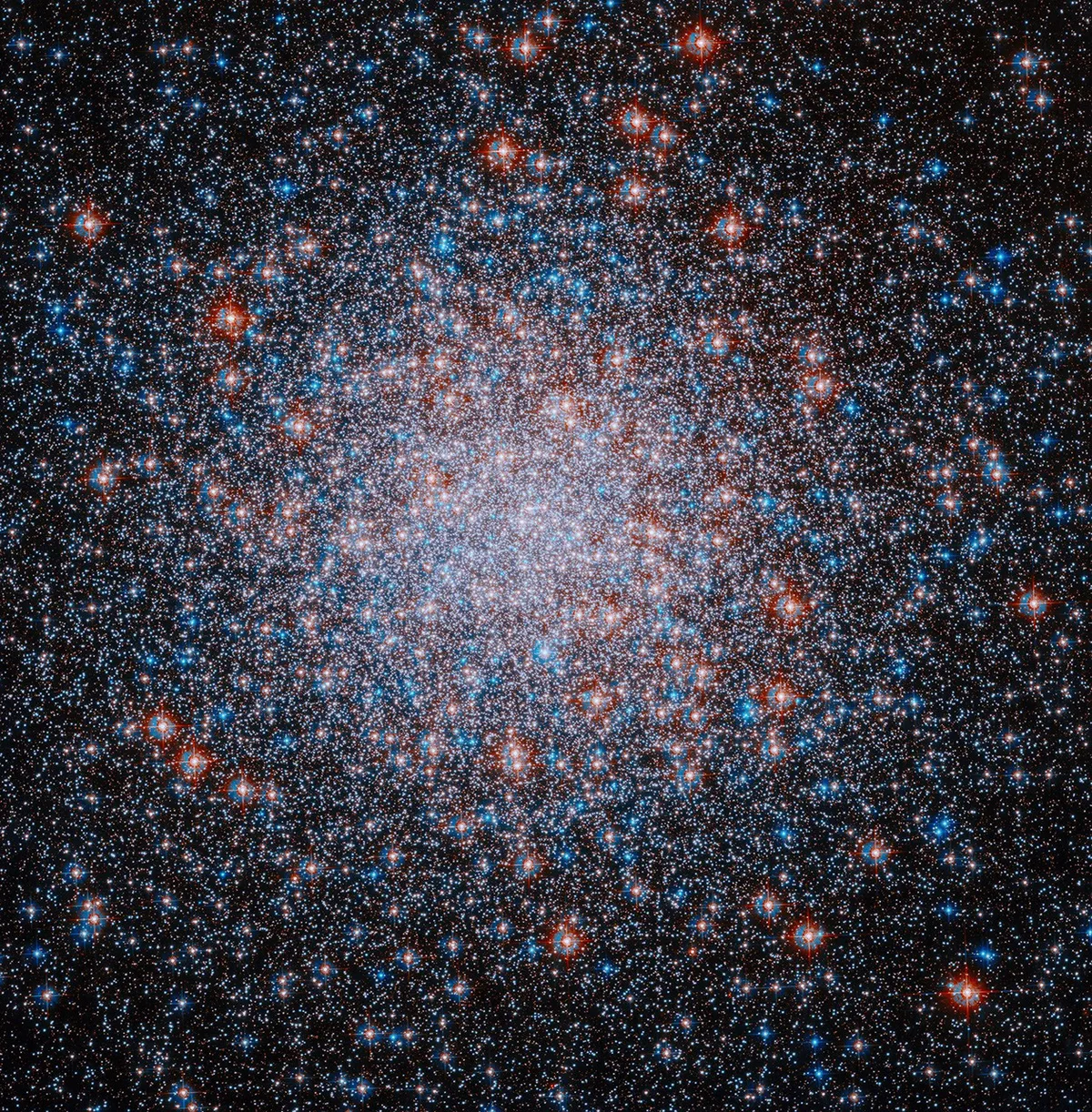
NASA's Hubble Space Telescope just delivered a cosmic mic drop: an image featuring over 500,000 stars. It's a dazzling, glittering, frankly excessive display of celestial bling, released as a rather spectacular nod to the United States' upcoming 250th anniversary.
The star of this show is Messier 3 (M3), one of the largest globular clusters in our Milky Way. Think of a globular cluster as the galaxy's most exclusive, tightly packed gated community for stars. They're spherical, held together by gravity, and their residents are, shall we say, established — ancient, all formed at the same time from the same primordial gas cloud. Our galaxy currently boasts about 150 of these stellar retirement villages.
M3: The Cluster That Refuses to Age Gracefully
M3 isn't just any old cluster. It's an overachiever. For starters, it's enormous and hangs out in the galactic suburbs, far from the bustling center. More impressively, it's home to over 240 RR Lyrae variable stars — that's more than any other cluster in the Milky Way. These are some of the galaxy's oldest residents, and their pulsating light is basically a cosmic yardstick, helping astronomers measure vast distances across space.
We're a new kind of news feed.
Regular news is designed to drain you. We're a non-profit built to restore you. Every story we publish is scored for impact, progress, and hope.
Start Your News DetoxThen there are the 'blue stragglers.' About 70 of them, looking impossibly young and blue compared to their older, redder neighbors. Scientists suspect these stars are basically cosmic vampires, rejuvenated by siphoning mass from nearby companion stars. Because apparently, even stars have their dramatic glow-ups.
M3's peculiar traits might stem from a dramatic past. It has two distinct populations of stars, hinting that it might actually be the result of two smaller globular clusters merging. These clusters were likely once part of a dwarf galaxy that our Milky Way, in its infinite galactic hunger, eventually absorbed. Talk about a cosmic hostile takeover.
Hubble has snapped M3 (also known as NGC 5272) multiple times, each shot revealing more of its complex personality. In this latest portrait, the blues represent shorter visible light wavelengths, while reds capture longer visible light and a touch of near-infrared. Hotter stars shimmer blue, cooler ones glow red. It's all carefully curated by Hubble's filters to give us the most accurate, and frankly gorgeous, representation.
This image is part of a larger Hubble initiative to survey about half of the Milky Way’s globular clusters, helping us piece together the origin story of our home galaxy. Hubble, still kicking after 30 years, continues to collaborate with newer kids on the block like the Webb Space Telescope and the upcoming Nancy Grace Roman Space Telescope, all working to paint an increasingly detailed, and frankly awe-inspiring, picture of the universe.