For centuries, physicists have been chasing the ultimate prize: a complete, objective blueprint of the universe. Think of it as the mythical "God's-eye view" – a perfect, all-knowing perspective on reality. Well, grab a seat, because physicist Carlo Rovelli just called shenanigans.
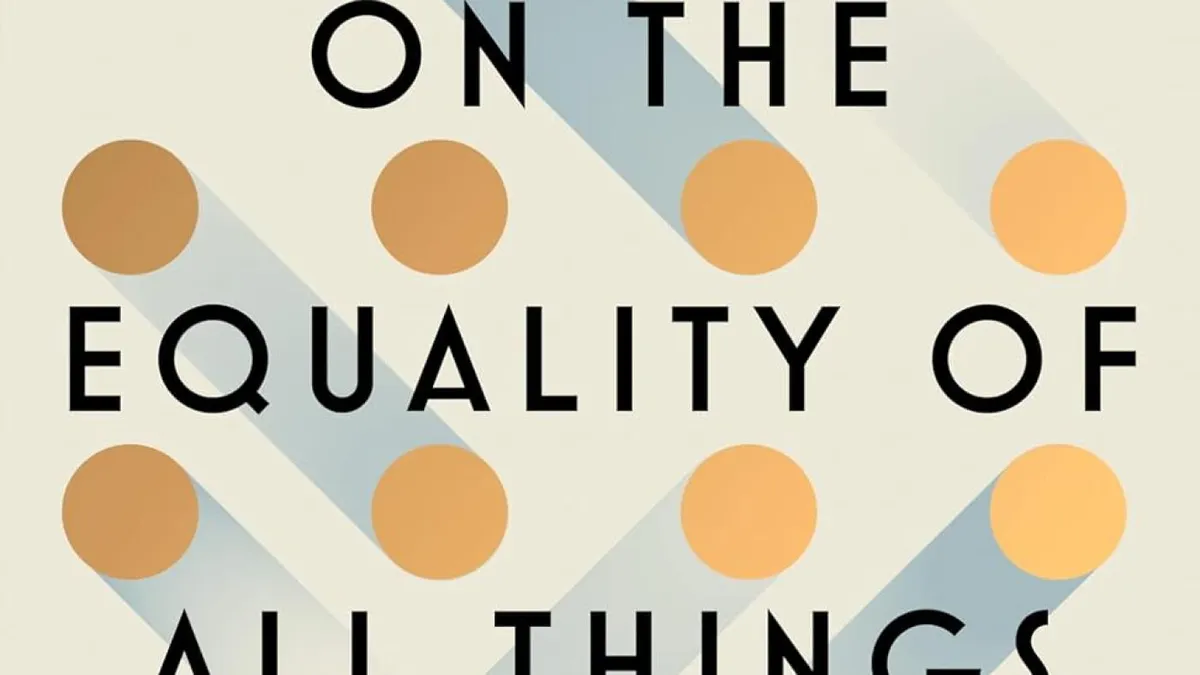
His new book, On the Equality of All Things, argues that not only can we not achieve this ultimate reality, but the very idea is fundamentally flawed. Which, if you think about it, is both impressive and slightly terrifying for a guy whose job is literally to explain the universe.
Your View is Just That: Yours
Rovelli points out that we’re all a bit biased. Living on a big, solid rock, we tend to assume objects are solid, in a fixed spot, and that we can measure their every move with absolute certainty. Cute, right? Turns out, physics has been quietly dismantling that notion for a while now.
We're a new kind of news feed.
Regular news is designed to drain you. We're a non-profit built to restore you. Every story we publish is scored for impact, progress, and hope.
Start Your News DetoxEinstein’s relativity theory showed that space and time are relative – your measurements depend on your perspective. Then quantum mechanics came along and said, "Hold my beer," revealing that an object's properties literally depend on how you measure them. So, no, there's no perfect, outside view. We're all just in here, looking around.
The Universe as a Relationship Status
This brings us to the wonderfully mind-bending "relational interpretation" of quantum mechanics. Imagine a world where nothing exists in isolation. Everything is defined by its relationship to everything else. That's Rovelli's universe.
For ages, physicists believed their equations described a reality that was just there, regardless of whether anyone was looking. Newton pretty much cemented this idea of an "Ultimate Reality" chilling out beyond our perception. But quantum physics threw a wrench in that. Suddenly, it was hard to say what properties an object had before it was measured. Cue Schrödinger's Cat, which is famously both dead and alive until you peek.
Some scientists tried to save the "Ultimate Reality" concept, proposing things like the universe splitting into parallel versions every time a measurement happens. Rovelli, politely, disagrees. For him, the real lesson is that everything is relational. There's no absolute, ultimate way to see things because such a perspective simply doesn't exist. And without that, physics can't "explain everything."
He puts it rather bluntly: "Physics is often credited with a power it does not have: that of exhausting what can be known about the world. This is nonsense. Knowing the physical laws of the world does not amount to knowing the world." Let that sink in. A physicist, telling physics to calm down.
The Wisdom of Not Knowing Everything
What makes Rovelli's argument particularly spicy is that he doesn't just stick to Western philosophy. He pulls in thinkers from India and Asia, like Nagarjuna and Zhuangzi, giving them equal footing with Plato and Aristotle in the grand quest to understand reality. Because apparently that's where we are now: quantum physics, Eastern philosophy, and a healthy dose of humility.
Even with these radical claims, Rovelli is still a staunch defender of science. He sees it not as a search for absolute certainty, but as a creative, ongoing exploration. It's about beautiful, useful knowledge, not total dominion. This shift, he argues, isn't a defeat; it’s an invitation to a new kind of wisdom, a deeper intimacy with a universe that's far more complex and interconnected than we ever imagined.
So, if you were hoping for a simple, definitive answer to everything, Rovelli's book might just tell you that you're asking the wrong question. And that, in itself, is a fascinating answer.