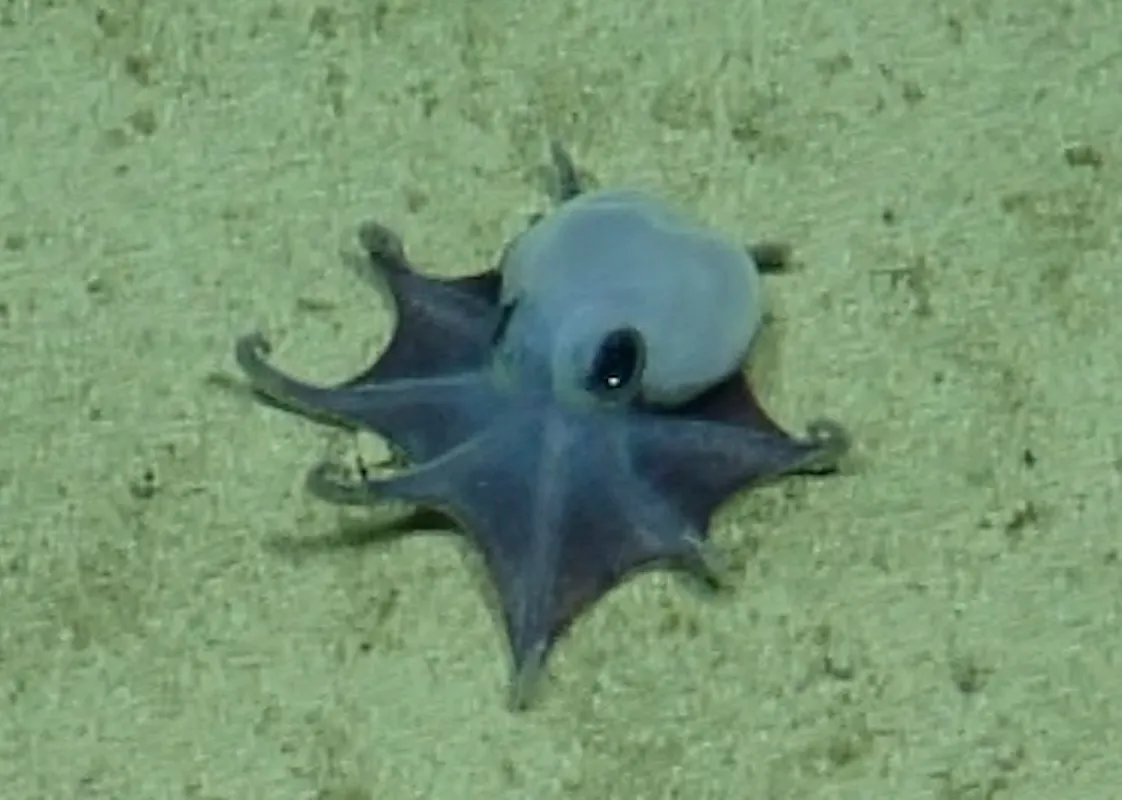
Deep in the inky blackness off the Galápagos, where the sun doesn't shine and the pressure could crush a small car, scientists have just confirmed the existence of a brand-new, golf-ball-sized octopus. He's blue. He's squat. And he's officially named Microeledone galapagensis.
This isn't some fresh-off-the-boat discovery. Back in 2015, a robot submarine (an ROV, for those in the know) was poking around an underwater mountain near Darwin Island, about 5,800 feet down. That's when it first spotted the little guy, looking very chill and very, very blue. The Charles Darwin Foundation and the Galápagos National Park Directorate managed to snag one with their ROV, while two others gave a quick video cameo.
The Museum's Newest Resident
Our tiny blue friend then embarked on a journey to Chicago, landing on the desk of Janet Voight, an octopus expert at the Field Museum. Now, describing a new species usually involves a bit of... well, dissection. But with only one specimen, and one as charmingly tiny as this, Voight wasn't keen on taking a scalpel to it.
We're a new kind of news feed.
Regular news is designed to drain you. We're a non-profit built to restore you. Every story we publish is scored for impact, progress, and hope.
Start Your News DetoxEnter the modern marvel of the CT scan. Voight and her team used it to create a full 3D model, allowing them to peek at every organ, every beak, every tiny tooth without disturbing a single tentacle. Which, if you think about it, is both impressive and a very polite way to meet a new species.
Comparing its internal blueprints to other known octopuses, it was clear: this little guy was unique. Those short, stubby arms with only a few suckers? Not your average octopus fashion statement. So, let's hear it for Microeledone galapagensis, proving that even in the deepest, darkest corners of the ocean, there's always something new, blue, and utterly delightful waiting to be discovered.