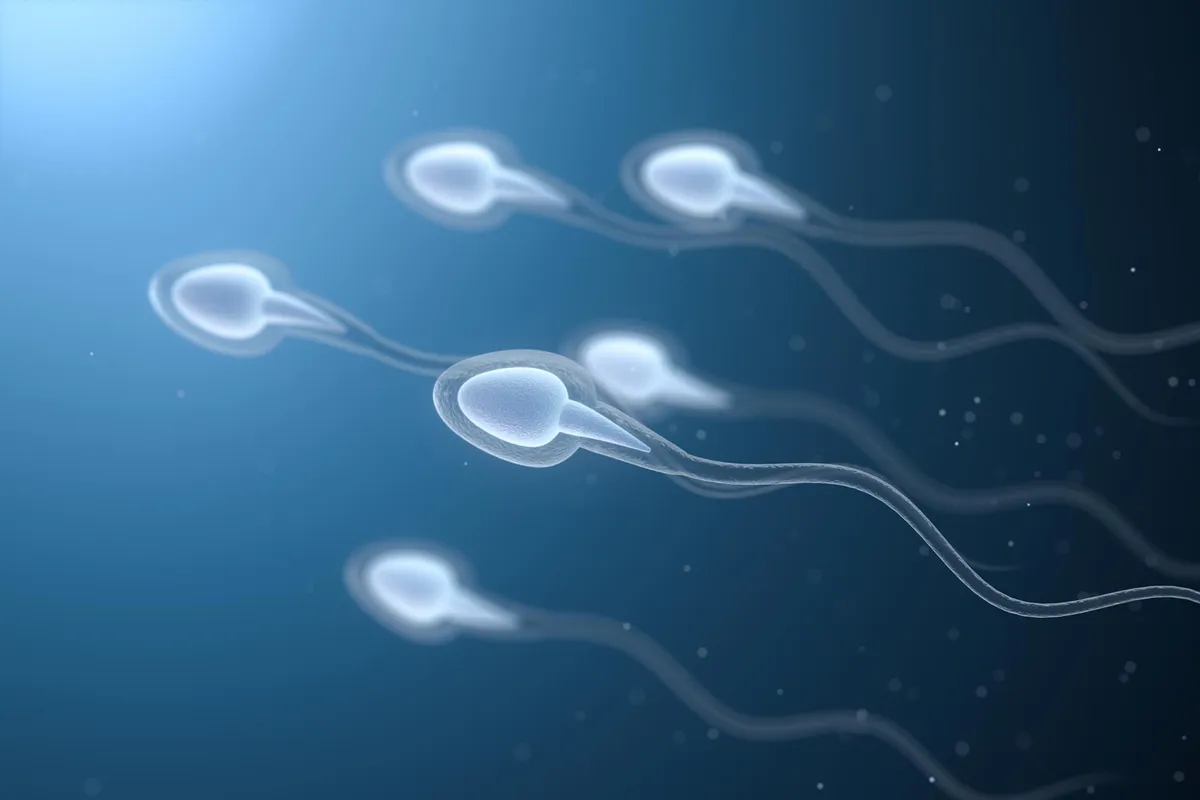
Sperm cells are tiny, but they face a big challenge. They need to swim through fluids that are very thick at their small scale. This fluid should stop them almost instantly.
New research suggests sperm overcome this by using a special property of living matter. Their movement seems to bypass a basic rule of physics called Newton's third law.
How Sperm Move Differently
Newton's third law says that for every action, there's an equal and opposite reaction. This works for things like billiard balls. But sperm are active systems. They constantly add energy to their own motion.
We're a new kind of news feed.
Regular news is designed to drain you. We're a non-profit built to restore you. Every story we publish is scored for impact, progress, and hope.
Start Your News DetoxKenta Ishimoto, a mathematical scientist at Kyoto University, led a study on this. He and his team explain that Newton's third law can be "violated" when looking at an open system like a sperm cell. This is because the cell constantly injects mechanical energy from its tiny active parts.
So, sperm aren't breaking physics. They are showing what happens when living systems put energy into their surroundings from the inside.
The Challenge of Tiny Swimmers
For a sperm cell, there's no gliding. When its tail stops, the cell stops moving right away. This is due to a problem called the scallop theorem. A tiny swimmer can't move through thick fluid by just repeating a motion back and forth. It needs a stroke that isn't perfectly reversible.
Sperm solve this with flagella, which are thin, flexible tails. These tails create traveling waves along their length. Green algae like Chlamydomonas use similar structures.
Tiny motors inside the flagellum power these waves. Because these motors add energy, the tail acts more like an active material than a simple spring.
The Role of "Odd" Elasticity
The study looked at something called odd elasticity. In normal elastic materials, the force applied and the response are linked. If you bend them, they push back in a predictable way.
Odd elasticity is different. In active materials, internal energy sources can create forces that don't just mirror the forces acting on them. This non-reciprocal behavior helps keep waves going, even when thick fluid tries to slow them down.
The researchers created a framework called odd elastohydrodynamics to describe this. It helps them understand the complex interactions of an elastic material in a thick fluid. This method allowed them to separate what the fluid does from what happens inside the flagellum.
They also introduced an odd-elastic modulus. This is a mathematical tool to tell the difference between normal elastic behavior and the active, non-reciprocal forces that drive motion.
What the Research Shows
The team used their model with data from human sperm and Chlamydomonas. The results suggest that these tiny swimmers use internal activity to create traveling waves in their flexible tails.
In human sperm, internal activity helped make the flagellar wave. Passive elasticity seemed to stabilize it. In Chlamydomonas, the non-reciprocal response matched the wave pattern of the flagellar beat. This suggests odd elasticity helps power the movement.
The researchers concluded that their framework can show the "nonlocal, non-reciprocal inner interactions within the material."
Simply put, a sperm tail is more than just a tiny whip. It's a structure that uses energy. Its internal mechanics help it move in a world where normal back-and-forth motion would fail.
These findings could help scientists understand how living systems move, from single cells to groups of swimmers. They might also help design tiny robots, artificial microswimmers, or soft materials that mimic living motion.
Deep Dive & References
Odd Elastohydrodynamics: Non-Reciprocal Living Material in a Viscous Fluid - PRX Life, 2023