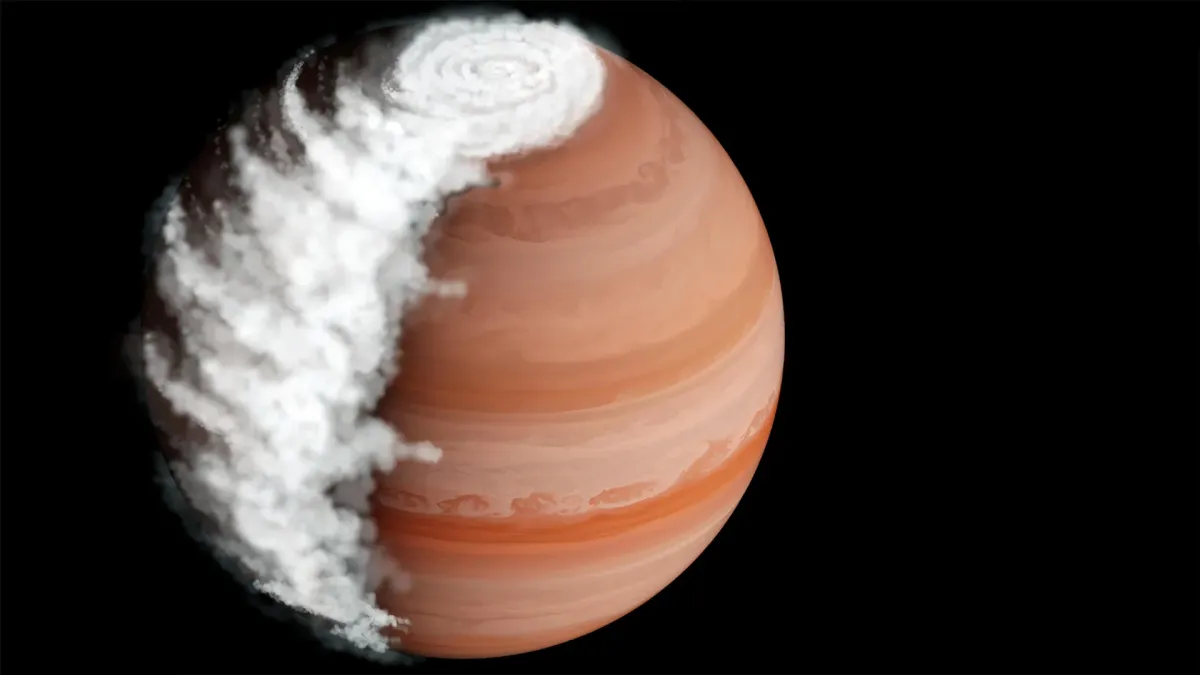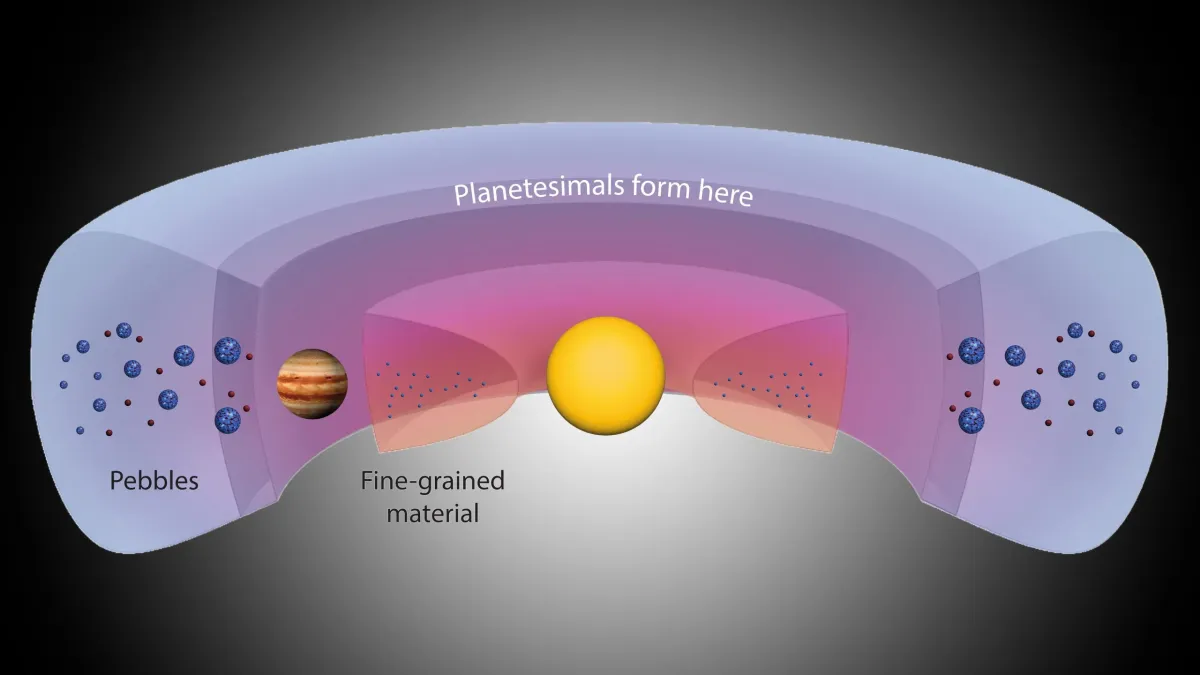
Scientists might have found where many of the solar system's first planets were made. This "planet factory" is located just outside Jupiter's orbit.
When our solar system was young, the Sun was surrounded by a huge disk of gas and dust. Over millions of years, tiny bits of this dust crashed together. They formed larger rocky objects called planetesimals. Some of these grew into planets, while others became the asteroids we see today.
Scientists have thought that this process was not neat or organized. Different parts of the early solar system likely had different conditions. Planetesimals might have formed at various stages all at the same time.
We're a new kind of news feed.
Regular news is designed to drain you. We're a non-profit built to restore you. Every story we publish is scored for impact, progress, and hope.
Start Your News DetoxJupiter's Orbit Created a Powerful Dust Trap
Researchers from the Max Planck Institute for Solar System Research (MPS) in Germany believe they have found a key region. It's just beyond Jupiter's orbit. A new study in The Astrophysical Journal suggests this ring-shaped area was a very effective place for planetesimals to form. It also created many different types of them.
Their computer models show that this region made planetesimals with very different makeups over about two million years.
Joanna Drążkowska, who leads the Lise Meitner Group on planet formation, explained that different types of planetesimals formed in the same area. They just did so at different times. The region outside Jupiter's orbit was perfect for this.
The study focused on a time about two to four million years after the solar system began. By then, Jupiter had already cleared out much of the material near its path. This left a gap in the surrounding disk of gas and dust.
Scientists think this also created a ring of higher gas pressure just outside Jupiter's orbit. Dust particles floating through the disk got stuck there. This caused huge amounts of material to build up. These dense piles of dust formed small clumps called pebbles.
Earlier studies showed that pebbles in these "dust traps" could quickly grow into planetesimals. But researchers didn't know if the same area could keep making objects with very different makeups over long periods.
Ancient Meteorites Reveal Clues
The new study suggests it could. Using advanced simulations, the team found that several distinct groups of planetesimals likely formed in this dust trap over millions of years. The results also closely match what scientists have learned from specific meteorites found on Earth.
Thorsten Kleine, MPS Director and cosmochemist, noted that for the first time, they could accurately match lab studies of meteorites with computer simulations. He said meteorites act as a "touchstone" for theories about how planets form.
Meteorites are space rocks that fall to Earth. Most are thought to be pieces of ancient planetesimals that haven't changed much since the solar system's early days.
The researchers looked at carbonaceous chondrites. These are stony meteorites rich in carbon. Lab studies suggest these meteorites formed beyond Jupiter during the same time period as the simulations.
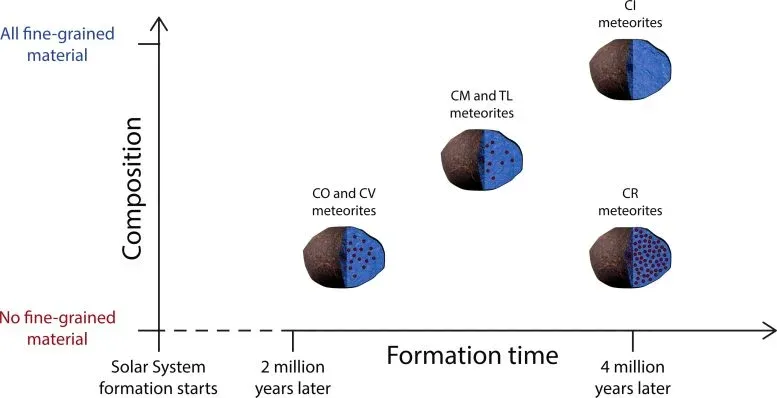
Scientists divide carbonaceous chondrites into six groups based on their age and makeup. Some are fragile and mostly made of fine, crumbly material. Others are stronger and have visible bits embedded in finer material.
In the simulations, these materials matched two different substances believed to be in the young solar system. One was delicate dusty material. The other was made of more stable clumps that formed early in hotter areas before spreading.
Nerea Gurrutxaga, a PhD student at the MPS and lead author, said it was vital to model how both materials behaved and interacted. This included both small and large scales.
Simulations Show Multiple Generations of Space Rocks
The models tracked individual particle collisions and the large-scale movement of material through the gas disk. Particles could stick together, break apart, drift toward the Sun, or collect in dense areas.
The simulations showed that Jupiter was a stronger barrier for larger, sturdier particles than for tiny dust grains. Also, new planetesimals gradually used up some of the available material.
Over time, these effects caused different mixes of material to gather beyond Jupiter's orbit. As the balance changed, distinct generations of planetesimals started to appear.
During the first 500,000 years, the amount of crumbly material first dropped, then increased over the next million years. Eventually, two clear groups of planetesimals emerged. One group was mostly fragile material, while the other was mostly stable matter.
The researchers think that even older meteorite types, beyond carbonaceous chondrites, might have also formed in this same dust trap.
Joanna Drążkowska concluded there is strong evidence that dust traps were the main birthplace for planetesimals in our solar system.
Deep Dive & References
Carbonaceous Chondrites Provide Evidence for Late-stage Planetesimal Formation in a Pressure Bump - The Astrophysical Journal, 2026