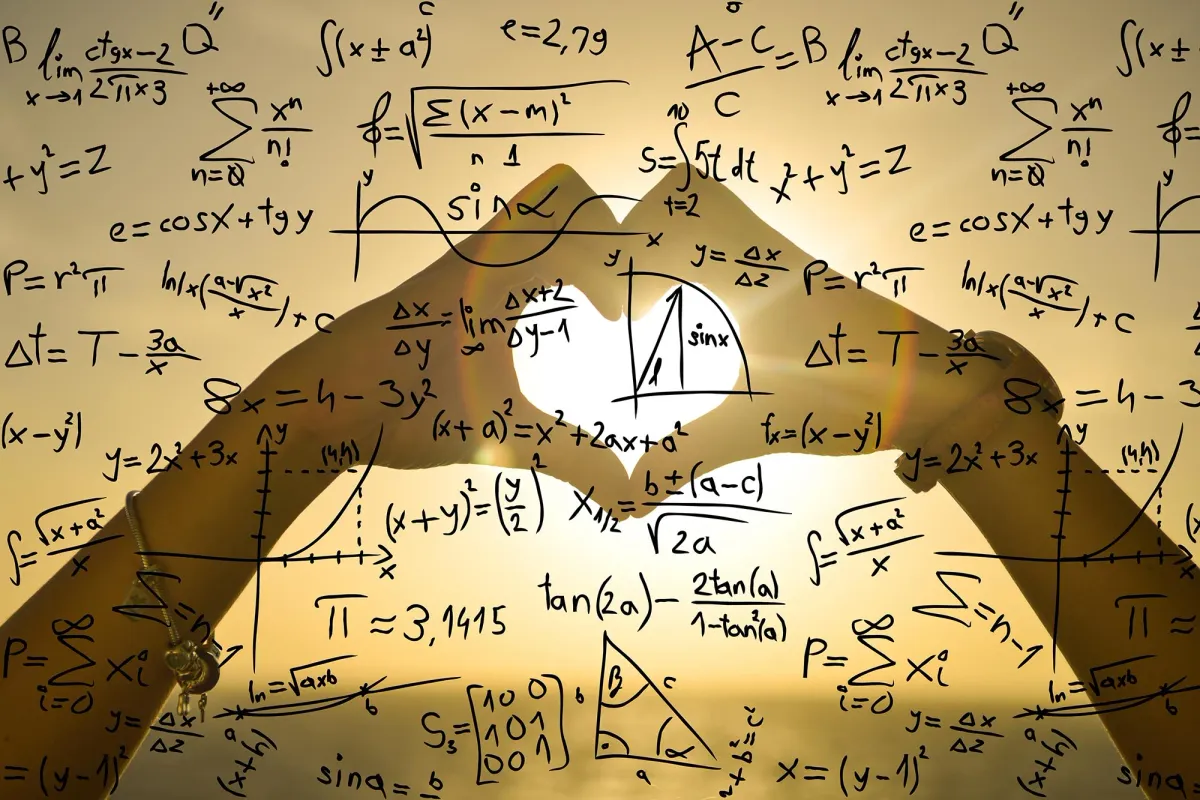
Ever wonder if your relationship has a secret expiration date written in the stars? Turns out, it might be written in numbers instead. Scientists are now applying mathematical models to the messy, beautiful chaos of romantic love, claiming it follows patterns that can actually be measured.
Think of it as a relationship GPS, but instead of avoiding traffic, it's steering you clear of breakup territory. Professor Laurent Pujo-Menjouet from the University of Lyon I, along with his colleagues, has been crafting models that treat feelings as "dynamical systems." Which is a fancy way of saying your emotions are constantly shifting based on a bunch of interacting forces, much like, say, the stock market or a flock of very confused pigeons.
In his book, Love! Valour! Equations!, Pujo-Menjouet suggests there's no magic to love. Just, you know, a lot of very interesting equations.
We're a new kind of news feed.
Regular news is designed to drain you. We're a non-profit built to restore you. Every story we publish is scored for impact, progress, and hope.
Start Your News DetoxThe Allee Effect, But For Your Love Life
The idea of using math to dissect romance isn't new; it actually started by tracking animal populations. Early models looked at how rabbit numbers exploded or how predators and prey kept each other in check. Researchers even used something called the "Allee effect," which basically says if a population drops below a certain size, it's probably toast. Now, this concept is being applied to your Saturday night date.
Pujo-Menjouet isn't trying to predict who you'll swipe right on. He's more interested in why some couples weather every storm, while others just… fizzle. His work stands on the shoulders of giants like Thomas Malthus (1700s population models) and the Lotka-Volterra equations (1920s predator-prey dynamics). Later, folks like psychologist John Gottman and mathematician Steven Strogatz took these ideas and aimed them squarely at the heart.
Dr. John Gottman, affectionately known as "Doctor Love," famously showed he could predict relationship outcomes with startling accuracy just by observing how couples argued. Now, researchers are even factoring in how delays in reacting to conflict can tip the scales. Because apparently that's where we are now.
Is Your Relationship Nearing the Critical Threshold?
Pujo-Menjouet's model posits that every relationship needs a minimum level of strength. If it dips below this "critical threshold," the math predicts a likely separation. He explains that if feelings drop below this point and stay there, the relationship is in decline. But here's the kicker: knowing about this threshold can actually help couples. It's like a dashboard warning light for your love life, signaling when you're in the "danger zone" and need to take corrective action.
His team's model incorporates all the usual suspects: arguments, stress, outside pressures. Crucially, it also measures how well couples bounce back. Because, as Pujo-Menjouet points out, arguing isn't the problem. It's whether you're strong enough to find your way back to a good place afterward.
The model highlights three key ingredients for a stable, long-term pairing:
- How much partners are attracted to each other (the initial spark).
- How feelings might slowly fade over time (the slow burn).
- How each partner reacts to the other's emotions (the emotional dance).
These factors combine to show a relationship's resilience. Pujo-Menjouet likens it to the Three Little Pigs: challenges will always come, but math can help couples build a robust "brick house" relationship.
The AI Relationship GPS
Looking ahead, future versions of these models could even integrate artificial intelligence. Imagine an AI warning you that your relationship is nearing a risky point, giving you time to course-correct. A "relationship GPS," as Pujo-Menjouet calls it, could show where you are, where you're headed, and suggest alternate routes to your desired destination. It won't tell you who to love, but it might just explain how to keep it.
Of course, these models aren't perfect. Most are built on Western relationship dynamics, and love looks very different across cultures, religions, and economic situations. A truly universal model would be incredibly complex. Plus, humans are gloriously unpredictable. These equations show general patterns, not destiny. Couples can always change their path through commitment, therapy, or good old-fashioned personal growth.
In the end, math can offer guidance, but Pujo-Menjouet reminds us that a relationship's success still comes down to two people choosing to care for their connection every single day. The equations can light the way, but you've still got to walk it together. Let that satisfying number sink in.