Quirky backyard sprinklers have helped scientists solve a decades-old physics puzzle. This mystery is about how flowing water makes objects spin.
Every summer, "silly sprinklers" with looping tubes spray water in unexpected ways. These simple toys helped mathematicians solve a long-standing physics problem.
Solving Feynman's Sprinkler Problem
The puzzle is called Feynman’s Sprinkler Problem. It asks what happens when a sprinkler pulls water in, instead of spraying it out. Researchers built special sprinklers in different shapes to find the answer. Their experiments showed how moving fluids create force and make objects rotate.
We're a new kind of news feed.
Regular news is designed to drain you. We're a non-profit built to restore you. Every story we publish is scored for impact, progress, and hope.
Start Your News DetoxLeif Ristroph, a professor at NYU, explained that this work provides the experimental answer. It shows how the spinning motion of water makes sprinklers rotate.
The findings do more than just solve a famous physics question. Brennan Sprinkle, a professor at Colorado School of Mines, noted that this knowledge can help design better devices. This includes turbines that turn fluid flows into energy.
Why Reverse Sprinklers Are Strange
The team first reported on Feynman’s Sprinkler Problem in 2024. Physicist Richard Feynman made the question famous in the 1980s after he couldn't solve it with experiments.
In their earlier work, scientists found that a reverse sprinkler spins about 50 times slower than a regular one. Both work through similar physics.
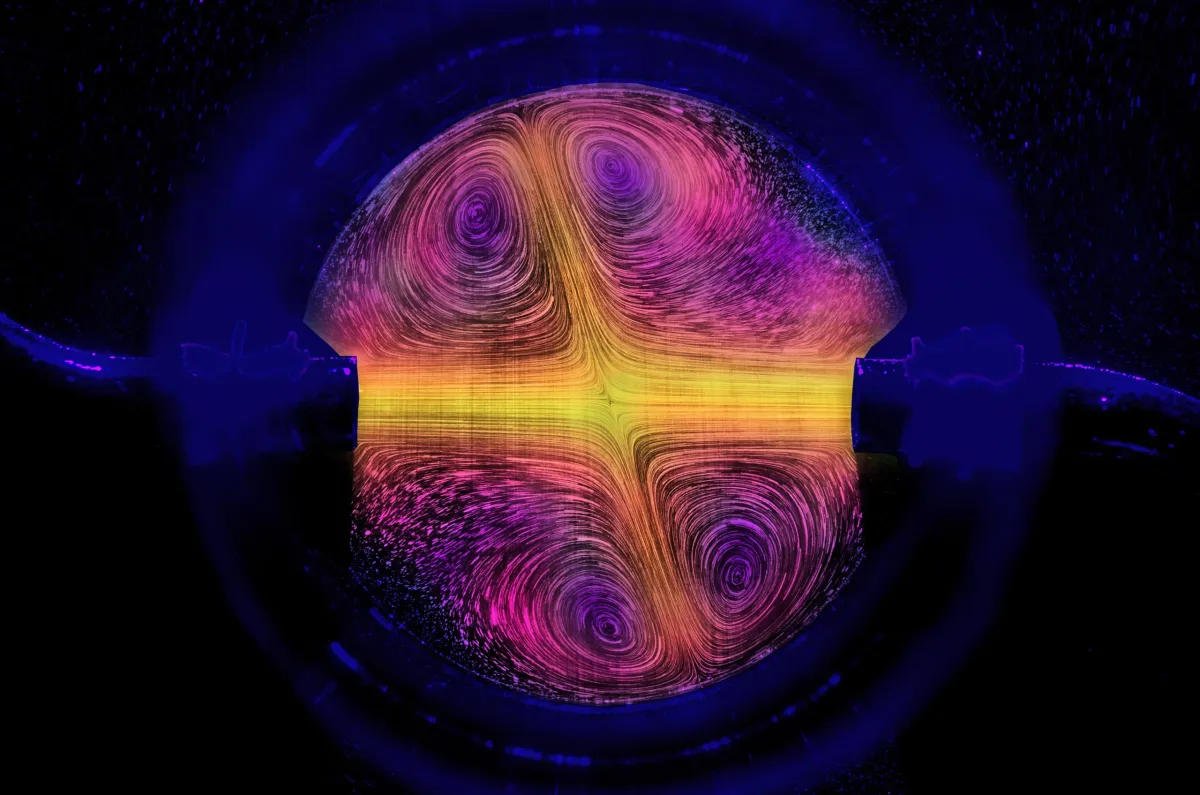
A normal sprinkler acts like a rocket. Water shoots out, pushing the sprinkler in the opposite direction. A reverse sprinkler is like an "inside-out rocket." Water enters its arms and forms jets inside the central chamber.
The team found that these two inward-moving jets collide, but not perfectly head-on. This slight imbalance creates forces that make the sprinkler rotate in reverse.
Ristroph, Sprinkle, and their colleagues called this the momentum flux theory. It explains how the momentum of swirling water moves through the sprinkler and causes it to spin.
Testing Sprinklers With Loops and Curves
The 2024 experiments only used standard sprinklers with S-shaped arms. This left a question: would sprinklers with more complex loops and curves behave differently?
The earlier work also hadn't fully ruled out other explanations proposed by scientists over the years.
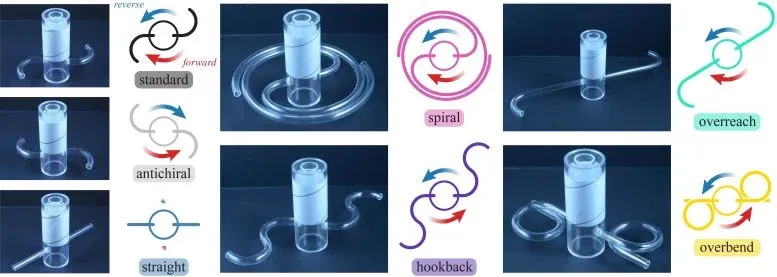
For the new study, researchers built many "silly sprinklers" with various shapes. They tested each one in both forward and reverse modes. In forward mode, water sprayed out. In reverse mode, water was pulled in.
These different designs allowed the team to track how each sprinkler rotated. They observed water movement and measured the twisting force, or torque, when the sprinkler was held still.
Competing Physics Theories Tested
The scientists compared their momentum flux explanation with two other long-standing theories.
One theory, from physicist Ernst Mach in the 1880s, suggested that the fluid swirls one way while the sprinkler turns the other. However, this idea couldn't explain the reverse rotations and torque measured in the new experiments.
Another explanation, linked to Feynman, focused on water moving around the outer ends of the sprinkler arms. The new tests showed that neither the outer parts of the arms nor the surrounding water flows affected the sprinkler's motion or torque.
The results strongly supported the momentum flux theory. The researchers expanded this theory. They showed it accurately describes both forward and reverse operation for every sprinkler shape they tested.
Their experiments also revealed that changing the arm shape can control the water jets. This could be useful for designing devices that rely on fluid flow.
Ristroph concluded that their findings solve a long-standing problem in fluid physics. They also provide useful knowledge about how these devices work.
Deep Dive & References
Geometry controls momentum flux in the sprinkler problem - Proceedings of the National Academy of Sciences, 2026