For decades, the dream of quantum tech — think hyper-powerful computers, unhackable communication, and energy breakthroughs — has been literally chilling. That's because quantum materials, the bedrock of these innovations, usually need to be colder than deep space to work.
Why the big freeze? Heat makes atoms vibrate like a toddler on a sugar rush, which utterly messes with the delicate quantum effects. This means huge, expensive cooling systems, effectively trapping quantum materials in labs. Not exactly ideal for your next smartphone.
Enter the physicists at Louisiana State University (LSU), who've just pulled off a magic trick: creating the first room-temperature quantum material. This isn't just any material; it can identify different quantum states of light and guide them on their merry, separate ways. Published in Nature, this discovery could blow the doors wide open for practical quantum applications.
We're a new kind of news feed.
Regular news is designed to drain you. We're a non-profit built to restore you. Every story we publish is scored for impact, progress, and hope.
Start Your News DetoxBuilding the Unbuildable
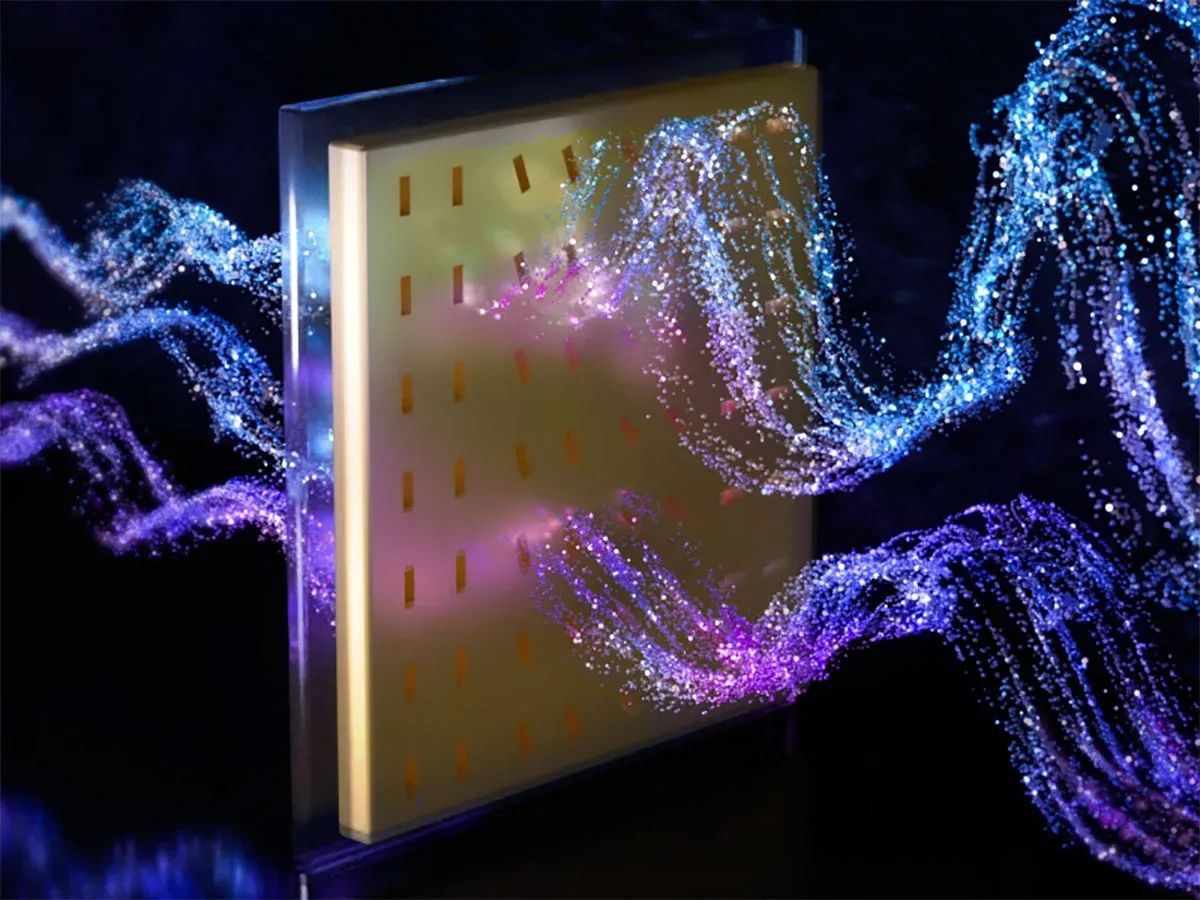
Instead of hunting for a rare, naturally occurring quantum gem, the LSU team — led by Omar S. Magaña-Loaiza's Quantum Photonics Group — decided to play Frankenstein. They started with a glass chip, coated it in a whisper-thin layer of gold, then used focused ion beams to carve out minuscule openings. Each opening acts like an artificial atom, a 'meta-atom.' These are arranged to form a crystal thinner than a human hair, unlike anything you'd find in nature.
When light hits this chip, it glides along the gold surface and interacts with these meta-atoms. By precisely adjusting their size, shape, and spacing, the researchers could control the light in ways previously impossible at room temperature. "It was exciting to build a material that nature doesn't provide on its own," noted Chenglong You, a former postdoctoral researcher on the project.
The Quantum Bouncer
So, what does this 'quantum statistical plasmonic metacrystal' actually do? Think of it as a bouncer at a very exclusive quantum club. Different light sources — sunlight, lasers, lamps — all produce photons. But these photons have subtle differences in their quantum behavior. Until now, spotting these differences required complex, super-cold equipment and millions of measurements.
This new metacrystal does it all on its own. It recognizes those subtle quantum differences and sends different light states down separate paths. Even better, some of these states can travel along these paths while keeping their defining characteristics intact, a phenomenon Magaña-Loaiza calls "robust transport." These quantum states carry information, and the crystal can sort and move them without a single cryo-cooler in sight. Keeping this "quantum coherence" stable has been a massive hurdle, and this crystal just sidestepped it.
The team also discovered that the metacrystal creates "quantum statistical bands," much like the electronic bands that govern electricity in semiconductors. This means future materials can be designed to guide specific quantum states, rather than relying on the limited properties of natural materials. Which, if you think about it, is both impressive and slightly terrifying in its potential.
Beyond the Lab
Working at room temperature means this isn't just a cool lab trick. Imagine quantum computers that don't need refrigerator-sized cooling systems, or quantum communication networks that can actually be deployed in the real world. That's the promise.
But it gets wilder. The team is now looking at solar energy. Today, a lot of sunlight hitting a solar cell turns into heat instead of electricity, reducing efficiency. Magaña-Loaiza's next step is to put this metacrystal inside solar cells to see if it can guide light more stably, converting more of it into usable power. If it works, a tiny, hair-thin crystal could help us harness the sun more effectively. Now that's a bright idea.