This week, the universe decided to remind us that the big picture is often made up of truly remarkable, almost impossibly specific details. From the infinitesimal dance of atoms to the vast emptiness between stars, the breakthroughs this week weren't just about discovery; they were about precision, about zooming in until the previously invisible became undeniable.
The Atomic Ballet and Quantum Leaps
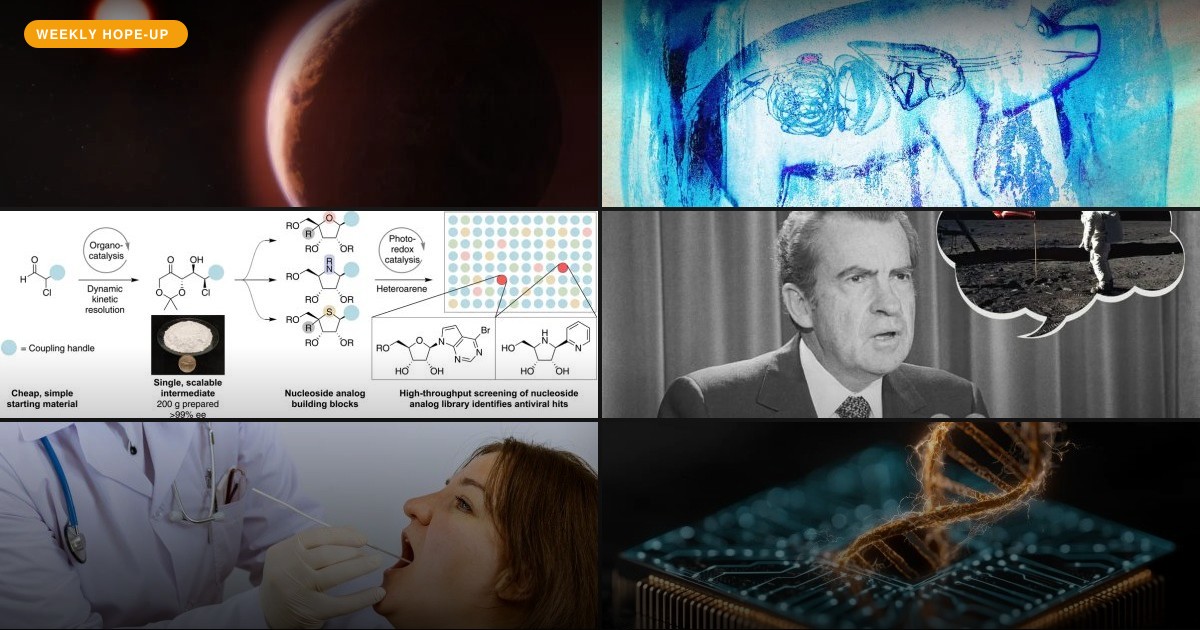
Imagine capturing chemistry in mid-twist, watching individual molecules bend and vibrate, atom by atom. That's exactly what scientists accomplished, watching chemistry unfold atom-by-atom to understand the fundamental dynamics of reactions. This isn't just a parlor trick; it's like finally seeing the choreography behind a magic show. Meanwhile, in the quantum realm, physicists have been busy confirming theories that sound like they belong in a sci-fi novel. After two decades, scientists confirmed a long-standing quantum prediction using what they call a "quantum bath." And if that wasn't specific enough, another team built a light switch that works in 74 femtoseconds, essentially redirecting light with light at speeds that make your fastest reflexes look like slow motion. What this means for you: From faster computers to understanding life itself, these hyper-specific insights are the building blocks of tomorrow's biggest revolutions.
"The coral had been declared dead in 2019. Five years later, it's not just alive — it's spawning." — Read the full story
Wait—What is Brightcast?We're a new kind of news feed.
Regular news is designed to drain you. We're a non-profit built to restore you. Every story we publish is scored for impact, progress, and hope.
Start Your News Detox
From the Cosmos to the Critters: Unraveling the Unknown
While some were watching atoms, others were looking up — way up. Astronomers detected an atmosphere on a potentially Earth-like world, a faint wisp of helium clinging to a distant rocky planet for three billion years. It’s a subtle detail with immense implications for the search for life beyond our solar system. Closer to home, yet still wildly unexpected, a sea worm’s jaw just redefined what a metal can be. Scientists found that this unassuming creature's gnashers are made of a bio-metal that may belong to an entirely new class of material, offering new avenues for material science. These discoveries aren't just fascinating; they remind us how much we still don't know about our own universe and the ingenuity of nature. What this means for you: The world is still full of genuine surprises, and sometimes the most ordinary-looking things hold the most extraordinary secrets.
Health on a Micro- and Macro-Scale
This week also saw incredible specificity in health breakthroughs. Organ donation, a race against time, just got a significant reprieve. Researchers figured out how to store kidneys for days, not hours, potentially saving countless lives by reducing the number of discarded organs. On the diagnostic front, a new oral cancer test is not only painless but delivers results in an hour with 95.5% accuracy. And in a development that sounds plucked from a sci-fi script, scientists successfully grew human sperm in a mouse kidney. While controversial, this hyper-specific biological engineering could revolutionize fertility treatments. What this means for you: From organ transplants to early cancer detection, the precision of modern science is making significant inroads into improving human health and extending life.
Hope stat: 3 billion — years a distant rocky world kept its atmosphere, defying cosmic odds.
Watch this space: The continued advancements in bio-engineering and organ preservation could reshape how we approach medical treatments and fertility in the coming year.