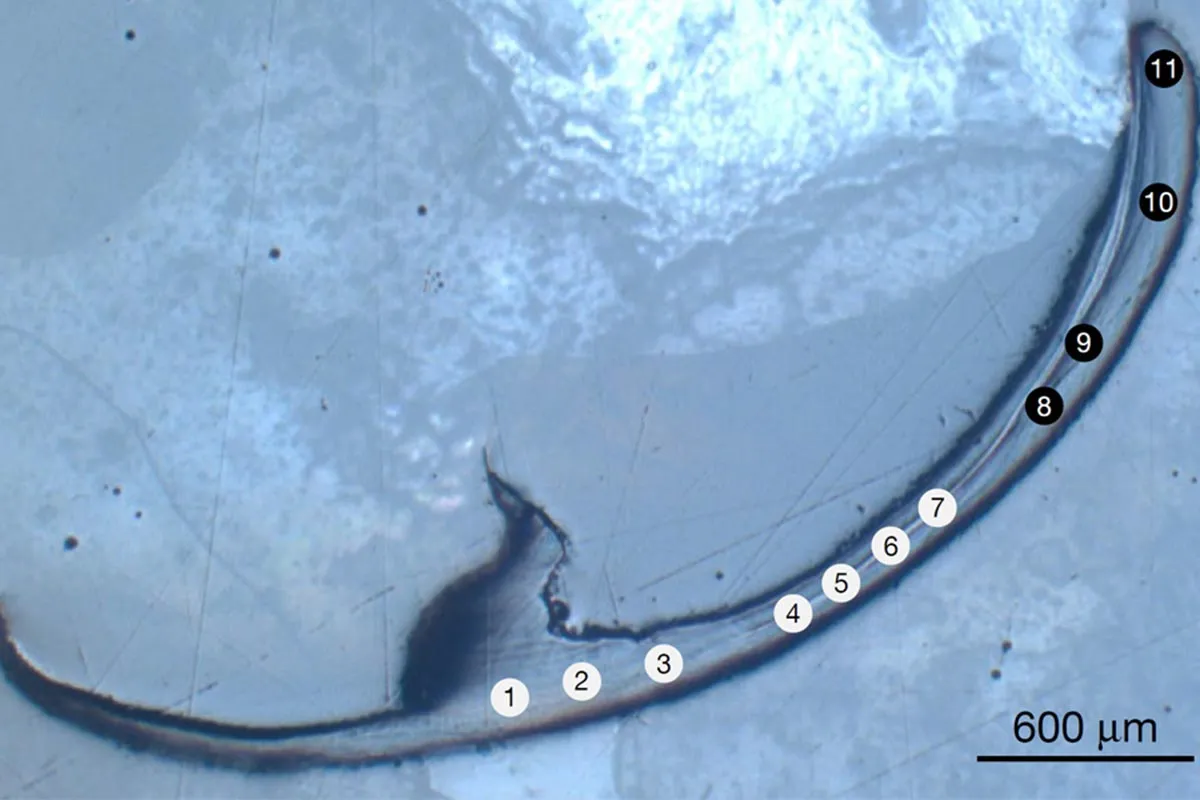
Imagine a material so unique, so downright unconventional, that scientists had to invent a whole new category for it. Turns out, it's not some futuristic alloy dreamed up in a lab, but the jaw of a humble sea worm. Yes, a worm. Specifically, Perinereis cultrifera.
These worms are sporting what researchers are now calling "bio-metals" — a blend of proteins and metal ions that gives their chompers incredible strength and toughness. It's like nature decided to give a tiny marine annelid a set of super-powered pliers, just because it could.
Not Your Average Hardware Store Metal
When we say "bio-metal," we're not just talking about something biological that looks metallic. We're talking about a very specific set of characteristics: how hard it is, how it handles stress, and the intricate dance between its proteins and ions. Researchers at TU Wien and the University of Vienna have been meticulously dissecting these wormy mandibles to pin down exactly what makes them tick, publishing their findings in Biophysics Reviews.
We're a new kind of news feed.
Regular news is designed to drain you. We're a non-profit built to restore you. Every story we publish is scored for impact, progress, and hope.
Start Your News DetoxThey used a technique called nanoindentation, which sounds like something out of a sci-fi movie but essentially involves poking the material with a tiny, tiny probe to measure its hardness. What they found was that the metal ions are more concentrated at the jaw tips, making them extra-hard — perfect for, you know, biting and crushing whatever unfortunate morsel crosses their path.
But here's where it gets really weird: the smaller the section of jaw they tested, the harder it became to dent. This phenomenon, known as the Nix-Gao nanoindentation size effect, is usually seen in actual metals like copper and silver. Basically, in smaller areas, the internal structure interlocks more tightly, making it tougher than you'd expect. So, a worm's jaw is acting like a tiny, organic, super-strong version of your grandpa's copper pipes. Who saw that coming?
The Elastic Worm
Christian Hellmich, one of the authors, pointed out that these bristle worm jaws also exhibit "size-dependent elasticity." This means their ability to bend and spring back into shape changes depending on the scale you're observing them at. Regular crystalline metals? They don't do that. At all. It's like the worm's jaw is saying, "Sure, I'll act like a metal, but I'm also going to throw in a few curveballs just to keep things interesting."
Scientists are now just scratching the surface, using mathematical models to understand these micro-scale elastic effects. The goal? To study more species, gather more data, and ultimately figure out if genetic tweaks could influence these natural materials. Because, as Hellmich eloquently put it, there's a "beauty, elegance, and refinement found in and produced by nature" that's just begging to be understood. And if that understanding leads to a whole new class of materials inspired by a sea worm, well, that's just an extra-tough bonus.