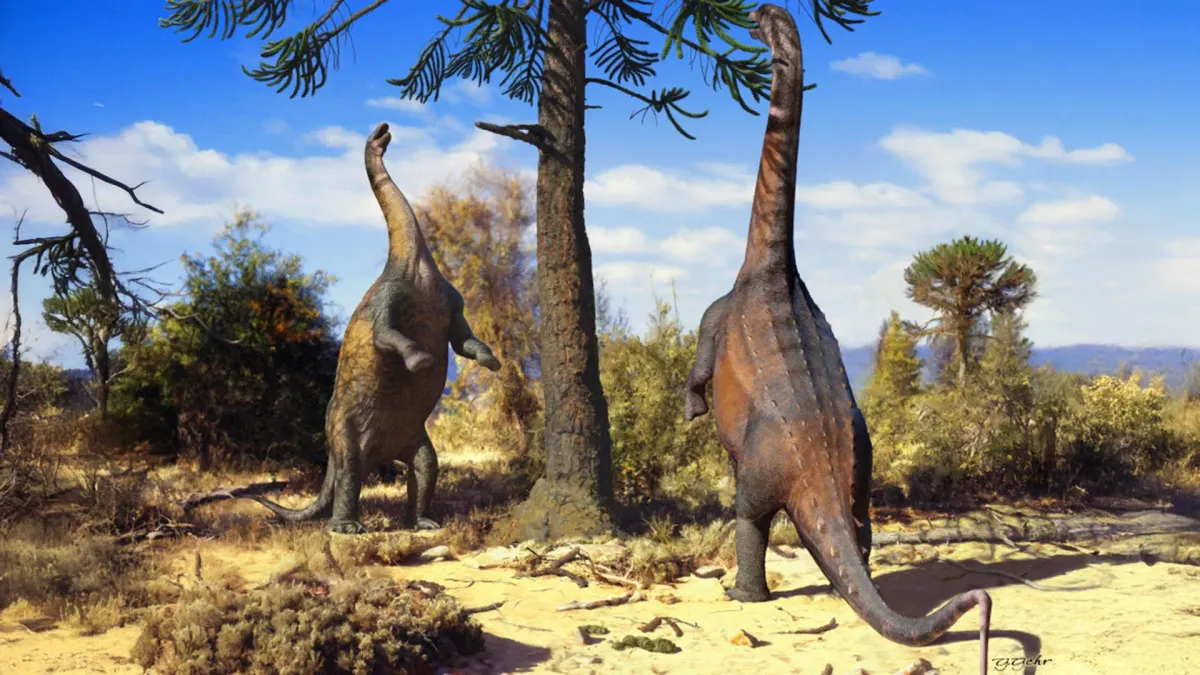
Turns out, some of the longest-necked dinosaurs weren't just lumbering giants. New research suggests certain South American sauropods, particularly when they were in their awkward teenage years, were surprisingly good at standing on their hind legs. Think of it as a prehistoric power move.
This wasn't just for show (though it probably helped). This upright stance likely helped them snag the best leaves from tall trees, look extra intimidating to anything eyeing them for lunch, or even, well, impress a date. Because apparently, even 66 million years ago, a good pose could get you noticed.
The dinosaurs in question, Uberabatitan from Brazil and Neuquensaurus from Argentina, started out roughly elephant-sized. But an adult Uberabatitan could stretch to a staggering 26 meters long, making it the biggest dinosaur ever found in Brazil. And that's where the problem started.
We're a new kind of news feed.
Regular news is designed to drain you. We're a non-profit built to restore you. Every story we publish is scored for impact, progress, and hope.
Start Your News DetoxAccording to a study published in Palaeontology, their ability to stand tall diminished with age. Younger animals found it easier; the older, heavier adults? Not so much. Their femurs (thigh bones) just couldn't handle the strain of all that growing up.
Engineering Dinosaurs: A Stress Test
To figure this out, scientists used a trick straight out of modern engineering: finite element analysis. It's the same computer modeling that ensures bridges don't collapse and buildings don't sway too much. They basically put digital dinosaur femurs through a stress test.
Julian Silva Júnior, lead author and postdoctoral researcher, explained that smaller sauropods had the bone and muscle structure for prolonged bipedal stands. Larger ones could manage it, sure, but it was a quick, uncomfortable flex. Imagine trying to hold a handstand after a massive Thanksgiving dinner.
They modeled femurs from seven different sauropod species, pulling data from museum fossils worldwide. The goal: see how much stress gravity and body weight put on the thigh bone when these behemoths leaned back.
The Young and the Strong-Boned
The simulations showed that two species, a young Uberabatitan ribeiroi and Neuquensaurus australis, both from the Late Cretaceous, had the lowest stress levels on their femurs. Their bones were thicker, better at distributing the immense forces of standing upright. They were built for it.
Older, larger sauropods, despite having massive muscles and giant femurs, just couldn't comfortably support their immense bulk for long periods. They could still do it, but it was probably like us trying to touch our toes after a long flight—possible, but not exactly pleasant.
So, why bother? High-reaching leaves were a big one. Think of it as exclusive access to the top shelf of the prehistoric buffet. For reproduction, a tall stance could help males show off or, more practically, mount females. And for defense, well, suddenly looking twice your size tends to deter most predators. A tripodal stance, using two legs and a tail for stability, would have turned them into a living, breathing tripod of terror.
Of course, the models didn't account for every squishy bit like cartilage or the full tail support. But as Silva Júnior noted, the tool is excellent for comparisons, giving us a good, albeit slightly cushion-less, idea of how these magnificent creatures behaved millions of years ago. Let that satisfying number sink in.