Hidden within a tiny fossil from southern China, two small limbs lay undisturbed for 518 million years. When scientists finally examined them, these ancient appendages offered a rare look at how scorpions got their pincers and spiders developed their fangs.
The fossil belongs to Urokodia, an ancient marine animal. Researchers from Yunnan University and the University of Leicester studied it. Its anatomy shows the earliest known signs of the structures that later became spider fangs. This discovery was published in Nature.
The Ancestor of Spider Fangs
Spider fangs are key to how spiders hunt. They use them to grip prey and often inject venom. Spiders are part of a larger group called chelicerates. This group also includes scorpions, ticks, and horseshoe crabs.
We're a new kind of news feed.
Regular news is designed to drain you. We're a non-profit built to restore you. Every story we publish is scored for impact, progress, and hope.
Start Your News DetoxChelicerates have jointed limbs and external skeletons. Their most important feature is a pair of specialized front limbs called chelicerae. These can be pincers or fangs, depending on the animal.
The Urokodia fossils were found at the Chengjiang fossil site in China. This site is famous for its well-preserved marine animals from early in Earth's history.
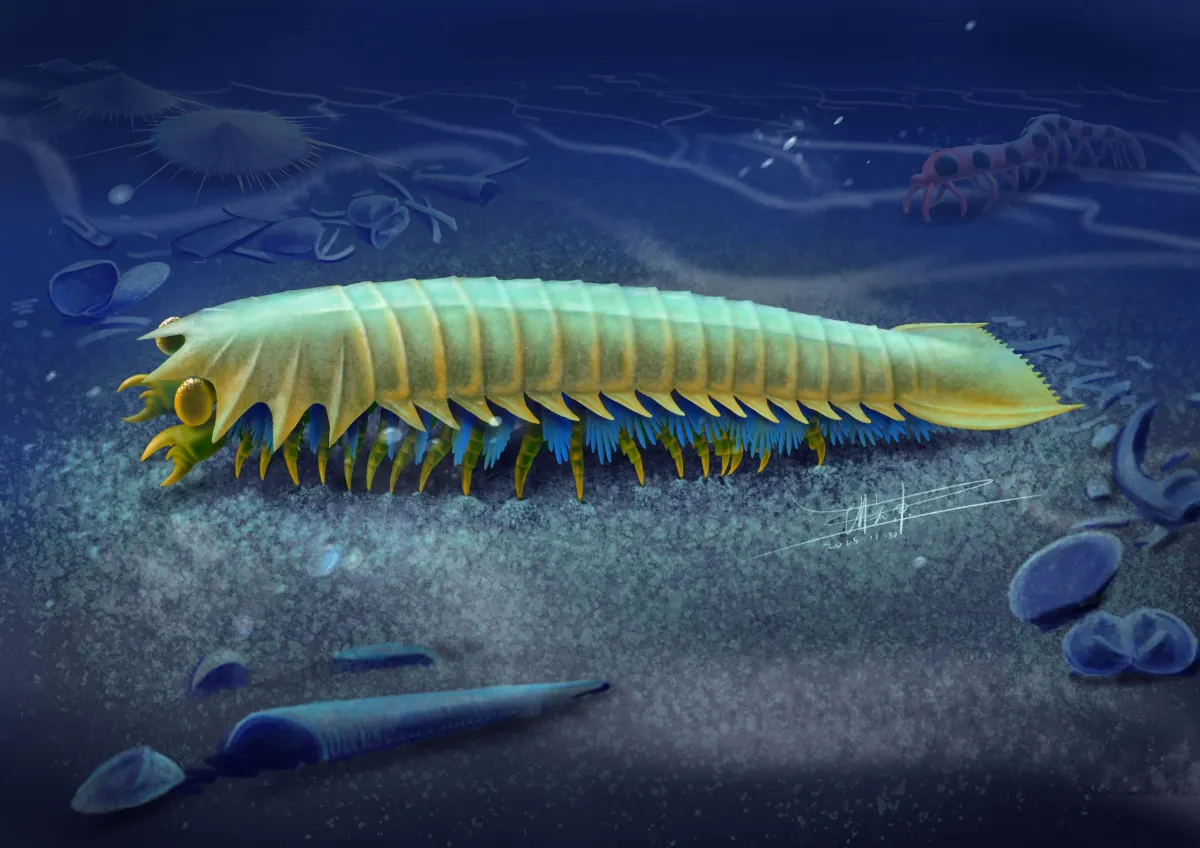
Urokodia was only about two to three centimeters long. It had a narrow, segmented body, jointed limbs underneath, and large eyes on stalks. Its unusual look made it hard to place on the animal family tree. To understand its evolutionary identity, researchers needed to see inside the fossil.
X-Rays Reveal Hidden Details
Scientists used X-ray tomography to study the fossils without cutting them. This technique is like a medical scan. It takes images from many angles to reconstruct hidden structures.
The scans showed that much of the animal's soft body parts had survived for millions of years. Soft tissues usually decay quickly, so this preservation offered crucial evidence.
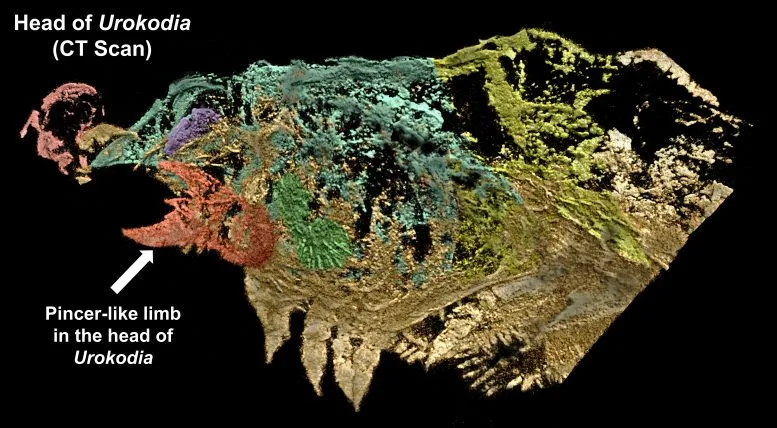 Soft anatomy in the head of Urokodia exposed under X-ray analysis. Credit: University of Leicester
Most importantly, the images revealed two pincer-like limbs right behind the animal's eyes. Their position and structure identified them as early chelicerae. This linked Urokodia to the group that includes spiders, scorpions, and ticks.
The scans also showed features on Urokodia's legs that might have been book gills. These layered breathing organs help aquatic animals get oxygen from water. Horseshoe crabs still have similar structures, suggesting Urokodia breathed in a similar way.
How Early Pincers Changed Predation
Chelicerates became very successful in both marine and land environments. Their specialized front limbs gave them a versatile way to grab, pierce, and eat food. This helped later members of the group become effective predators.
This discovery suggests that the basic tools for spider fangs first appeared in the ocean over half a billion years ago. Over vast periods of time, the small pincers of Urokodia changed into the diverse feeding structures seen in modern chelicerates.
Professor Yu Liu of Yunnan University led the study. He noted that seeing the pincer-like limbs was an exciting moment. It confirmed Urokodia as a distant ancestor of living chelicerates.
Professor Mark Williams from the University of Leicester added that Urokodia was part of an ancient ecosystem with over 200 animal types. These fossils offer real insights into how life evolved on Earth.
Deep Dive & References
Urokodia sheds light on the origin of chelicerae and book gills of Chelicerata - Nature, 2026