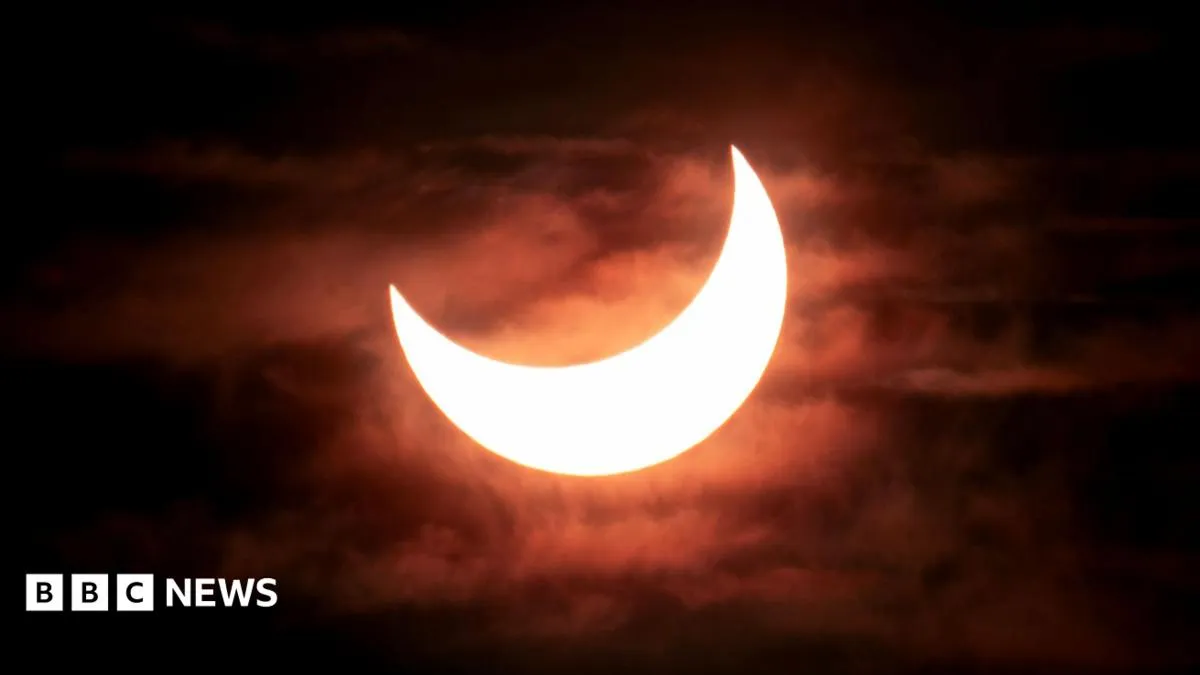
The UK will experience its most significant solar eclipse since 1999 on Wednesday evening. It will also be the best one for the next 50 years.
The eclipse will be visible across the entire UK. The Moon will cover up to 96% of the Sun's disc, depending on your location.
Where to See the Eclipse
Other parts of the world will see a total eclipse. This includes northern Spain, Russia, Greenland, Iceland, and Portugal. Hundreds of thousands of people have traveled to northern Spain for this event.
We're a new kind of news feed.
Regular news is designed to drain you. We're a non-profit built to restore you. Every story we publish is scored for impact, progress, and hope.
Start Your News DetoxIn the UK, over 90% of the Sun will be hidden by the Moon. The peak viewing time will be between 6:58 PM and 7:15 PM BST. This timing varies by location.
Devon, Cornwall, and western Pembrokeshire in Wales will see the fullest eclipse, with 94% to 96% of the Sun covered. The rest of Wales, Northern Ireland, parts of the West Midlands, the South West, and western Scotland can expect 92% to 94% coverage.
People across the UK have been buying specialist eclipse glasses. A bakery in central London sold about 100 pairs on Tuesday morning.
Weather conditions will vary. Much of the UK should have clear skies for a good view. However, clouds might appear between 6:00 PM and 7:00 PM in parts of north Wales, northern England, Scotland, and Northern Ireland. Some areas in western Scotland and northern/western Northern Ireland might even see rain.
In Spain, clear skies are expected for a total eclipse in Bilbao, Valencia, and Palma, Mallorca. Barcelona and Madrid will see over 99% coverage. The total eclipse will peak between 8:26 PM and 8:33 PM local time (7:26 PM to 7:33 PM BST).
Spain expects half a million visitors for the event. Julie, who traveled from Brest, France, to Burgos, Spain, was "very excited." She had seen an eclipse before and found it "beautiful and amazing." Leonor Aguilar from Jaén, Spain, hoped to "see the grandeur of nature" with her family.
Martin Griffith, director of Brecon Beacons Observatory in Wales, called the eclipse "one of the great phenomena of nature." He noted that Spain would see about one minute and 40 seconds of totality, where the Moon completely covers the Sun.
The next time the Moon covers as much of the Sun in the British Isles will be in 2081. The next total solar eclipse in the UK will be in 2090.
How a Solar Eclipse Works
A solar eclipse happens when the Earth, Moon, and Sun align, or nearly align. The Moon passes between the Earth and the Sun, blocking sunlight.
A total solar eclipse occurs somewhere on Earth about every 18 months. To see a total eclipse, you must be in the narrow path of the Moon's shadow, called the path of totality.
Outside this path, like in the UK, you will see a partial eclipse. The Moon only blocks part of the Sun.
During a total eclipse, the sky darkens. When the Sun is fully blocked, a pearly-white rim appears around it. This is the Sun's atmosphere, called the corona. It is a vast halo of superheated plasma. The corona is usually invisible because it is over a million times fainter than the Sun's surface.
Just above the visible surface is a thin, pinkish layer called the chromosphere. It is only a few thousand kilometers thick. In the first seconds of a total eclipse, it appears as a narrow pink-red ring around the Moon's edge.
Safe Viewing Tips
Looking at a solar eclipse without proper eye protection can cause permanent eye damage. Regular sunglasses, welding goggles, or looking through your phone do not offer enough protection. Binoculars or telescopes can only be used with a special solar filter.
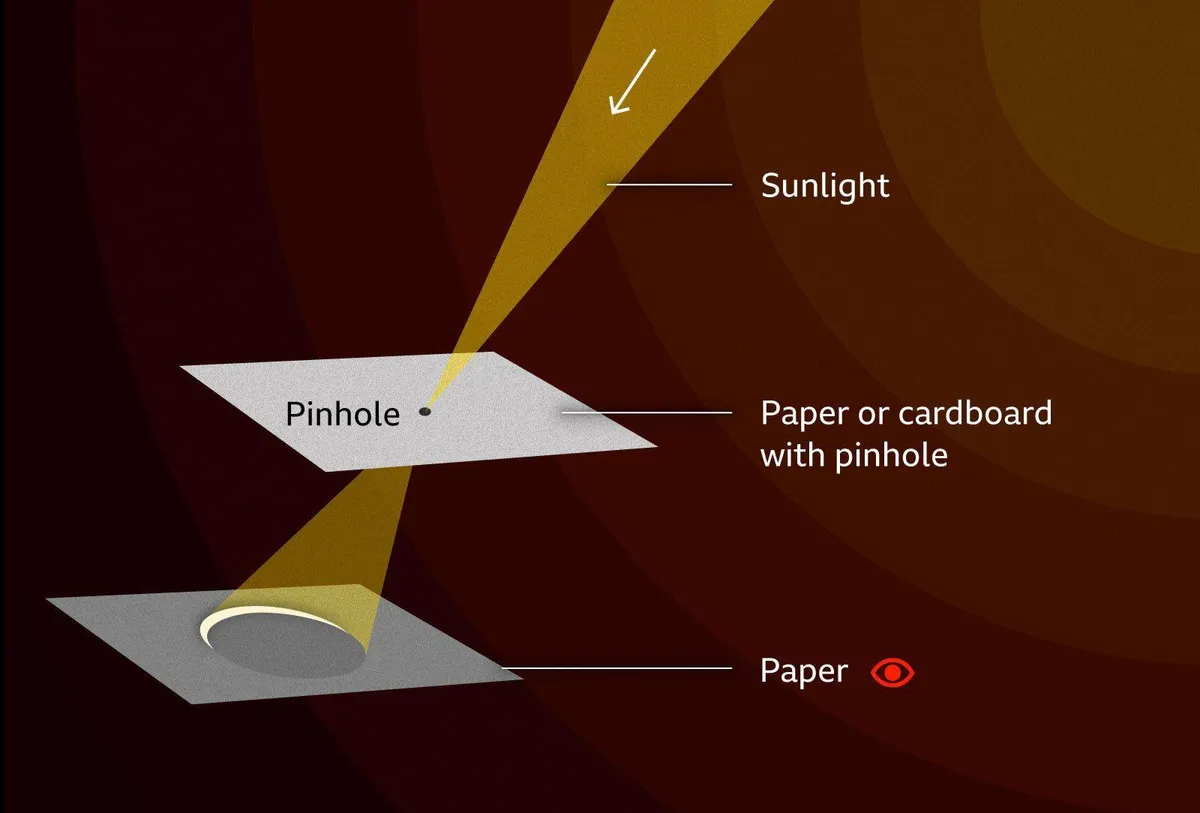
The safest ways to watch are with certified solar glasses or by making a pinhole viewer. To make a pinhole viewer, create a 3mm hole in one piece of paper or card. With your back to the Sun, project the eclipse onto another piece of white paper or card. Paper plates work well.
Kitchen items can also be used. A colander or draining spoon will create many mini-eclipses projected onto the ground while you stand with your back to the Sun.
Meteor Shower During the Eclipse
The Perseid meteor shower also peaks on Wednesday evening. During a total eclipse, the darkened sky offers a brief chance to see meteors. This would only be possible in areas with a total eclipse, like Spain, not in the UK.
Even in areas with a total eclipse, the chances of seeing a shooting star are very slim. Dr. Becky Smethurst, a Royal Astronomical Society research fellow, said you would need to be "very, very lucky."
Remember, always use certified solar glasses for a solar eclipse. Looking directly at the Sun without proper eye protection can cause permanent eye damage.