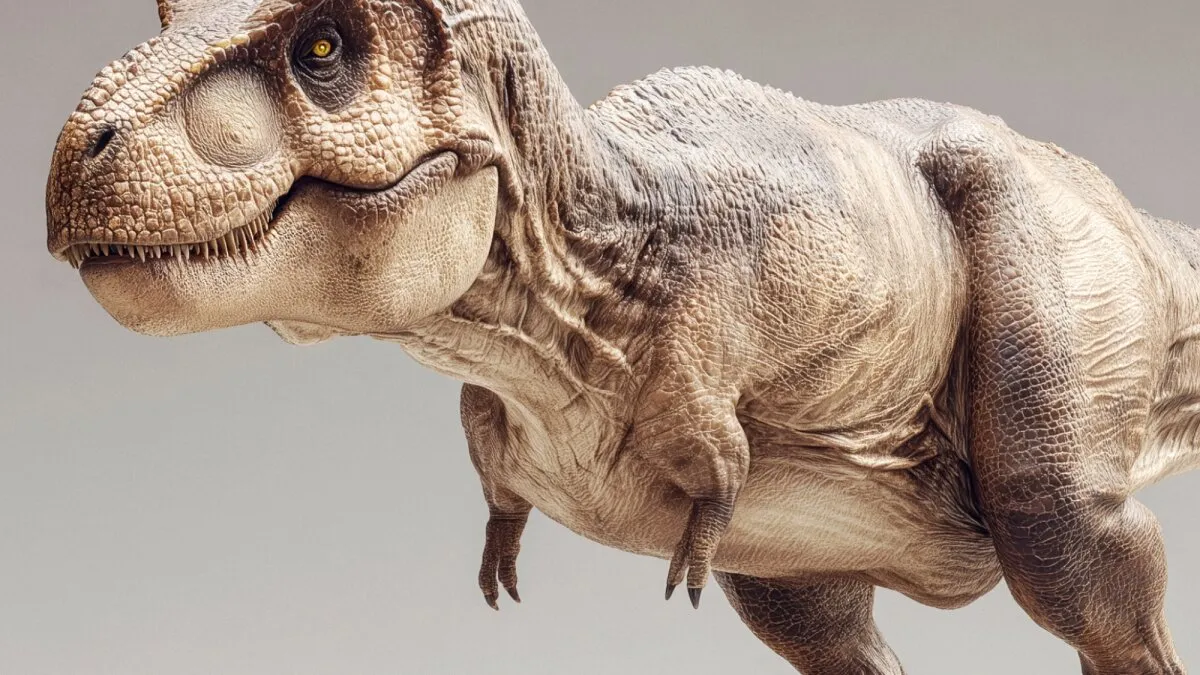
For eons, the Tyrannosaurus rex has been the poster child for "all bite, no bicep." Its famously tiny arms, comically out of proportion with its massive body and skull, have stumped paleontologists for generations. Was it a genetic prank? A cosmic joke? Turns out, it was just good, old-fashioned evolution.
A new study suggests T. rex's arms didn't just shrink by accident. Instead, they were deliberately downsized, not once, but in at least five different groups of meat-eating dinosaurs. And the reason? Their heads got too good at the job.
When Your Skull Does All the Heavy Lifting
Imagine you're a giant, prehistoric predator. You've got a skull that could crush a small car and a body the size of a bus. What do you need dinky little arms for? That's the gist of the theory from paleontologist Charlie Scherer at University College London.
We're a new kind of news feed.
Regular news is designed to drain you. We're a non-profit built to restore you. Every story we publish is scored for impact, progress, and hope.
Start Your News DetoxAs these dinosaurs evolved stronger skulls and heavier bodies to tackle bigger prey, their forelimbs became less crucial. Scherer's team crunched data on the arms, skulls, and body mass of 85 different two-legged dinosaurs (theropods, to their friends). They mapped these traits over millions of years of evolutionary history.
The verdict? Those tiny arms weren't just a byproduct of getting bigger. They were an active adaptation, directly linked to developing a seriously robust skull. It wasn't about skull size, but skull strength that drove the arm-reduction program. Less limb-flailing, more head-bashing.
This independent arm-shrinking act popped up in various dino families, including the Abelisauridae, Carcharodontosauridae, and of course, the Tyrannosauridae. When you're bringing down something colossal, a powerful bite is far more effective than a high-five.
Of course, not all dinosaurs got the memo. The Spinosaurus, for instance, kept its long arms. Scherer speculates this is because Spinosaurus had a different diet, perhaps using its arms more than its jaws for hunting. It's almost as if evolution has a sense of humor, giving some the short end of the stick while others got to keep their reach.
It’s a pattern we see elsewhere, too. Toothed whales, for example, have skulls adapted for smaller prey, because anything too big just won't fit. It just goes to show: what you eat often dictates the shape of your head – and the usefulness of your arms.