It takes a special beehive chamber to raise a honeybee queen, according to new research.
A study in Nature describes how a queen's royal compartment has unique properties. These properties might help a monarch develop. Researchers also found a distinct group of worker bees that build these special nurseries.
The findings reveal a new "job" for bees and new factors that contribute to a queen's royalty.
We're a new kind of news feed.
Regular news is designed to drain you. We're a non-profit built to restore you. Every story we publish is scored for impact, progress, and hope.
Start Your News DetoxMore Than Just Royal Jelly
Honeybees have different roles in their complex societies. A queen is usually the only female in a colony that can reproduce. Male drones mate with her. Female worker bees collect nectar and pollen, maintain the hive, and care for the queen and her offspring.
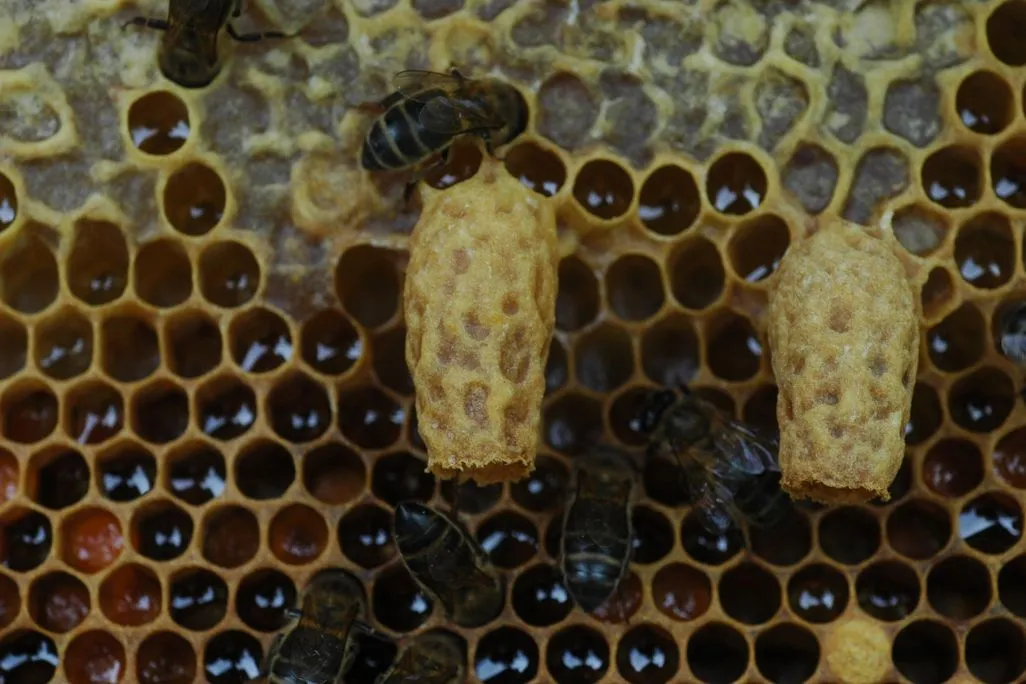
Before, scientists thought queens became powerful mainly because they ate a lot of royal jelly. This substance is secreted by worker bees. Young queens also grow up in waxy compartments called cells. These cells are shaped differently from the usual hexagonal ones. A royal chamber looks like a peanut sticking out from the hive.
Until recently, scientists did not pay much attention to how these shelters might help shape a queen.
"For centuries, we believed ‘you are what you eat’ was the only rule for making a queen bee. Our study rewrites that rule to say, ‘you are where you live, too,’" said Kai Wang. Wang is a bee researcher at the Chinese Academy of Agricultural Sciences and a co-author of the study.
Wang's two-year-old son inspired the study. He asked why a queen cell looked so different from other cells in the lab. "That innocent question hit me like a lightning bolt," Wang said.
The Special Queen Cell
Wang and his team studied this unique bee house. Microscope images showed that queen cell wax is more flexible and less dense than worker cell wax. Further tests showed it has a higher melting point and different chemicals.
The researchers raised dozens of baby queens for seven days. Some were in cups with worker wax, others with queen wax. Bees that grew up with worker wax were smaller and died more often than those in royal wax. This suggests that the queen cells' special environment is vital for young queens to develop.
The bees that build queen cells are also special. They are usually younger than worker cell builders. They have higher body temperatures and different gene activity. These royal construction workers seem to change recycled wax by adding new substances, like fatty compounds called lipids.
Thomas Seeley, a biologist at Cornell University not involved in the research, called the discovery "very cool and thought-provoking." He noted that odors from a developing queen might fill the wax walls. This would mark them as special spots that workers recognize and protect.
Ecologist James Nieh found the wax's role "quite interesting." He wonders if similar things happen in other bees, like Melipona bees, where workers decide if they become a queen. Nieh, from the University of California, San Diego, was not part of the study. He thinks the answer might be in the queen cells' chemical traits.
Many questions remain. The team is especially curious about the unique chemical scents in the royal cells. Wang wonders if they influence the queen's senses, preparing her for mating. He also questions if the larva produces some scents or if the future queen communicates with the workers building her chamber.
Researchers plan to find out exactly when the royal wax starts to shape a growing queen's development.
Deep Dive & References
What Determines Royalty Among Honeybees? Not Just a Distinct Diet—Queens Also Need Specially Built Regal Chambers, a Study Suggests - Nature, 2026