Restructuring molecules without starting over is a key goal in modern organic chemistry. This process, called skeletal editing, helps chemists find new chemical structures. It also simplifies making molecules that could become new medicines.
However, editing functional groups like esters has been tough. Their carbon-carbon and carbon-oxygen bonds are hard to break under gentle conditions.
Now, a team led by Professor Toshifumi Dohi from Ritsumeikan University has found a new solution. Yusuke Yoto from Ritsumeikan University and Dr. Hideyasu China from Doshisha Women's College of Liberal Arts also contributed.
We're a new kind of news feed.
Regular news is designed to drain you. We're a non-profit built to restore you. Every story we publish is scored for impact, progress, and hope.
Start Your News DetoxTheir study, published in JACS Au, shows that adding chlorine to hydroxycoumarins can start a series of events. These events break and then form new bonds. This removes a carbonyl group and rebuilds the molecule into a coumaranone.
Dohi explained that their goal was to find a new way to edit ester skeletons. They wanted to break tough bonds gently and immediately rebuild the molecule into a useful structure.
From Cutting to Rebuilding
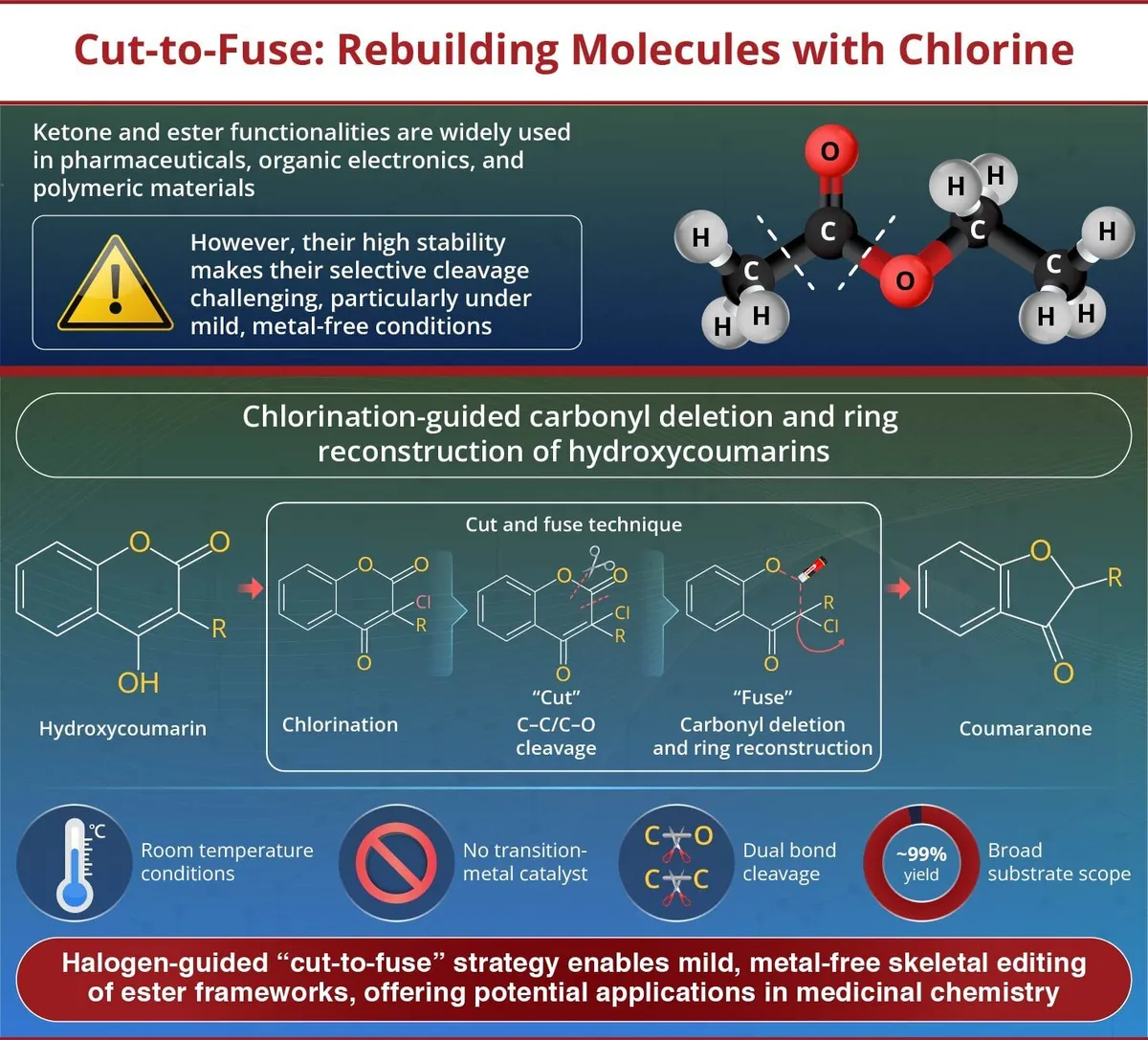
The team's idea came from a "cut-to-fuse" strategy. In this method, halogenation first "cuts" bonds in a ring-shaped compound. This creates a reactive chain. Then, a reaction within the molecule "fuses" the chain into a new ring structure.
The researchers thought a similar process could remove a carbonyl unit from hydroxycoumarins.
Their first experiments had an unexpected result. They were looking into fluorine-induced carbon-carbon bond breaking. But fluorination caused the hydroxycoumarin to break into separate pieces.
Dohi noted that chlorine completely changed the reaction. When they treated a hydroxycoumarin with N-chlorosuccinimide (NCS), it formed a chlorinated intermediate. This intermediate then underwent a reconstruction that removed the carbonyl group. It produced a coumaranone instead of breaking apart.
Gentle Conditions, High Yields
The researchers then made the reaction better. They found it could happen at room temperature in almost neutral conditions, without needing metal catalysts. Under these improved conditions, hydroxycoumarin was treated with NCS, water, and sodium acetate in ethyl acetate, then with potassium phosphate.
This method created the coumaranone in over 99% yield. The researchers say these are the gentlest non-enzymatic conditions reported so far for breaking both C–C and C–O bonds in this type of carbonyl removal.
The reaction also worked for many different molecules. Hydroxycoumarins with methoxy, halogen, azide, phenol, carboxylic acid, and boron groups all worked. So did molecules with substituted aromatic rings, naphthalene, pyridine, thiophene, furan, and aliphatic groups.
Many products were made in good to excellent amounts. This shows the method can handle a lot of different structures. A similar cyclic β-keto ester also underwent reconstruction, proving the chemistry isn't limited to just one type of molecule.
Evidence for Selective Chlorination
Experiments showed that selective chlorination was very important. When the chlorinating agent was left out, the starting material remained unchanged. Step-by-step experiments showed that chlorination happened first. Then, the molecule lost carbon dioxide, and finally, it formed a ring within itself.
The team also showed how useful the method could be. On a gram scale, the reaction produced the desired coumaranone in 91% yield. This new structure could then be changed further. It could be turned into a benzofuran, given a quaternary carbon center, or used in metal-catalyzed coupling reactions.
For example, a coumaranone with a boron pinacol ester was useful. It could be used directly in palladium-catalyzed coupling without needing to be separated first.
A Nature-Inspired Editing Method
Inspired by how halogenation drives changes in natural products, researchers found a new way to think about removing carbonyl groups and building molecular structures.
Their cut-to-fuse strategy offers an efficient way to turn hydroxycoumarins into coumaranones. It avoids the harsh conditions usually needed to break ester bonds.
This study could help future medicinal chemistry. In that field, efficient molecular editing is becoming more valuable for quickly creating many different compounds.
Deep Dive & References
Halogen-Guided Reconstructive Transformation of Hydroxycoumarin to Coumaranone - JACS Au, 2026