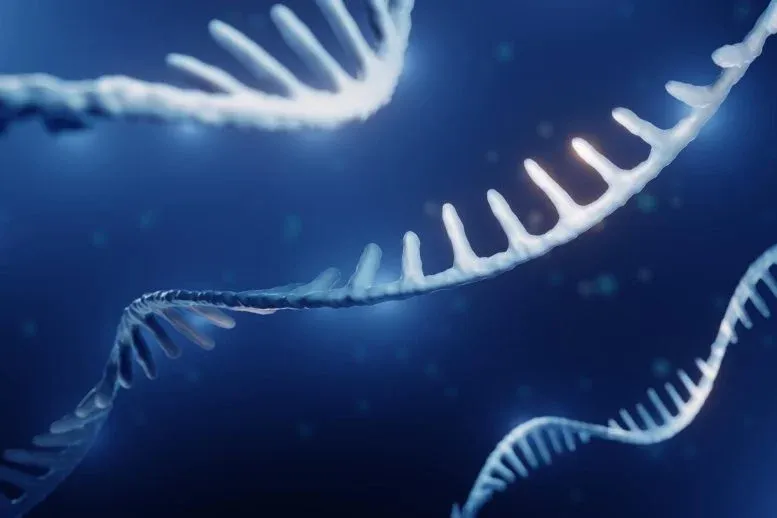
Before life got all complicated with cells and DNA, there was a problem: how did the fragile building blocks of existence survive the early Earth's chaotic, often hostile environment? Turns out, the answer might be a tiny chemical difference that made RNA better at forming protective, liquid-like blobs.
Imagine the primordial soup: hot, acidic, and not exactly a safe space for delicate molecules to hang out and swap genetic secrets. Without cell walls, early RNA—which many scientists believe was the OG molecule for both storing info and kickstarting reactions—would've struggled. It needed a bouncer, or at least a VIP section.
The Droplet Solution
The prevailing theory is that RNA found its own solution: it gathered into liquid-like droplets, or condensates. Think of them as tiny, membrane-less clubs where RNA could concentrate, interact, and get a bit of protection from the outside world. Which, if you think about it, is both impressive and slightly terrifying for a bunch of molecules.
We're a new kind of news feed.
Regular news is designed to drain you. We're a non-profit built to restore you. Every story we publish is scored for impact, progress, and hope.
Start Your News DetoxNew research from the University at Buffalo, published in Nature Communications, just dropped a bombshell on why RNA was so good at this. It all comes down to a single, humble oxygen atom.
This tiny chemical distinction between RNA and DNA helps RNA form these droplets more easily as temperatures climb. Even better, it also nudges these droplets to transition into more rigid, gel-like networks, offering even more protection. It's like RNA leveled up from a liquid club to a fortified bunker.
Professor Priya R. Banerjee, who led the research, says these findings highlight how minuscule chemical tweaks can orchestrate the creation of larger, self-organized structures. This could be a missing piece in the puzzle of how simple molecules made the leap to early life.
The Oxygen Advantage
To really dig into it, the researchers compared RNA directly with single-stranded DNA. The results were stark: RNA started forming droplets about 10 degrees Celsius lower than DNA. It's the molecular equivalent of RNA showing up to the party first and setting up shop.
The secret? That one extra oxygen atom. RNA has a 2′-hydroxyl (2′-OH) chemical group on each sugar unit, which DNA lacks. Using fancy microscopy, X-ray scattering, and computer simulations, the team found this 2′-OH group strengthens RNA's interactions with magnesium ions and reduces the water molecules clinging to its backbone.
Basically, it makes RNA molecules more eager to cozy up together as the heat rises. They even tweaked the 2′-OH group to a similar modification found in natural RNA, and watched as RNA's ability to condense plummeted. It confirmed the 2′-OH group was the VIP pass to droplet formation.
As Gable Wadsworth, a postdoc in Banerjee's lab, put it, this single oxygen-containing group has a powerful effect. It controls whether these molecules assemble, stay fluid, or become a gel. Which is a lot of responsibility for one little atom.
Banerjee's lab is now pushing the boundaries, trying to program these RNA droplets to perform basic cell functions, hoping to build active, dynamic, cell-sized compartments. The ultimate goal? Synthetic cells made entirely from RNA. Because apparently that's where we are now. And if they pull it off, it might just be the closest we get to recreating life's first awkward steps.