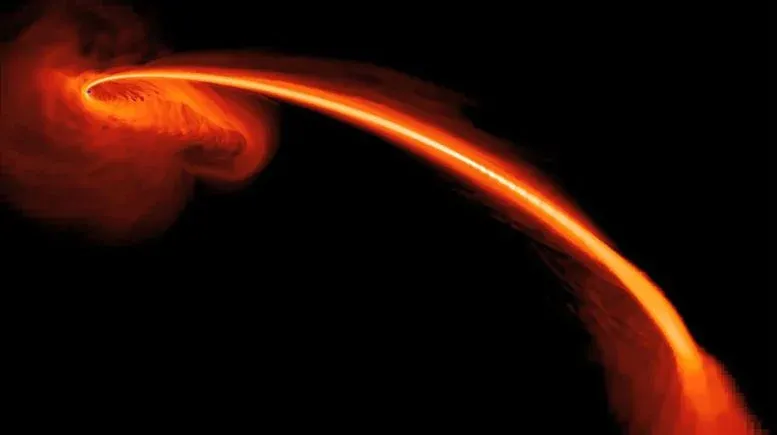
Imagine a supermassive black hole at the center of a galaxy, casually ripping apart stars like they're tissue paper. Standard operating procedure, right? Except sometimes, a star gets mostly ripped apart, then dusts itself off and comes back for more. These are called repeating partial tidal disruption events (rpTDEs), and they've been a cosmic head-scratcher.
See, when these stars make their repeat performance, shedding more material and flashing bright, astronomers noticed something weird: about 40% of these stellar performances started to… fade. The flares got progressively dimmer, which didn't make sense to the brilliant minds trying to model these interactions. Two years they puzzled over it. Until now.
The Spin Cycle of Stellar Demise
Astrophysicists at Syracuse University, led by doctoral student Ananya Bandopadhyay, have a new theory, published in The Astrophysical Journal: It all comes down to how fast the star was spinning before its first close encounter with the black hole.
We're a new kind of news feed.
Regular news is designed to drain you. We're a non-profit built to restore you. Every story we publish is scored for impact, progress, and hope.
Start Your News DetoxPreviously, models assumed that as a star made repeated passes, the black hole's immense gravity would make it spin faster and faster. This increased spin meant that even if less material was stripped off the star each time, it would fall into the black hole faster, keeping the flares consistently bright. The math just didn't match the observations of fading light shows.
The new "ingredient"? A star that was already spinning at a good clip. If a star starts out with a significant amount of rotation, it doesn't get nearly as much of a speed boost from subsequent black hole encounters. If the star isn't speeding up its rotation dramatically, the time it takes for the stripped material to fall back to the black hole remains relatively stable.
And that's the key. Less material stripped + stable fall-back time = dimmer flares. Bingo. The fading mystery, finally solved.
The Case of the Captured Binary
This immediately begs the question: why would a star be spinning so fast before its first dance with galactic oblivion? And why are these stars on such tight, repeated orbits in the first place? It's not easy to "bind" a star to a supermassive black hole for these short, dramatic orbits.
Enter the "Hills mechanism," a delightful bit of cosmic drama where a binary star system (two stars orbiting each other) gets too close to a black hole. The black hole acts like an interstellar bouncer, tearing the binary apart, flinging one star into deep space, and capturing the other in a tight, new orbit.
If that original binary was super close, the stars would have been "tidally locked," meaning they were already spinning quickly as they orbited each other. So, the captured star, fresh from its binary breakup, would already be a fast spinner—perfectly setting the stage for those fading rpTDE flares.
Essentially, the same violent event that captures a star into a short, repeating orbit around a black hole also explains its initial rapid spin and the subsequent fading of its flares. It's a neat, elegant solution to a two-year-old puzzle, bringing us closer to understanding the bizarre physics happening in our own galactic backyard, like around Sagittarius A*.
Which, if you think about it, is both impressive and slightly terrifying.