A new fossil goose found in New Zealand is changing what scientists thought about the history of birds there. This discovery suggests that birds arrived, died out, and evolved quickly on the islands many times.
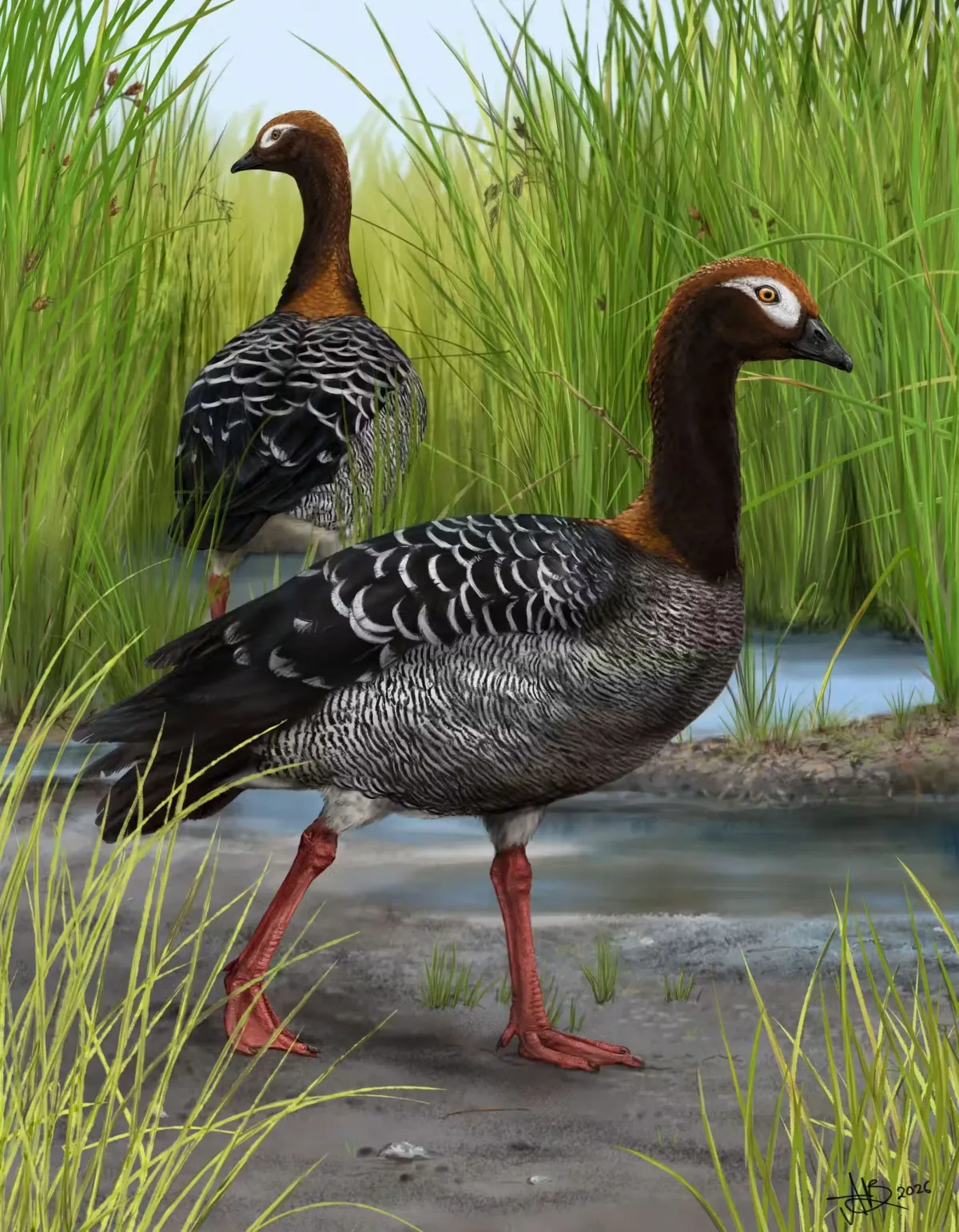
Metechen luti*). Artwork by Sasha Votyakova, © Te Papa CC BY 4.0*
Associate Professor Nic Rawlence from the University of Otago co-authored a paper about this fossil. The study, published in Historical Biology, involved researchers from Otago, Te Papa Museum, and the University of Cambridge. They analyzed fossils found near St Bathans.
A New Species from Ancient Mud
Researchers re-examined goose bones from the fossil beds. They compared these bones to other waterfowl fossils and many modern and ancient bird skeletons.
We're a new kind of news feed.
Regular news is designed to drain you. We're a non-profit built to restore you. Every story we publish is scored for impact, progress, and hope.
Start Your News DetoxThey found an unknown species, about the size of a small goose. The team named it Meterchen luti, or the St Bathans goose. Meterchen means "mother goose" in ancient Greek, and luti is Latin for "of the mud." This name refers to an ancient goose emerging from fossilized mud.
The St Bathans goose is not related to the giant flightless New Zealand geese (Cnemiornis species) that are now extinct. It is also not related to their Australian cousin, the Cape Barren goose.
New Ideas About Bird Evolution
This discovery, along with other genetic findings, shows that New Zealand's bird history was more complex than once thought. Many bird species arrived in New Zealand at different times. The ancestors of large birds like takahē, Forbes’ harrier, and the giant Haast’s eagle arrived surprisingly recently, within the last four to five million years.
Lead author Alan Tennyson from Te Papa explained an older theory. It suggested the St Bathans goose was a direct ancestor of the giant flightless Cnemiornis geese. This would mean a very long history of at least 14 million years in Zealandia.
However, this idea clashed with genetic evidence. That evidence suggested Cnemiornis ancestors came from Australia only about seven million years ago. The new research supports this later arrival theory.
Rapid Changes on Islands
Associate Professor Rawlence noted that the ancestors of the St Bathans goose arrived in Zealandia over 14 million years ago. But their lineage did not survive.
He explained that using DNA and fossils helps scientists understand how Zealandia's changing geology, climate, and human history shaped the evolution of its animals.
The recent evolution of the giant flightless Cnemiornis geese is a striking example. These geese grew to one meter tall and weighed up to 18 kilograms. This shows how quickly physical changes can happen on islands over a short time.
Deep Dive & References
A review of fossil goose (Aves: Anserinae) records from the Miocene St Bathans deposits, New Zealand, with the description of a new species - Historical Biology, 2026