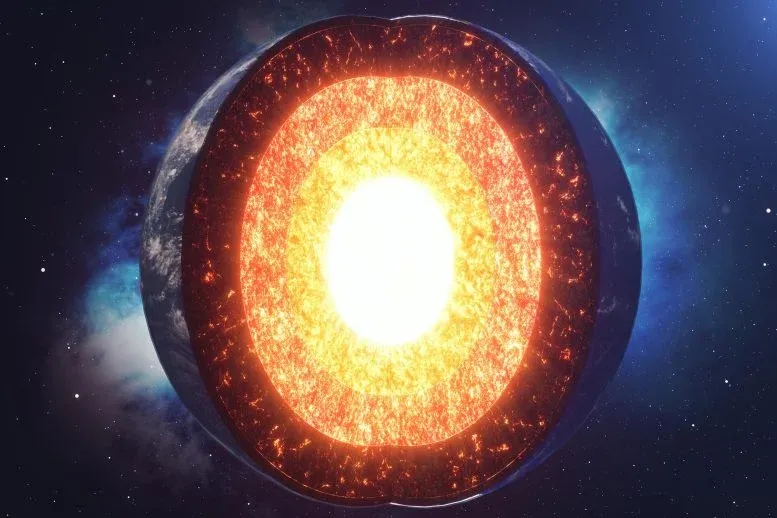
Imagine the very center of our planet. It’s a place of unimaginable pressure and heat, where the rules of matter start to get a little… weird. Scientists have long suspected that some materials down there might behave in ways we don't see anywhere else. Now, new experiments suggest that iron hydride, a key ingredient, can become "superionic."
What does superionic mean? Picture this: the iron atoms stay locked in a solid structure, but the hydrogen atoms within that structure start zipping around almost like a liquid. It's like a solid sponge that's somehow also a flowing river on the inside. This discovery offers some seriously cool clues about what Earth's deepest parts are made of and how they actually behave.
The Planet's Weirdest Jell-O
Earth's inner core is mostly iron, seasoned with a dash of lighter elements. For years, computer simulations have whispered that under the core's crushing conditions, alloys with hydrogen, oxygen, and carbon could become superionic. This would mean the heavier atoms (like iron) hold their ground, while the lighter ones flow freely through the solid framework.
We're a new kind of news feed.
Regular news is designed to drain you. We're a non-profit built to restore you. Every story we publish is scored for impact, progress, and hope.
Start Your News DetoxThis internal fluidity could also make the alloy softer, which might just solve a long-standing mystery: why seismic waves (the ones generated by earthquakes) travel unusually slowly through the inner core. Until now, this was mostly a theoretical hunch, a cosmic "what if?"
Enter the real-world experiment. Researchers at the Institute of Science Tokyo in Japan, including doctoral students Yoshihiro Nagaya and Yusuke Okazaki and Professor Kenji Ohta, have now delivered solid, undeniable proof. They showed that face-centered cubic (fcc) iron hydride (FeHX) indeed becomes superionic under the exact high-pressure and high-temperature conditions found in Earth's inner core. Their findings were published in Nature Geoscience, which, if you think about it, is both impressive and slightly terrifying.
Ohta noted that seeing this superionic state in iron-light-element alloys had been a white whale for scientists because it only exists under such extreme conditions. To catch a glimpse, they used time-resolved synchrotron X-ray diffraction (XRD) – basically, a super-powered X-ray camera that watches crystal lattices squish and heat up in real-time. They squeezed tiny samples of FeHX in a diamond-anvil cell to between 50 and 110 gigapascals (that's 500,000 to 1.1 million times atmospheric pressure) and then laser-heated them to over 2,000 Kelvin (about 3,140°F). Because apparently, that's where we are now.
Hydrogen: Trapped, But Still Zooming
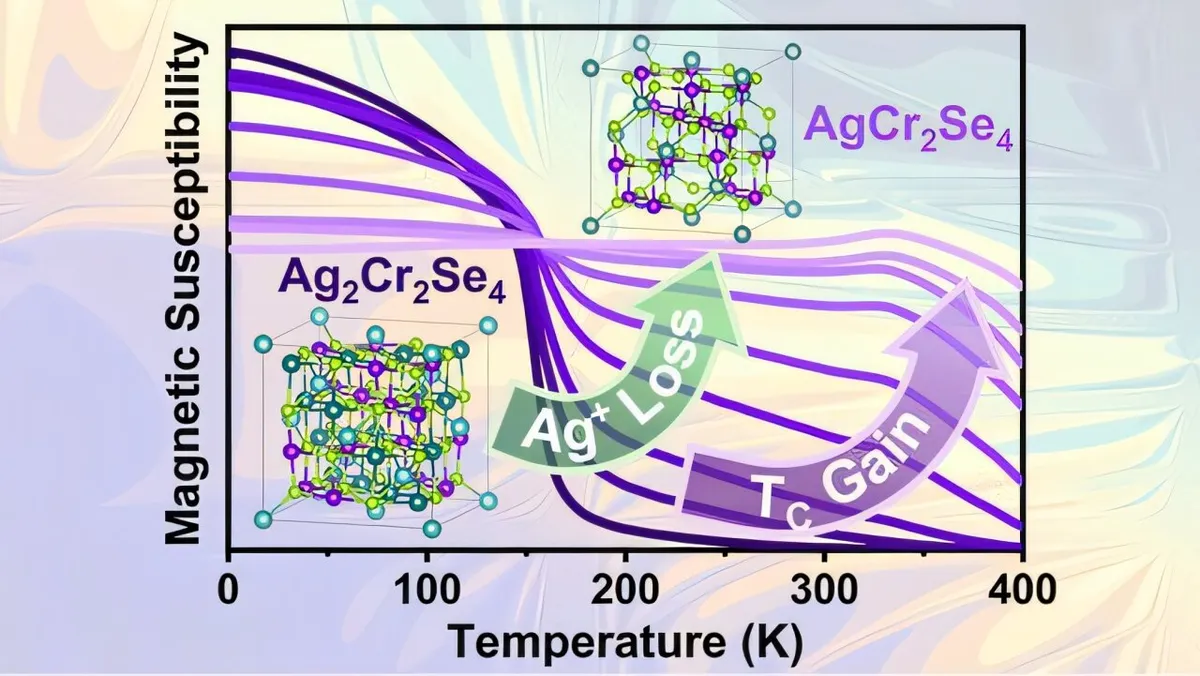
Around 1,590 Kelvin, the researchers observed a distinct λ-shaped anomaly in the thermal expansion coefficient – a fancy way of saying they saw a tell-tale wiggle that signals a phase transition, a signature seen in other superionic materials. When they extrapolated these findings to the actual pressures of Earth's inner core, the predicted transition temperature was well below the core's estimated heat. Translation: yes, FeHX could absolutely be superionic down there.
But did the hydrogen actually move? In a second set of experiments, they applied a constant voltage across the samples under high heat and pressure, then watched. They saw a sudden, undeniable change in the hydrogen content of the FeHX. After quickly cooling the material, they confirmed hydrogen had shifted along one direction, proving it had become incredibly mobile in its superionic state. It's moving at about 10³ µm²s⁻¹, which, for hydrogen, is practically a sprint.
Here's the kicker: even with this sharp increase in mobility, hydrogen's journey in the inner core would still be glacially slow. Researchers estimate Earth's geomagnetic field would only nudge hydrogen by about 0.1 micrometers over 10,000 years. At that rate, it would take more than 100 times Earth's current age for hydrogen to traverse the inner core's 1,200 km radius. So, any hydrogen trapped inside the core when the planet first formed is probably staying put for billions of years.
These experiments aren't just a cool party trick; they could fundamentally change how we understand the processes within Earth's core. They might even improve our models of how our planet formed and evolved. Ohta believes these findings will help explain those puzzling seismic-wave velocity anomalies and give us a clearer picture of Earth's deep, mysterious interior. Because apparently, the core has a lot more going on than just keeping us from floating off into space.