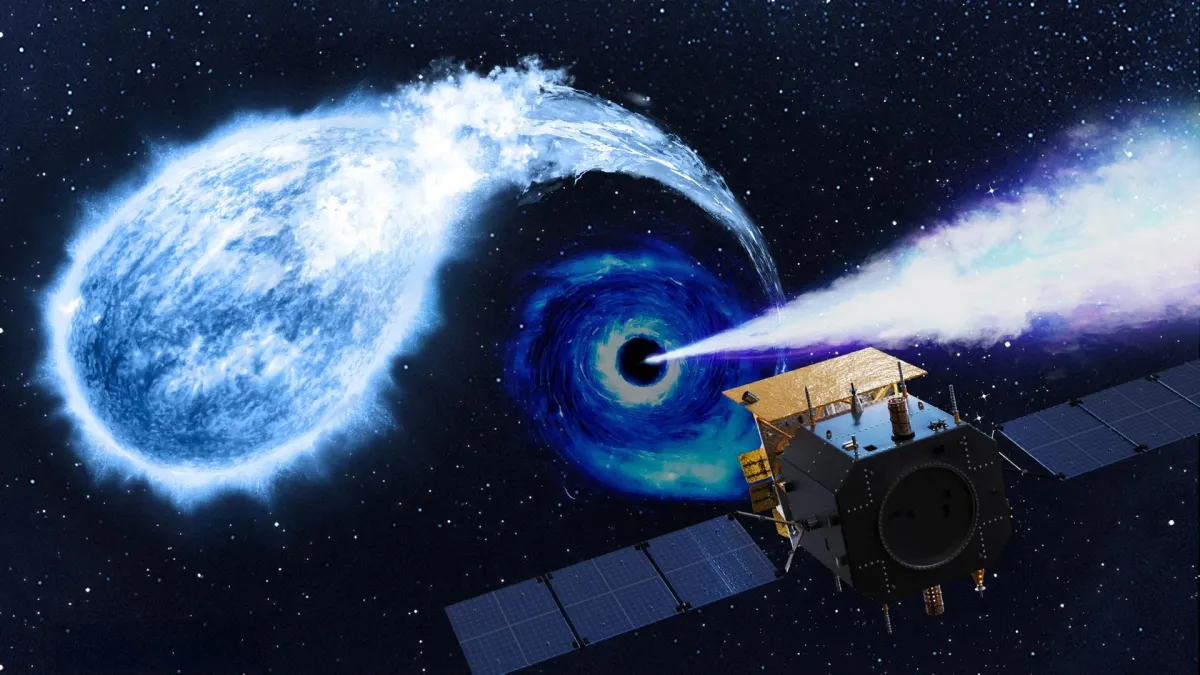
Imagine catching a cosmic mugging in progress. Not just the aftermath, but the whole chaotic scene, from the first ominous shadow to the final, fiery gulp. That's what astronomers think they just witnessed: a black hole, not content with merely existing, absolutely annihilating a star.
And not just any star, but a white dwarf — basically, a stellar zombie, the dense core left over after a star runs out of fuel. The culprit? An intermediate-mass black hole, a notoriously elusive type that's bigger than stellar black holes but smaller than the supermassive monsters at galactic centers. It's the Goldilocks of cosmic devourers, and this might be the first time we’ve seen one in action.
The Einstein Probe's Cosmic Paparazzi Moment
The whole dramatic event unfolded on July 2, 2025, when the China-led Einstein Probe (EP) space telescope, a wide-eyed sentinel constantly scanning the skies, picked up an unusually bright X-ray source. It wasn't just bright; it was changing fast, signaling something truly wild was happening.
We're a new kind of news feed.
Regular news is designed to drain you. We're a non-profit built to restore you. Every story we publish is scored for impact, progress, and hope.
Start Your News DetoxWhat followed was a global scramble, with observatories around the world dropping everything to point their instruments at this cosmic anomaly. Scientists from various institutions, including a key team from The University of Hong Kong, jumped into action.
Their conclusion, now published in Science Bulletin, is a doozy: an intermediate-mass black hole ripped a white dwarf star to shreds and then proceeded to eat it. If they're right, it's the first time we've had direct evidence of such a specific, brutal feeding frenzy.
The Einstein Probe actually has two X-ray instruments. Its Wide-field X-ray Telescope (WXT) first spotted the flickering X-ray source, charmingly named EP250702a (or GRB 250702B). Simultaneously, NASA's Fermi Gamma-ray Space Telescope picked up gamma-ray bursts from the same cosmic neighborhood. Which, if you think about it, is both impressive and slightly terrifying.
But the real kicker came when scientists dug into earlier WXT data. Turns out, the telescope had already seen a steady X-ray glow from that exact spot about a day before the gamma-ray bursts. This pre-show signal is like finding security footage of the villain casing the joint before the big heist. It's incredibly rare for these kinds of powerful cosmic explosions.
Then, about 15 hours after the initial detection, the source went supernova (metaphorically speaking) with intense X-ray flares, becoming one of the brightest outbursts ever recorded. Dr. Dongyue Li from the National Astronomical Observatories of China pointed out that this early X-ray signal confirms this wasn't just your garden-variety gamma-ray burst. This was something far more...personal.
A Star's Last Light
With WXT providing a precise location, astronomers quickly aimed other major telescopes at the source, confirming its location on the outskirts of a distant galaxy. The Einstein Probe's second instrument, the Follow-up X-ray Telescope (FXT), then settled in to watch the cosmic drama unfold.
Over the next 20 days, the object's brightness plummeted by over 100,000 times. Its X-ray light also shifted from higher-energy "hard" X-rays to lower-energy "soft" ones, like a dying ember changing color.
When researchers crunched all the data, EP250702a defied easy explanation. The X-ray emission before the gamma-ray burst, the insane brightness, the rapid fade, and its location far from the galactic center — this combination just doesn't fit neatly into existing models of cosmic explosions. Most high-energy events happen closer to the bustling galactic core, where the action is.
After ruling out pretty much everything else, the only explanation left standing was an intermediate-mass black hole performing a stellar tidal disruption event — essentially, ripping a white dwarf apart with its immense gravity and then, well, having it for lunch. Let's hope the white dwarf didn't suffer too much.
It's a stark reminder that even the "dead" stars aren't safe in the cosmic wilds. And that sometimes, the universe offers up a show so spectacular, you just have to stop and stare.