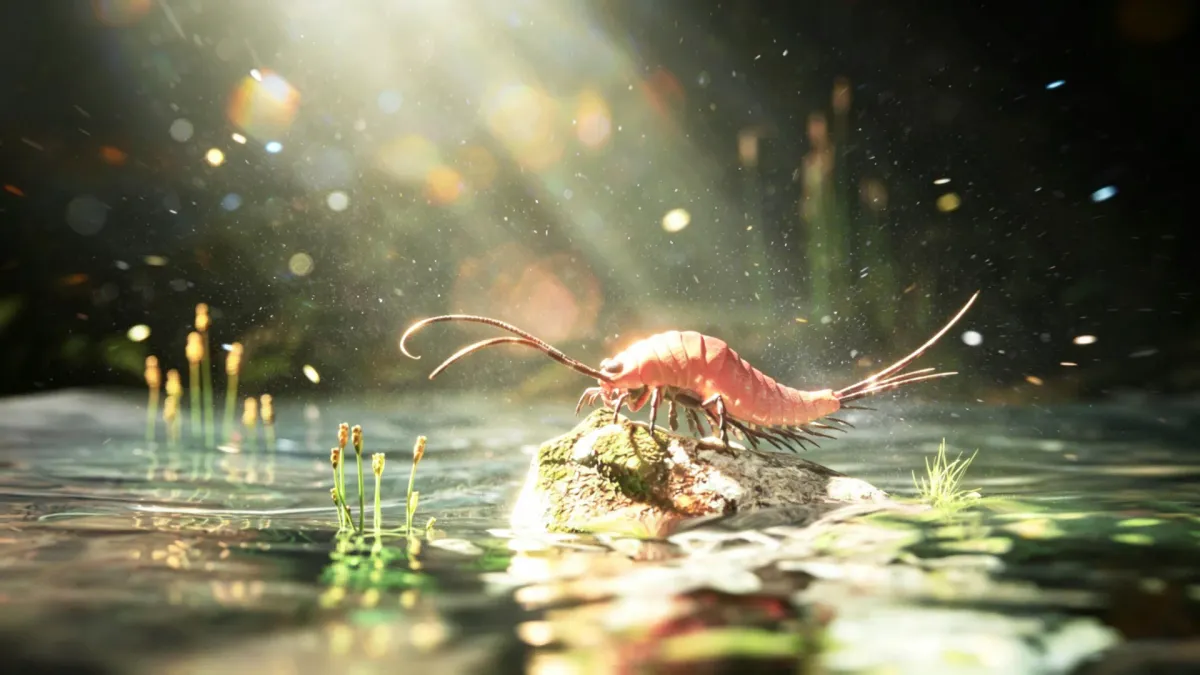
Before insects flew and spread across land, some of their ancestors might have swum in shallow coastal waters. They would have used rows of paddle-shaped limbs on their bellies.
Today, insects live almost everywhere on land. They make up more known species than any other animal group. Their success helped change early land ecosystems. They moved nutrients, broke down dead plants, and formed complex relationships with plants. But it has been hard to trace how they became so successful because early insect fossils are rare.
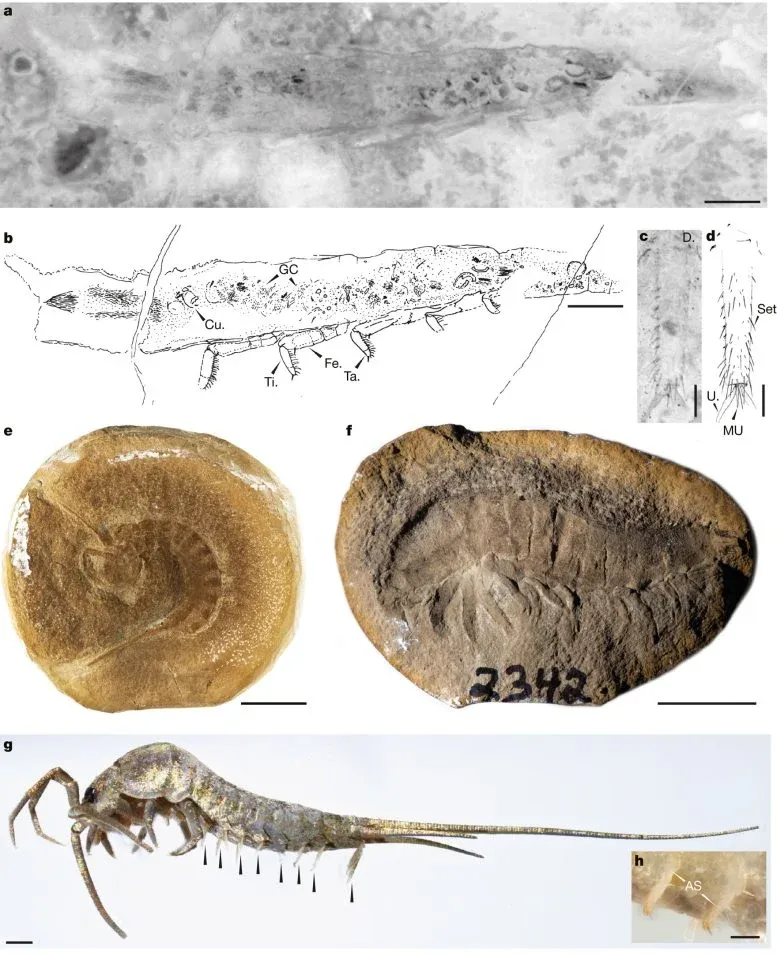
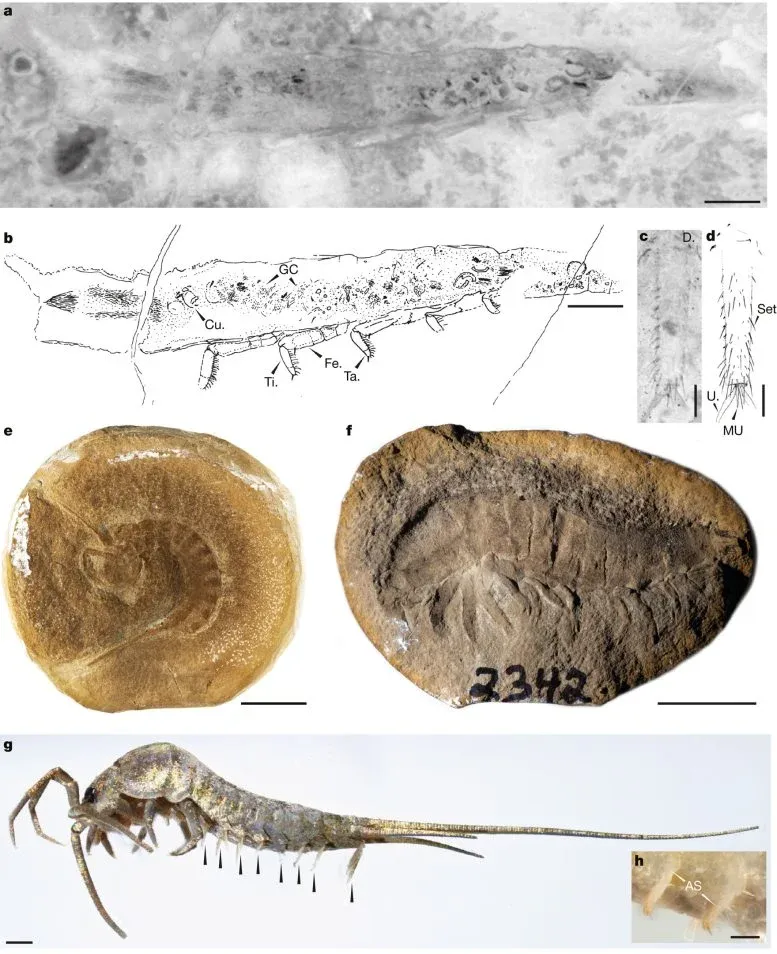
A new species found in western Texas offers a rare look into this missing history. The animal is called Chosha praecursor. It lived about 324 million years ago. It had the key features of an insect but also paddle-shaped limbs on its belly, perfect for water.
We're a new kind of news feed.
Regular news is designed to drain you. We're a non-profit built to restore you. Every story we publish is scored for impact, progress, and hope.
Start Your News DetoxThese fossils suggest that insects did not just move onto land all at once. Instead, they had a long stage where they lived both in water and on land. Early insects seem to have kept, changed, and slowly lost body parts from their water-dwelling ancestors as they adapted to humid places between water and land.
A Rare Fossil Changes Insect History
Chenyang Cai from the Nanjing Institute of Geology and Paleontology led this study. Erik Tihelka, a Ph.D. student at the University of Cambridge, also led the work. The team included researchers from the United States, Spain, and other countries. Their findings were published in Nature.
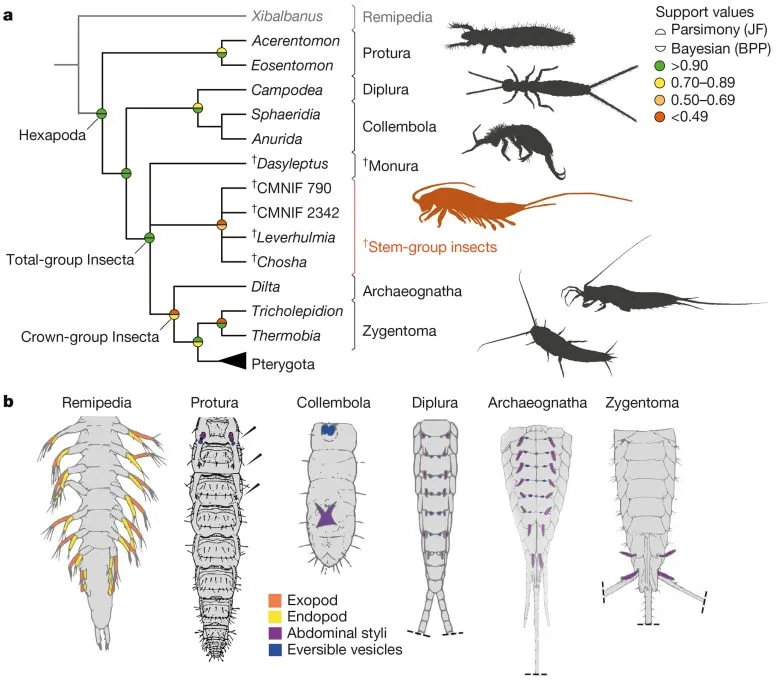
The researchers did more than just describe C. praecursor. They compared it to other mysterious hexapod fossils. These included material from Britain's Early Devonian chert and the Late Carboniferous Mazon Creek in the United States. This wider analysis helped them find a primitive group of stem insects that had not been noticed before.
Stem insects are not modern insects, but they are more closely related to living insects than to other animals. Fossils from this part of the evolutionary tree can show a mix of old and new traits that later disappeared. This makes them very important for understanding how the familiar insect body evolved.
Bridging an 80-Million-Year Gap
Genetic studies suggest that hexapods separated from their marine crustacean relatives. They began adapting to land between the Cambrian and Ordovician periods. However, the oldest clear hexapod fossils are from Scotland's Rhynie Chert, dating back about 405 million years. Clear insects do not become common until the Late Carboniferous. This leaves about 80 million years of their early history with few fossils.
This gap has made it hard to know when insects got their six-legged body plan. It is also unclear when they lost their ancestors' swimming limbs and became fully terrestrial. This also creates a difference between genetic estimates, which suggest insects appeared earlier, and the fossil record, which shows them much later.
By identifying Leverhulmia from Early Devonian Scotland, an unnamed hexapod from Mazon Creek, Illinois, and C. praecursor as part of the same primitive group, researchers pushed back early insect diversification to the Early Devonian. These fossils together form the oldest known insect group. They help bring the fossil record closer to what genetic studies suggest.
An Insect for Both Water and Land
The C. praecursor fossils were found in claystone concretions in the Tesnus Formation of western Texas. These concretions can form around buried organisms. They protect delicate structures from being crushed or decaying. This explains why the fossils are so well preserved.
Researchers used cross-polarized light imaging to study details that had been missed before. The specimens were thought to be crustacean larvae. But the new analysis showed they were adult female stick insects.
Their bodies were about 32 millimeters (1.26 inches) long. With a tail filament and two cerci, they reached about 49.66 millimeters (1.96 inches). They had a segmented body, six walking legs, an ovipositor (for laying eggs), and a tail filament. These features combined traits of insects and hexapods with older characteristics.
The most interesting parts were on the abdomen. Segments one through nine had jointed appendages. Those toward the back were broad and paddle-shaped. No living insect today has similar abdominal appendages. Some aquatic insect larvae have different structures for swimming or breathing.
Life on a Paleozoic Coast
Geological evidence shows that C. praecursor lived in a shallow delta near an ancient coastline. Its paddles would have been useful in water. Its six legs and more insect-like body could have helped it move through wet shoreline areas. So, the animal was not just aquatic or terrestrial. It was adapted to the boundary between the two.
This amphibious lifestyle offers a likely intermediate step in insects moving onto land. Instead of leaving water quickly, early insects may have spent millions of years in marshes, deltas, damp soils, and other wet places. In these areas, both water and land adaptations were useful.
These animals likely ate humus, decaying plants, and fungal spores. By feeding on organic debris, they acted as consumers and decomposers. They returned nutrients to environments that were still developing into complex land ecosystems.
How Insects Lost Their Extra Limbs
Modern hexapods have six walking legs, all on their thorax. Their abdomen has lost almost all the limb structures found in their crustacean relatives. The Texas fossils show that this change happened slowly. Early stem insects could keep a full set of segmented abdominal appendages even after getting other insect traits.
As insect ancestors relied less on swimming, their abdominal limbs got smaller. Losing these limbs may have made moving on land more efficient. It also freed up abdominal segments for other uses. This led to the distinct insect body we see today. The thorax is for movement, and the abdomen is mainly for digestion, reproduction, and other internal processes.
The preserved ovipositor adds another important detail. C. praecursor shows that specialized egg-laying structures appeared early in insects. The ability to lay eggs in protected or resource-rich places may have later helped insects colonize many land microhabitats. This also contributed to their huge diversity.
An Amphibious Path to Insect Success
These fossils challenge the idea that insects moved from sea to land in a simple way. Water-based structures remained useful long after the basic insect body appeared. They then changed or disappeared as these animals became more independent of water.
This gradual change also helps explain how insects could be part of land ecosystems before becoming fully terrestrial. Living along the edges of ponds, deltas, and coastlines would have allowed early insects to process organic material from both environments. They also adapted to new food sources and ecological chances.
Deep Dive & References
Amphibious stem-insect sheds light on colonization of land - Nature, 2026