For nearly two decades, a cosmic explosion known as GRB 061201 was the universe's most perplexing party pooper. When this gamma-ray burst flashed in 2006, its energy output just didn't make sense compared to its rowdier siblings. It was like finding a tiny firecracker that somehow blew up a skyscraper. Scientists scratched their heads. And then, the James Webb Space Telescope showed up.
Gamma-ray bursts (GRBs) are basically the universe's mic drops — some of the most powerful events out there. Short GRBs usually mean two super-dense objects, like neutron stars or a neutron star and a black hole, just had a very bad day and collided. But GRB 061201 was a special kind of problem child: it was "hostless." Its fading glow was spotted, but no galaxy could be found nearby. Without a home galaxy, astronomers couldn't figure out its true distance, which meant they couldn't calculate its actual energy. It was like trying to guess a car's speed without knowing if it was a toy car or a Ferrari.
The Case of the Missing Galaxy
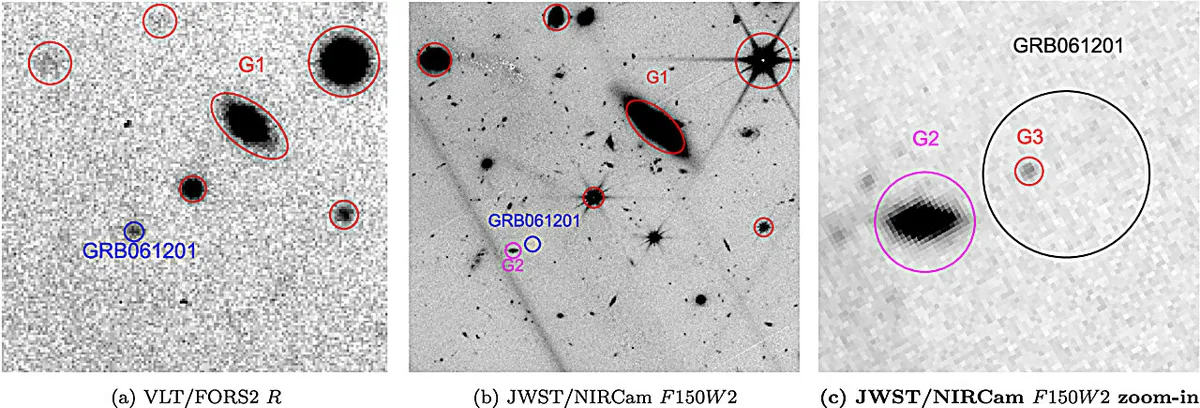
The prevailing theories were a cosmic shrug. Either it happened in a relatively nearby galaxy (G1) and had an absurdly narrow jet of energy (which defied everything we knew about these things), or its real home was just too faint and too far away for our telescopes to spot. The nearby idea was especially problematic, suggesting these massive mergers were happening way more often than gravitational-wave detectors had ever indicated. Something was off.
We're a new kind of news feed.
Regular news is designed to drain you. We're a non-profit built to restore you. Every story we publish is scored for impact, progress, and hope.
Start Your News DetoxEnter the new study, led by Yuhan Mao from the Purple Mountain Observatory. They decided to throw the big guns at the problem: images from the James Webb Space Telescope, combined with Hubble's data. They painstakingly scoured the same patch of sky where GRB 061201 had made its grand, confusing entrance.
And there it was. A very faint galaxy, previously unseen, dubbed G2, lurking incredibly close to the burst's original location. They also spotted an even fainter object, G3. By analyzing G2's brightness across different wavelengths, they estimated its redshift to be around z = 1.2. This number, if you're keeping score, perfectly matched earlier, theoretical estimates of the burst's distance. Let that satisfying number sink in.
To ensure G2 wasn't just some random galaxy photo-bombing the shot, the team ran statistical tests. The odds of G2 being a coincidence? A respectable 18%. G3, however, had a 43% chance of being a cosmic red herring and its colors suggested it was far too distant to be the culprit. G2 was looking good.
With G2 as the likely host, everything clicked into place. The burst's energy output suddenly fit known patterns. The way its afterglow behaved made sense. Even the implied rate of neutron star mergers aligned beautifully with what gravitational-wave observatories have detected. The researchers concluded that the "z = 1.2 high-redshift origin emerges as the most self-consistent physical framework for GRB 061201." Basically, the universe finally made sense again.
They still need a direct measurement of G2's distance to fully confirm it, but for now, a 20-year-old cosmic cold case looks like it's finally been cracked. All it took was a little patience and the universe's most powerful new eye.