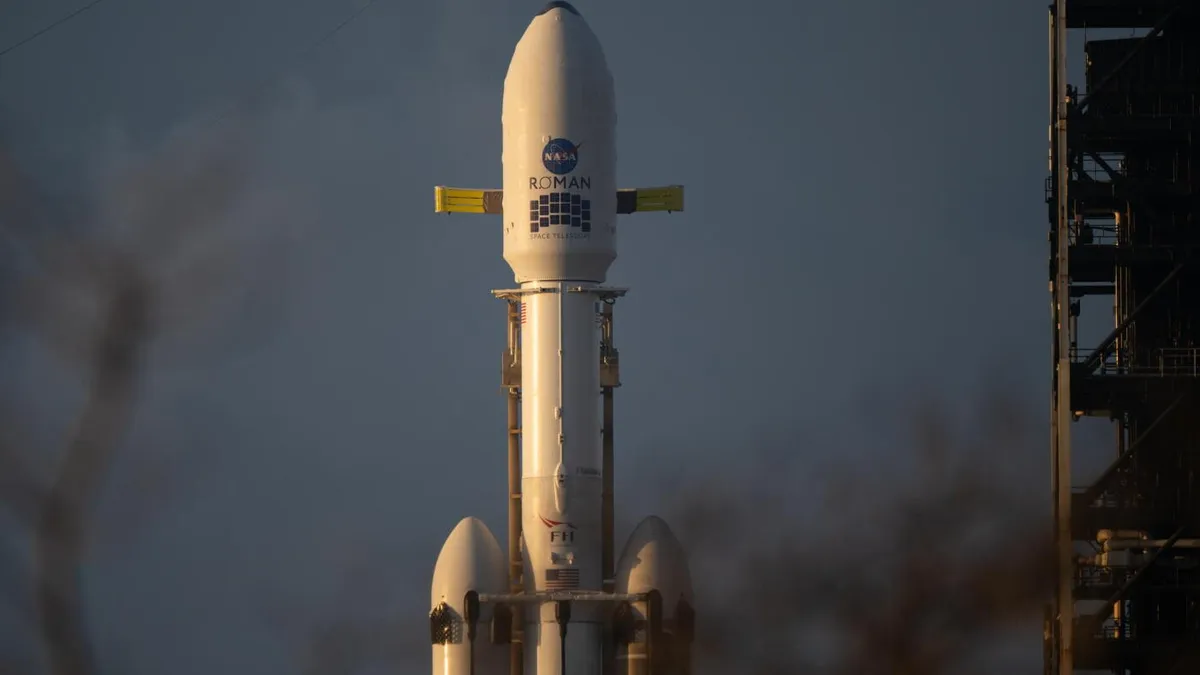
NASA's newest eye on the cosmos, the Nancy Grace Roman Space Telescope, just blasted off from Florida's Kennedy Space Center. Carried by a SpaceX Falcon Heavy rocket, the launch happened Sunday at 7:26 a.m. ET, sending a bus-sized, 18,000-pound marvel on a million-mile journey.
Its mission? To untangle the universe's biggest head-scratchers: dark matter, dark energy, and a few hundred thousand new planets.
The Mother of Hubble's New Ride
Roman is headed for the L2 Lagrange point, a sweet spot in space a million miles from Earth where it can orbit steadily with minimal fuel, getting an unblocked view of the universe. It's the same neighborhood the James Webb Space Telescope calls home.
We're a new kind of news feed.
Regular news is designed to drain you. We're a non-profit built to restore you. Every story we publish is scored for impact, progress, and hope.
Start Your News DetoxThe trip will take over three months, during which scientists will be "kicking the tires," as integration and test scientist Jeremy Perkins put it. They'll be ensuring everything, from focus to pointing, is perfectly calibrated before Roman gets to work.
Named after Nancy Grace Roman, NASA's first chief astronomer and the "Mother of Hubble," this new telescope shares Hubble's legendary sharp vision. But here's the kicker: Roman's field of view is 100 times larger. Imagine going from a peephole to a panoramic window, all while maintaining the same clarity. That's Roman.
Cosmic Mysteries, Meet Your Match
Roman's main gig is to hunt for more clues about dark matter, the invisible stuff that holds galaxies together. It'll map how gravity bends light across huge swathes of the sky, helping us finally get a handle on this elusive cosmic glue.
Then there's dark energy, the mysterious force accelerating the universe's expansion. Roman will track Type Ia supernovas – exploding stars with a known brightness – to measure how fast the universe is really stretching. Finding more of these "standard candles" could completely rewrite our understanding of the universe's ultimate fate.
And because apparently that wasn't enough, Roman will also be a prolific planet hunter. Since the 1990s, we've found over 6,000 exoplanets. Roman is expected to boost that number by at least 100,000, by looking for tiny dips in starlight as planets pass by. It'll also use a technique called microlensing, detecting subtle shifts in background starlight caused by a distant planet's gravity, to find another 1,000 or so. Plus, it's testing tech to directly image planets by blocking out their stars.
A Flood of Cosmic Gold
This cosmic powerhouse will beam back 1.4 terabytes of raw science data every single day via a high-gain antenna. And here’s the truly wild part: that data will be immediately available to scientists and the public through a cloud-based system called Roman Nexus.
Perkins noted that after its five-year mission, Roman's database will be larger than a standard music streaming platform. He's particularly excited that anyone, anywhere, can dive into this raw data and potentially uncover the next big cosmic secret. Because, as he says, there will be "all these one-in-a-million things that we're going to be able to see with Roman."
Which, if you think about it, is both impressive and slightly terrifying.