For a while now, scientists have been trying to figure out how to make electronics even smaller, even faster, and generally just more… sci-fi. One of the contenders in this race for tiny tech? Magnetic waves, affectionately known as magnons.
Think of them as the whisper network of the atomic world. Instead of pushing electrons around, which is what your phone does, magnons carry information using the tiny magnetic 'spins' within a material. It's a bit like passing a secret note through a crowd by subtly nudging the person next to you, who nudges the next, and so on. No one has to actually move much, but the message still travels.
The holy grail has been getting these magnons to generate their own rhythm, without constantly being told what to do, and then making them listen to an outside signal. Because apparently that’s where we are now: teaching magnetic waves to be both independent and responsive. Which, if you think about it, is both impressive and slightly terrifying.
We're a new kind of news feed.
Regular news is designed to drain you. We're a non-profit built to restore you. Every story we publish is scored for impact, progress, and hope.
Start Your News DetoxThe Magnetic Maestro
Previous attempts to get magnons to create their own beat were a bit like trying to herd cats — either their rhythm was tied directly to a constant instruction, or they were free-spirited but completely unpredictable. Not exactly ideal for building reliable circuits.
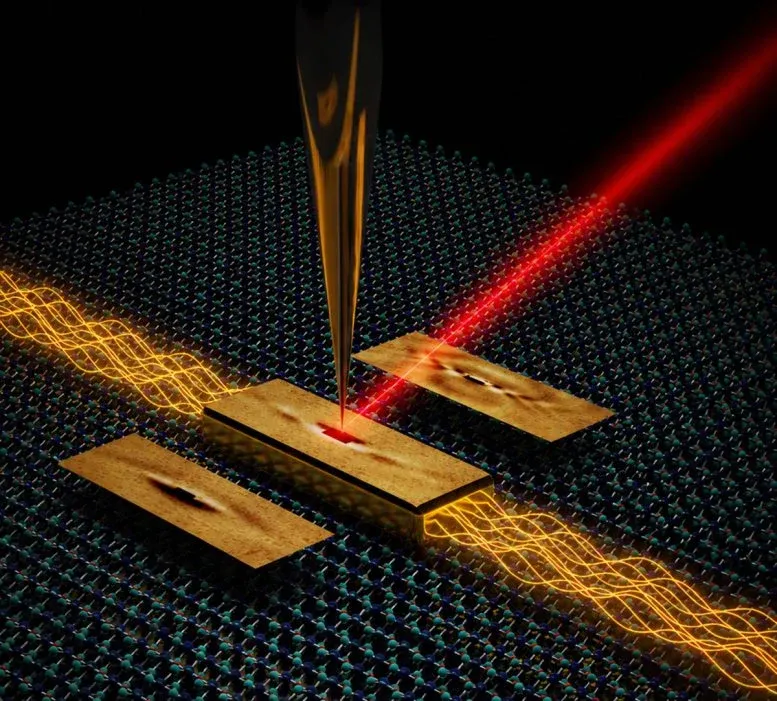
Enter a team of researchers who decided to try 'parametric pumping.' Sounds a bit like a new workout craze, but it’s actually a way to inject energy into these magnetic waves using an outside microwave signal. They built a device with a thin strip of yttrium iron garnet (YIG) – a fancy crystal – and two tiny antennas. The antennas would launch the spin waves and also listen to them.
They then cranked up the microwave pump just enough to trigger something called four-wave mixing. In human terms, two 'pump' magnons high-fived and, in doing so, created two new waves: a spontaneous magnon (the one they wanted) and an 'idler' mode (its less interesting companion). At a specific magnetic field, a 5.53-GHz pump created a spontaneous magnon at 5.766 GHz. Let that satisfying number sink in.
The truly wild part? This spontaneous wave was incredibly sharp and clear, oscillating with an unusual precision. And they could actually tune its frequency just by adjusting the pump. It’s like having a tiny, invisible radio station that can change its own channel on command.
Learning to Listen
But here’s the real mic drop: after getting this magnon to dance to its own beat, the researchers introduced a separate signal. And the spontaneous oscillation didn't just ignore it; it 'phase-locked' to it. Meaning, its independent rhythm synced up perfectly with the outside signal. It learned to listen.
This isn't just a parlor trick. It means these self-generating magnetic waves can now be controlled and used for advanced information processing, especially for things that rely on perfect synchronization. They even found that this spontaneous magnon could act as an amplifier, boosting signals by a whopping 40 decibels.
All of this happened at room temperature, by the way, not in some super-cooled lab. So while it’s not a quantum computer (yet), it’s a massive leap in understanding how to control magnetic dynamics for future low-power microwave tech and, yes, potentially even smaller quantum hardware. The immediate takeaway? Scientists just gave magnetic waves their own internal clock, and then taught them how to tell time with everyone else. Your phone just got a glimpse into its future, and it’s looking very magnetic.