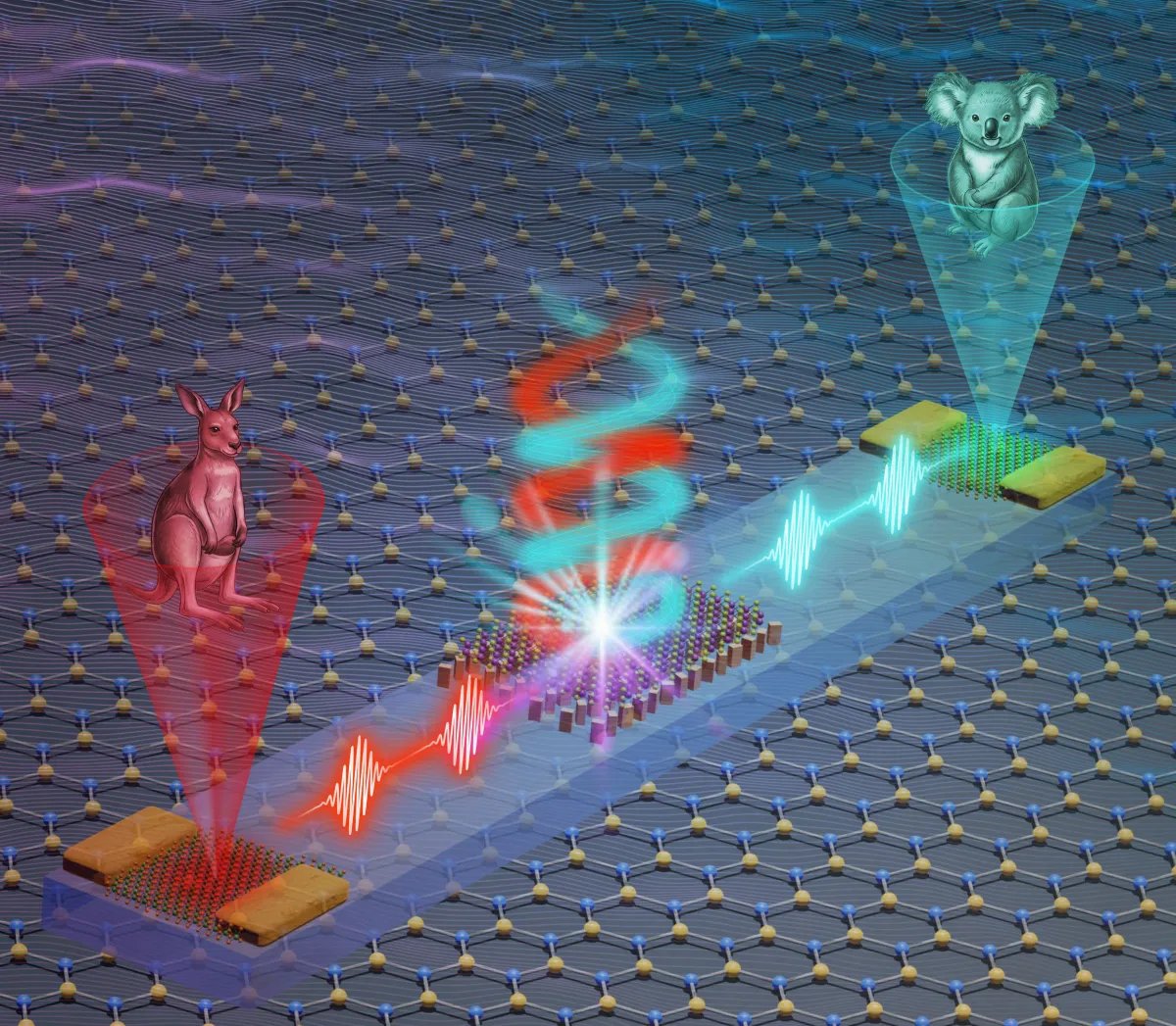
Imagine a quantum computer. Now imagine it shrinking from a room-filling behemoth to something that could fit on a penny. Scientists just made a rather significant leap towards that reality, thanks to a breakthrough with tiny magnetic waves called magnons.
These magnons are essentially ripples in magnetic materials, like waves in a pond, but far more industrious. Unlike photons, which zip through empty space, magnons live in solids. And here's the kicker: they can have incredibly small wavelengths, meaning circuits built with them could be as tiny as the chips in your smartphone. Plus, they play nice with other particles, making them prime candidates for quantum systems.
The catch? Magnons have always had the attention span of a goldfish. They could only hold quantum information for a few hundred nanoseconds — not exactly ideal for any serious quantum computation.
We're a new kind of news feed.
Regular news is designed to drain you. We're a non-profit built to restore you. Every story we publish is scored for impact, progress, and hope.
Start Your News DetoxThe Magnon Lifespan Extravaganza
Enter the physicists at the University of Vienna, who just pulled off a magic trick. They managed to extend magnon lifetimes to an astonishing 18 microseconds. That's nearly 100 times longer than previous records. Let that satisfying number sink in.
This isn't just a minor improvement; it's a game-changer. An 18-microsecond magnon could reliably carry quantum information, potentially rivaling the superconducting qubits currently powering today's quantum processors. The team published their findings in Science Advances, which, if you think about it, is both impressive and slightly terrifying.
How'd they do it? Two main moves. First, they conjured up short-wavelength magnons, which are less bothered by pesky flaws on crystal surfaces (the usual culprits for magnon demise). Second, they chilled super-pure spheres of yttrium iron garnet (YIG) to a bone-chilling 30 millikelvin. That's practically absolute zero, a temperature so low it stops the heat processes that typically wreck magnons.
Turns out, the remaining limit on magnon longevity comes down to microscopic impurities in the crystal itself. The purer the material, the longer the magnons lasted. Even their least pure sample set a new record, which suggests future advancements hinge more on better materials than on discovering new physics. Because apparently that's where we are now.
Penny-Sized Quantum Future?
An 18-microsecond magnon lifespan could transform these magnetic waves into robust quantum memories and efficient on-chip communication channels. They could act as a kind of "quantum bus," connecting hundreds of qubits and paving the way for truly scalable quantum computers.
And because magnons live in solid materials and can interact with various quantum systems, they could also become "universal translators." This means different quantum technologies, which normally can't speak the same language, could finally chat. Suddenly, that penny-sized quantum computer doesn't seem so far-fetched after all.