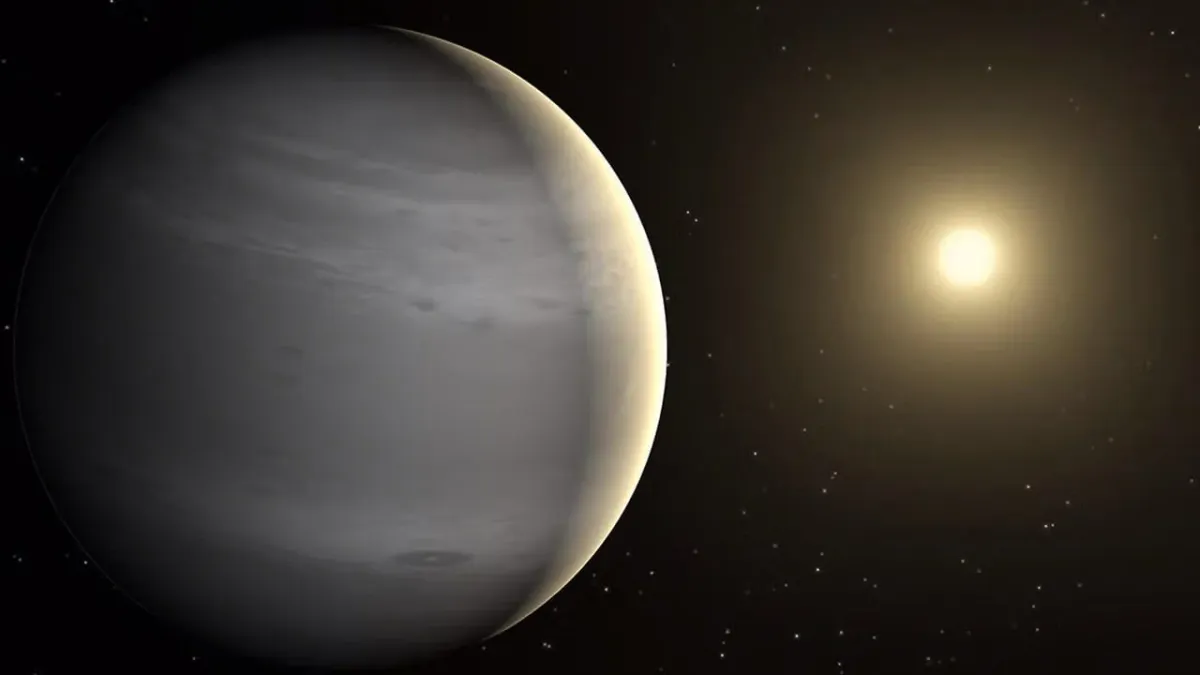
Most giant planets in the cosmos are either scorching hot or bone-chillingly cold. Think Jupiter, but on steroids, or a planet orbiting so close to its star it’s basically a cosmic barbecue. But then there’s TOI-199b, a planet that apparently didn’t get the memo.
NASA’s James Webb Space Telescope recently spotted this Saturn-sized world, and it’s a bit of an anomaly. Scientists are calling it a "temperate giant planet" because, get this, its temperatures are remarkably Earth-like. And it’s got methane in its atmosphere. Which, if you think about it, is both impressive and slightly terrifying.
This isn't just some random space rock. TOI-199b is part of a tiny, exclusive club of known worlds that aren't extreme. And this is the first time anyone has managed to peek into the atmosphere of such a mild-mannered giant planet in such detail. Basically, it's the Goldilocks of gas giants, and someone finally got to taste its porridge.
We're a new kind of news feed.
Regular news is designed to drain you. We're a non-profit built to restore you. Every story we publish is scored for impact, progress, and hope.
Start Your News DetoxThe findings, led by a team from Penn State and NASA's Jet Propulsion Laboratory (JPL), were published in The Astronomical Journal. They’re hoping this discovery will help fine-tune our computer models of how planets and atmospheres form and evolve – perhaps even shedding some light on our own little blue marble.
Not Too Hot, Not Too Cold
TOI-199b zips around its star, located over 330 light-years away, completing an orbit in about 100 days. Its estimated temperature hovers around 175 degrees Fahrenheit. While that might sound like a bad hair day for us humans, it's positively balmy compared to the superheated "hot Jupiters" that usually hog the astronomical headlines. Researchers noted it’s akin to the inside of a car parked in direct sunlight on Earth. Cozy.
So, it’s warmer than our solar system’s chilly gas giants, but nowhere near the inferno of its more extreme cousins. It’s just right. Which, for a planet that’s essentially a massive ball of gas, is quite the flex.
How Webb Sniffed Out the Methane
To figure out what TOI-199b’s atmosphere was made of, astronomers employed a technique called transmission spectroscopy. It’s less complicated than it sounds. When the planet passes in front of its star (an event called a transit), the Webb Telescope measures how the starlight changes as it filters through the planet's atmosphere.
Think of it like this: the telescope acts as a super-sensitive prism, splitting the starlight into a rainbow of wavelengths. As the starlight interacts with different gases in the planet's atmosphere, certain wavelengths get absorbed. This leaves a unique "fingerprint" in the light spectrum, telling scientists exactly what chemicals are present.
Aaron Bello-Arufe, a researcher at JPL, explained that they first watched the star for 20 hours to get a baseline. Then, the planet’s transit, which lasted a hefty seven hours (much longer than those speedy hot Jupiters), allowed them to compare the light. The differences screamed "methane!" — a prediction that models had made for temperate gas giants, now gloriously confirmed.
The observations also hinted at the presence of ammonia and carbon dioxide. More observations could nail down the exact quantities of these gases, giving us an even clearer picture of this surprisingly chill giant. And who knows, maybe understanding TOI-199b will help us understand why Earth isn't just a giant ball of methane.
This discovery opens the door for more deep dives into similar planets. Because if there’s one Goldilocks out there, there might be others. And we'd like to know if they also prefer their porridge just right.