Our star, the sun, is apparently having a bit of a mid-life crisis. Or, at the very least, a significant internal reorganization. New research suggests the sun's magnetic activity – the stuff that causes all those dramatic solar flares and space weather – is getting squished into a much shallower layer beneath its surface.
Think of it this way: the sun's internal "biorhythm" is shifting, and it's becoming more skin-deep with each passing solar cycle. An international team, led by the University of Birmingham, just dropped these findings in Monthly Notices of the Royal Astronomical Society, and it points to some long-term changes in how our most important star behaves.
The Sun's Secret Soundtrack
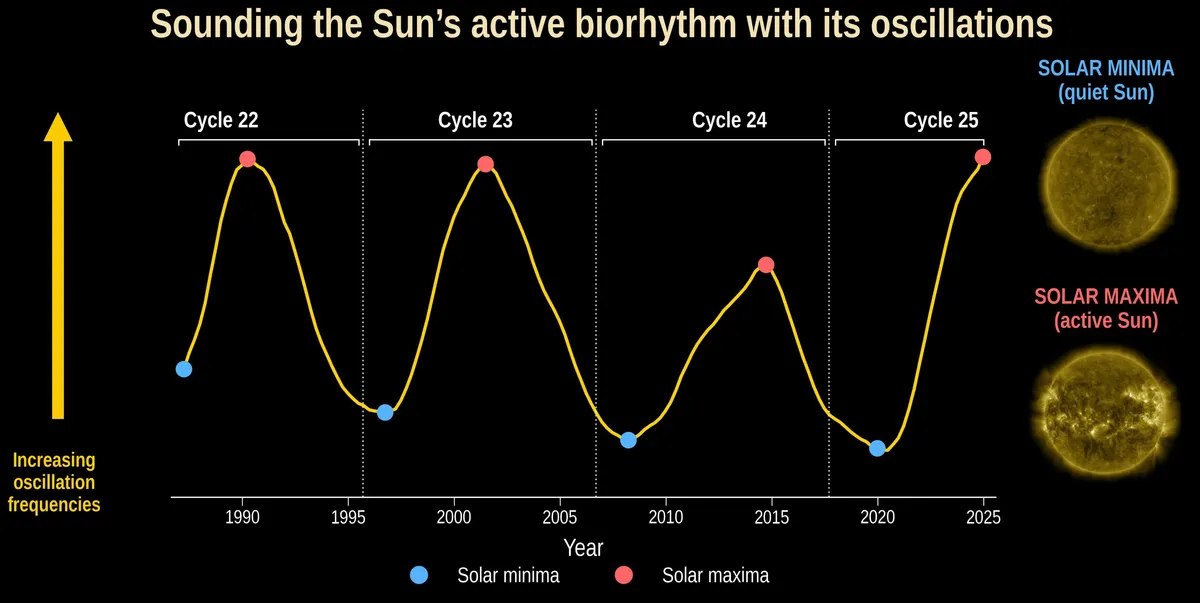
We all know the sun has an 11-year activity cycle. It's the reason we get solar flares, charged particle ejections, and the occasional space weather event that can mess with satellites, GPS, and even power grids back on Earth. Understanding this cycle is pretty crucial if we want to avoid future disruptions.
We're a new kind of news feed.
Regular news is designed to drain you. We're a non-profit built to restore you. Every story we publish is scored for impact, progress, and hope.
Start Your News DetoxTraditionally, scientists track these cycles by looking at sunspots and other surface shenanigans. But that's like judging a book by its cover – it doesn't tell you what's going on inside. Enter helioseismology, the scientific equivalent of putting a stethoscope to the sun. Scientists "listen" to tiny sound waves rippling through its interior, which allows them to peek beneath the surface.
Using nearly 40 years of helioseismic data from six telescopes in the Birmingham Solar Oscillations Network (BiSON), the team found a gradual, undeniable change in the sun's structure. This shift has been happening over several cycles, and the current Solar Cycle 25 is really leaning into it.
Professor Bill Chaplin, the lead author, noted this is the first discovery of its kind. He explained that the sun's magnetic activity is becoming progressively more confined closer to the surface with each cycle. Which, if you think about it, is both impressive and slightly terrifying.
What the Waves Are Whispering
The researchers focused on "p-mode oscillations" – basically, global sound waves inside the sun. The frequencies of these waves change with magnetic activity, giving scientists a sort of internal barometer. By tracking these frequency shifts from 1987 all the way to 2025, they could see how the sun's guts were changing.
They grouped these oscillations into different frequency bands to explore various depths, then compared them to traditional measures of solar activity. What they found was pretty stark:
- Changing Behavior: The relationship between these internal sound waves and surface activity has dramatically changed since Cycle 23. This isn't just a blip; it suggests a deep, evolving process within the sun.
- Surface Confinement: Those structural changes driven by the solar cycle? They're increasingly getting crammed into a shallow layer, only about 1,000 kilometers (roughly 620 miles) from the sun's visible surface. That's like the sun deciding to keep all its secrets just under its skin.
- Reinterpreting Cycle Strength: Traditional methods might make Cycle 25 look a bit weak. But when you listen to the high-frequency helioseismic data, it actually looks comparably strong. So, maybe it's not weaker, just... different.
Professor Sarbani Basu from Yale University summed it up: the sun is undergoing a "structural reorganization" of how its magnetic activity is stored. It's like the sun is moving all its furniture around, and we're just now noticing the new layout.
Continued data from BiSON will hopefully tell us if this is a temporary redecorating project or a permanent shift in our star's magnetic personality.