NASA's Lucy mission found that asteroid Donaldjohanson is a wobbling, peanut-shaped space rock. Sunlight has gradually changed its rotation for millions of years. The asteroid also shows signs that liquid water briefly existed on its parent body. This offers new clues about how the solar system first formed.
Even a small asteroid can have a dramatic past. Lucy's close flyby of Donaldjohanson revealed an oddly shaped world. It wobbles through space and has scars from an ancient crash. It also holds evidence that liquid water was present on its parent body long ago.
The asteroid formed about 155 million years ago. This happened when pieces from a violent impact slowly came back together. Since then, sunlight has slowly changed its spin. This subtle but powerful process leaves clues about its long history.
We're a new kind of news feed.
Regular news is designed to drain you. We're a non-profit built to restore you. Every story we publish is scored for impact, progress, and hope.
Start Your News DetoxLucy's Visit to Donaldjohanson
On April 20, 2025, Lucy flew within 650 miles of Donaldjohanson. This happened while the spacecraft traveled through the main asteroid belt. It was on its way to the Jupiter Trojan asteroids. Lucy took the first detailed pictures and measurements of this asteroid.
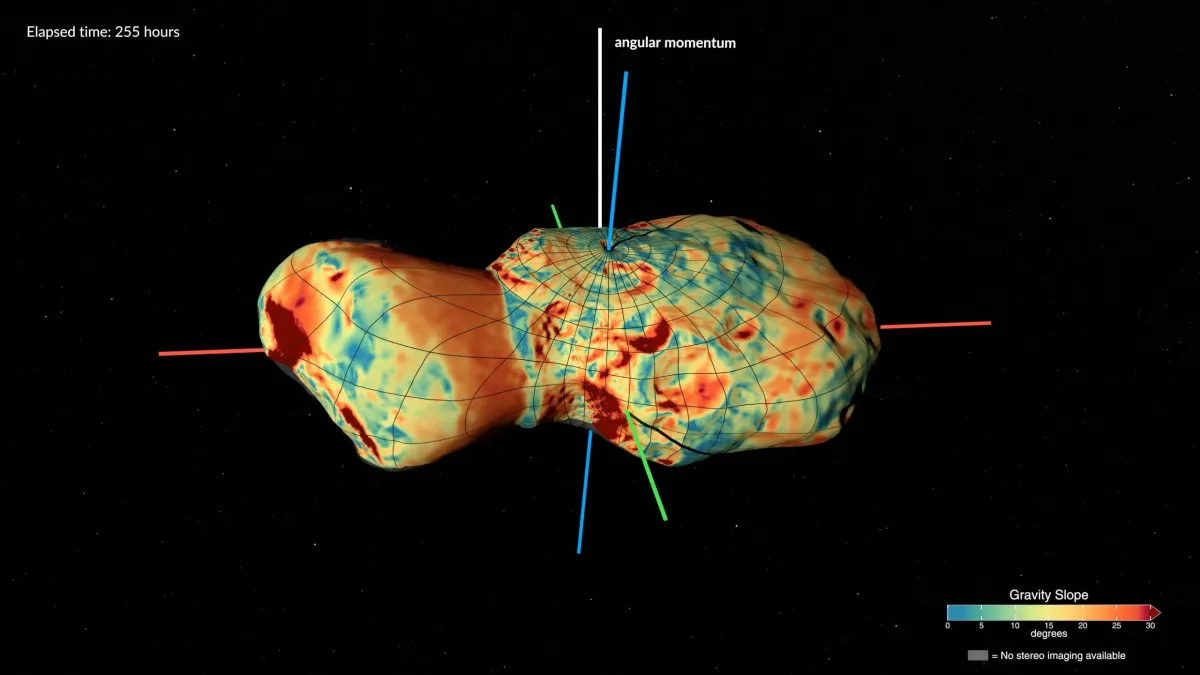
Donaldjohanson does not rotate around a single axis like most planets. Instead, it has a complex motion with two separate spins. The flyby also showed its unique peanut shape. Many craters and ridges cover its surface.
This encounter was a practice run for Lucy's main mission. Lucy will start exploring the Trojan asteroids with a flyby of Eurybates on August 12, 2027. All systems on the spacecraft worked as planned. Scientists also got a chance to compare Donaldjohanson with two other asteroids, Bennu and Ryugu. These two have similar makeups but had very different histories.
The Lucy team's first findings were published on June 18 in the journal Science.
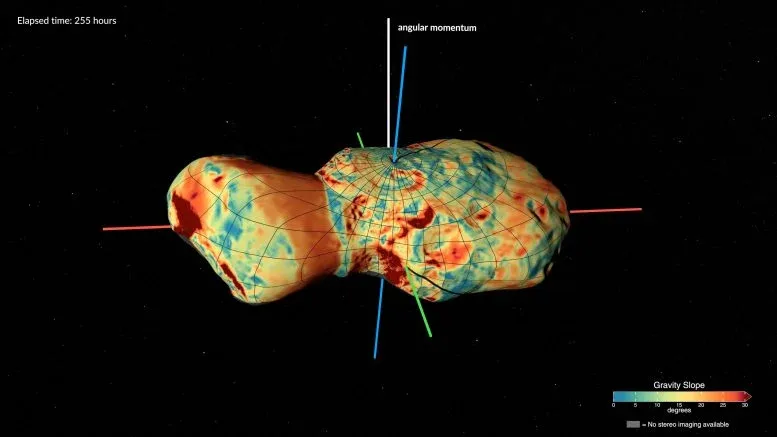 The asteroid Donaldjohanson is shown slowly rotating in a tumbling, non-principal axis motion, with its angular momentum vector and rotation axes indicated. The surface is colored by gravity slope, which measures the angle between the local surface and the direction of gravity. Higher values (warmer colors) indicate steeper terrain relative to the local gravitational pull. Regions with limited stereo image coverage have been masked out where the shape model is less well constrained. Credit: Kel Elkins/NASA’s Science Visualization Studio/DLR
A Wobbling Asteroid
Before Lucy arrived, telescopes on Earth saw regular changes in the asteroid's brightness. This suggested the long object rotated every 10.5 Earth days.
Lucy showed that its movement is much more complex. Donaldjohanson wobbles like a spinning top. It rotates end over end every 10.5 days. It also rocks back and forth around its long axis every 26.5 days.
How the Peanut Shape Formed
Earlier observations hinted that the asteroid was long. But Lucy's close-up images showed it is "bilobate." This means it has two connected parts separated by a narrow neck, making it look like a peanut.
Scientists think these two parts were once separate pieces from an asteroid crash. Their own gravity eventually pulled them together into one object.
Researchers estimate that Donaldjohanson once spun at least 10 times faster than it does now. Over the last 20 million to 60 million years, its rotation slowed down. As it spun slower, the balance between gravity and outward force changed. This allowed loose rocks and debris to slide downhill. This softened the look of many craters seen in Lucy's images.
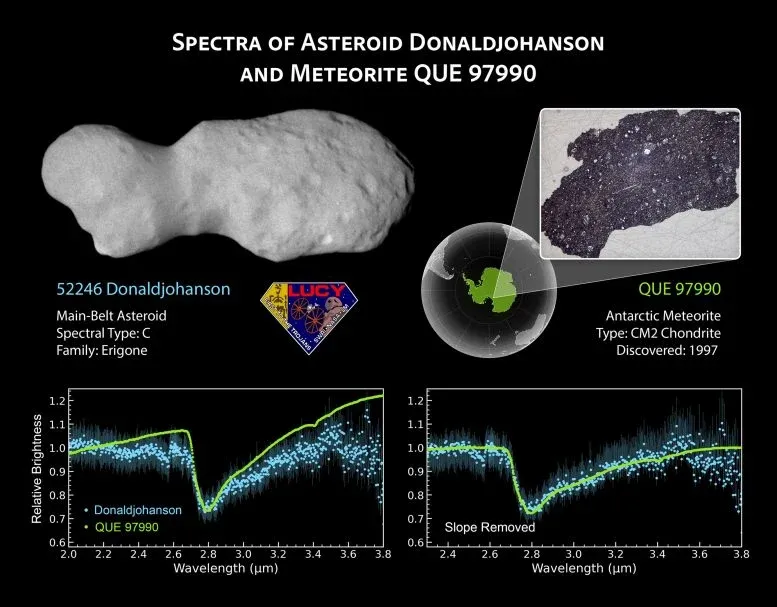 During its April 20, 2025, encounter with the main-belt asteroid Donaldjohanson, NASA’s Lucy spacecraft discovered evidence for iron-rich clays on the surface using its infrared spectrometer. These clays, which are similar to those found in carbon-rich meteorites such as QUE 97990, indicate that water was briefly present in the asteroid during the distant past. Credit: NASA/Goddard/SwRI/Dan Gallagher
Sunlight Changed Its Spin
Researchers believe the slowdown was due to the YORP effect. This process is driven by sunlight.
The Sun warms different parts of an asteroid's surface. These areas then release the absorbed energy as infrared light. The force created is very small. But an unevenly shaped asteroid feels a tiny twisting effect. This can slowly change its rotation over millions of years.
This same process can either slow down or speed up other asteroids. Bennu, for example, now rotates every four hours. Ryugu spins about every seven hours. Scientists think both of these asteroids once spun much slower before the YORP effect sped them up.
Clues of Ancient Water
As Lucy flew past Donaldjohanson at about 30,000 mph, its tools found iron-rich clay minerals on the asteroid's surface.
These minerals could only have formed if liquid water was present long ago. However, researchers believe the water was only there for a short time. This is because long exposure to water usually replaces the iron in these clays with elements like magnesium.
This is different from Bennu and Ryugu. On those asteroids, scientists found magnesium-rich clay minerals. This suggests water was present for much longer, possibly millions of years. This would have happened while those asteroids were still part of larger parent bodies.
The different mineral signs suggest that the parent asteroids may have formed at different times. They might also have formed in different parts of the early solar system. Eventually, they all ended up in the main asteroid belt.
Comparing Donaldjohanson with Bennu and Ryugu
Scientists believe Donaldjohanson is made from the remains of a larger asteroid. This parent asteroid contained both carbon and water. It was shattered in a collision within the main asteroid belt. Bennu and Ryugu are thought to have a similar origin.
However, the differences are also important.
Donaldjohanson formed about 155 million years ago. This makes it much younger than Bennu and Ryugu, which formed about 1 to 2 billion years ago. Donaldjohanson has also stayed in the asteroid belt. Bennu and Ryugu, however, slowly moved into orbits that bring them close to Earth. This made them good targets for missions to collect samples.
Simone Marchi, Lucy deputy principal investigator, said it helps scientists to compare Donaldjohanson with asteroids like Bennu and Ryugu. He noted that every small difference gives another clue to our origin story.
Marchi added that learning more about the Trojan asteroids will challenge our understanding of how the solar system formed. The Trojan asteroids are a completely different group of space rocks with very different histories.
Lucy's Mission to the Trojan Asteroids
Donaldjohanson is just a preview of Lucy's main mission.
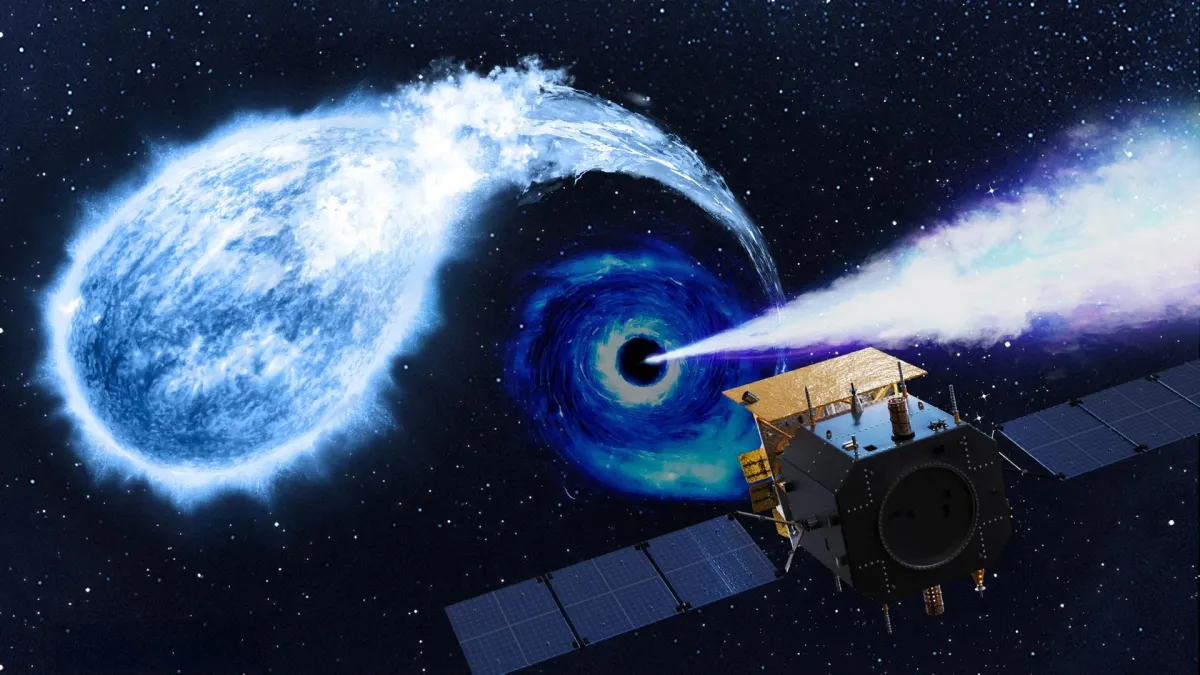
The mission is named after the famous fossilized human ancestor found in Ethiopia in 1974. Lucy will be the first spacecraft to explore Jupiter's Trojan asteroids. These old, well-preserved objects formed in the earliest days of the solar system. They may help scientists understand how the planets formed, moved, and settled into their current orbits.
Deep Dive & References
The Lucy flyby of (52246) Donaldjohanson: A bilobed asteroid with tumbling rotation - Science, 2026