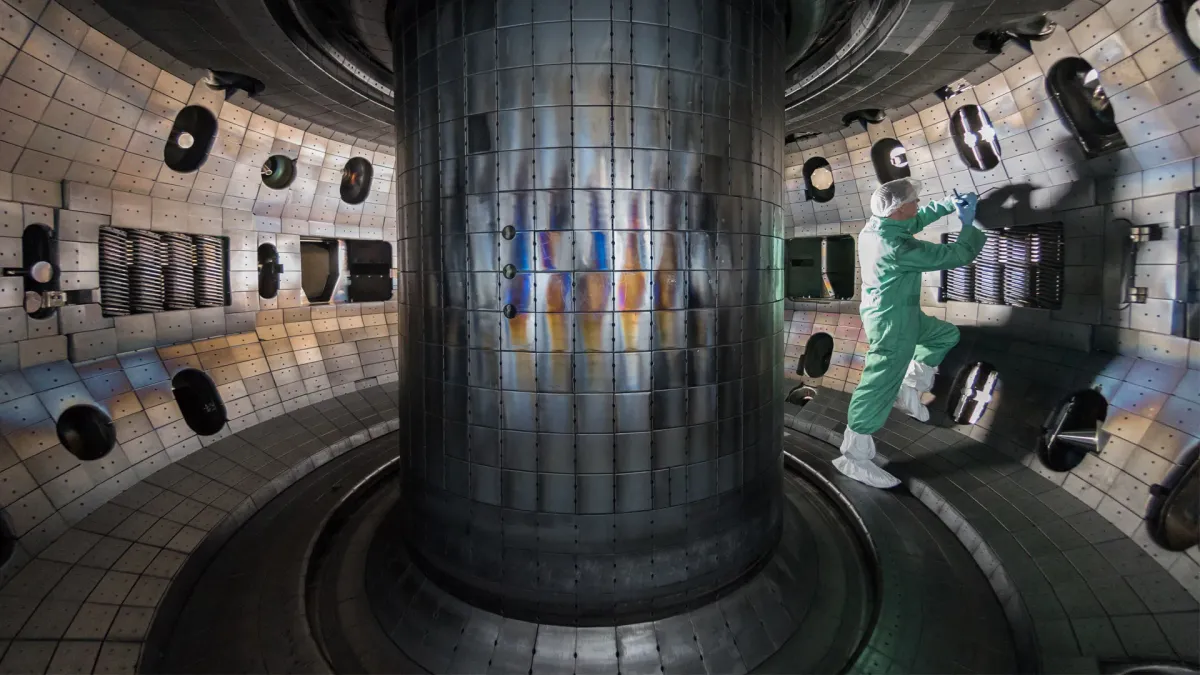
Imagine trying to contain a piece of the sun, hotter than its core, in a donut-shaped magnetic field. That’s essentially what goes down inside a fusion machine. And while those extreme conditions are crucial for generating clean energy, they also tend to make the machine itself… wiggle a bit.
At the DIII-D National Fusion Facility, even the tiniest twitch from the massive magnets surrounding the plasma can throw an entire experiment off course. For years, predicting these subtle shifts was a nightmare. Now, scientists have unleashed a machine-learning system that not only learns from these changes as they happen but can actually predict how the hardware will behave in the next experiment. It’s like having a psychic mechanic for your mini-sun.
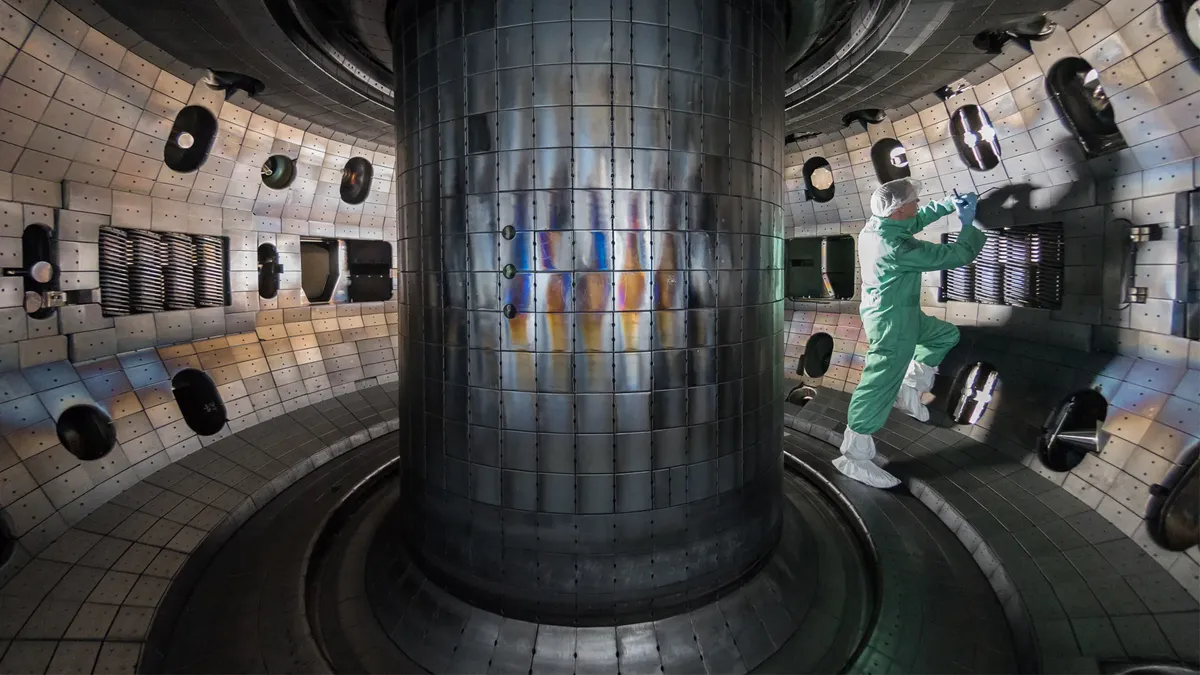
The result? This new method slashes prediction errors by a whopping 80% compared to older models. Which, if you think about it, brings AI a whole lot closer to being a practical tool for fusion research, rather than just a very clever data analyst.
We're a new kind of news feed.
Regular news is designed to drain you. We're a non-profit built to restore you. Every story we publish is scored for impact, progress, and hope.
Start Your News DetoxTeaching AI to Anticipate Trouble
Kishan Rajput, a data scientist at Jefferson Lab and one of the brains behind this, explains that this technique lets fusion scientists spot problems before they even brew. The DIII-D is a tokamak, that aforementioned donut-shaped device, which uses ridiculously strong magnetic fields to cradle superhot plasma.
Surrounding this plasma are colossal magnets, called toroidal field (TF) coils. They’re built with surgical precision, but they’re not entirely static. They can subtly shift as the plasma’s stability changes between experiments — or “shots.” Rajput notes that knowing how these coils will move helps scientists understand how stable an experiment will be and if trouble is on the horizon. The catch: the data describing this movement is a chaotic, ever-shifting beast, making traditional machine learning throw up its hands.
See, a model trained on old data assumes the future will look a lot like the past. But TF coil data drifts like a tumbleweed in a hurricane, thanks to the plasma's constantly changing behavior. Rajput says a model trained only on past data would be about as reliable as a chocolate teapot without constant updates. The DIII-D team needed something more… nimble. They needed a virtual doppelgänger of the TF coil system that could update itself between shots and actually predict the future.
The Digital Twin with a Crystal Ball
So, Rajput and his team cooked up an approach using deep neural networks trained with "online learning." Instead of a one-and-done training session, online learning continuously feeds new information into the system, letting it adapt as conditions change. Think of it as a student who never stops learning, even after graduation.
They took this a step further, creating an “online ensemble” — basically, a squad of several models, each trained on different historical timeframes. This is genius because changes in a fusion machine happen at different speeds. One model might be a whiz at sudden jolts, another at slow, creeping shifts. Others cover everything in between. It's a full-spectrum prediction team.
Another sticky wicket: how does the system know if its prediction is any good during the forecast? They solved this by giving each prediction an “uncertainty estimate.” This is essentially the model saying, “I’m 80% sure about this, but that other bit? Maybe 50/50.” The ensemble then trusts the models with the most reliable uncertainty ranges. So, it not only predicts what will happen but also tells operators how much they should actually trust that prediction.
The results were genuinely impressive. Online learning slashed prediction errors by 80% compared to static models. Then, the uncertainty-guided ensemble chopped off another 10% of errors compared to standard online learning with a single model. Let that satisfying number sink in.
Researchers are calling their system a “digital twin” of DIII-D’s toroidal-field coil system. It's a virtual copy that can gobble up information and spit out predictions of how the physical machine will respond. Rajput explains they can now test different parameters in this virtual replica before running them on the actual machine. This is particularly handy at DIII-D, where experiments happen every ten minutes. That’s not a lot of time to scratch your head over unexpected hardware behavior.
Predicting coil movement before the next shot means operators can tweak plasma settings or even perform maintenance, preventing tiny problems from snowballing into bigger, more expensive ones. The team plans to feed the system years of data to help it encounter rarer events and refine its uncertainty estimates. Because, as Rajput notes, people want to understand what's happening inside an AI model, rather than it being a "black box," which, fair enough, builds trust.
For now, the framework is ready for DIII-D and could be adapted for other fusion machines. If that happens, AI could leapfrog beyond just analyzing fusion experiments after they occur. It could become a real-time decision-maker, part of the system that greenlights the next experiment. Which, if you ask us, is both impressive and slightly terrifying. In the best possible way, of course.