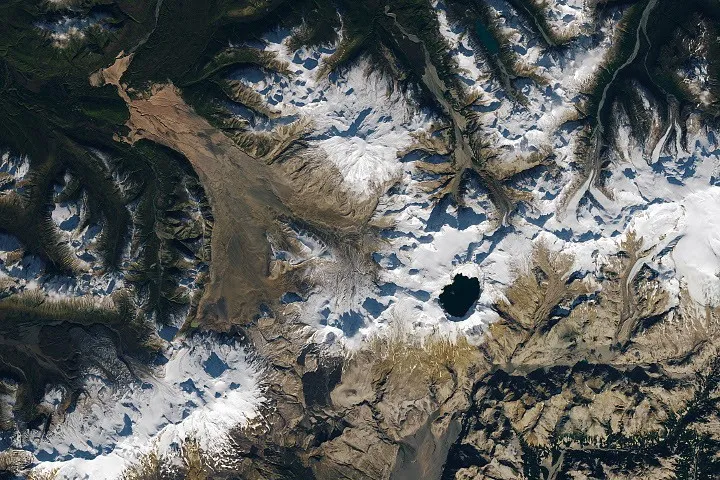
Before they ever set foot on the actual Moon, NASA's Apollo astronauts had to learn how to play its game. And by "game," we mean pretending to collect rocks in a landscape so alien, it might as well have been another planet. Their training ground? The Valley of Ten Thousand Smokes in Alaska's remote Katmai National Park.
Back in 1965 and '66, these future lunar explorers were dropped into a volcanic wasteland, a place that looked like the Moon's angry cousin. There, they'd pair up and, according to Apollo's science training coordinator William Phinney, "play the Moon game." The goal: gather rock samples and describe their findings to scientists, all while pretending they were millions of miles from Earth. Which, let's be honest, was probably easier than pretending they weren't freezing.

This particular playground was a testament to the raw power of nature. It was filled with the debris from the 1912 eruption of Novarupta, an event so massive it was the largest volcanic eruption on Earth in the entire 20th century. We're talking ash flows up to 660 feet thick, deposited at a casual 1,380 degrees Fahrenheit. Just a little toasty.
We're a new kind of news feed.
Regular news is designed to drain you. We're a non-profit built to restore you. Every story we publish is scored for impact, progress, and hope.
Start Your News DetoxThe valley earned its dramatic name from the countless fumaroles – those vents that belch gas and steam – that filled the area for a decade after the eruption. Some even lingered until the 1990s, just to keep things interesting.
Initially, scientists thought the eruption came from nearby Mount Katmai. But nope, it was Novarupta, which, rather fittingly, means "new eruption." Novarupta basically siphoned off all the magma from under Katmai, leaving a void so vast that Katmai's top collapsed, forming a 2.5-mile-wide caldera. Because apparently, one dramatic volcanic event just isn't enough.

The Moon Game Continues
While the Valley of Ten Thousand Smokes is a much younger volcanic landscape than the Moon's ancient lava flows, it offered the Apollo crews an unparalleled opportunity to get up close and personal with volcanic materials and landforms. They studied everything from those persistent fumaroles to deep gorges carved by streams.
Fast forward to today, and researchers still trek into this Alaskan wilderness, searching for geological clues to better understand the Moon and Mars. In 2024, the Goddard Instrument Field Team (GIFT) explored its icy volcanic terrain. Why? Because Mars, like this valley, has glaciers and ice sheets mixed with dust and ash. It's almost like Earth is a giant, convenient cheat sheet for space exploration.
The GIFT team even collected samples from formations reminiscent of the Moon's mysterious Gruithuisen Domes – hardened lava structures with a composition that baffles scientists. So, the "Moon game" isn't just a historical footnote. It's an ongoing, slightly chilly endeavor that continues to help us unravel the secrets of our celestial neighbors. And probably makes for some epic hiking stories.