Imagine a cosmic event so dramatic, so utterly bizarre, that scientists have to invent a whole new category for it. Well, that's precisely what Chinese astronomers might have stumbled upon: a blue optical transient named AT2019ijn that’s basically rewriting the rulebook for stellar fireworks.
Discovered in a dwarf galaxy, this thing brightens ridiculously fast, fades slowly, and then, just to keep things interesting, blasts out radio waves so bright they make other explosions look like a whisper. It’s like the universe decided to throw a party and then set off a firework that refused to quit.
The Universe's Most Peculiar Party Trick
Astronomical transients are, by definition, extreme. They’re the universe’s way of saying, “Look at me!” Among these, Fast-evolving Blue Optical Transients (FBOTs) are the divas. They hit their peak brightness in under ten days, glow a brilliant blue, and then dim over about a month. AT2019ijn, first spotted by the Zwicky Transient Facility in May 2019, started out looking like one of these. But then, it got weird.
We're a new kind of news feed.
Regular news is designed to drain you. We're a non-profit built to restore you. Every story we publish is scored for impact, progress, and hope.
Start Your News DetoxNew observations, led by Hucheng Ding from Anhui Normal University, revealed AT2019ijn isn't just a unique FBOT; it's practically in a league of its own. It brightened to a peak luminosity of -21.05 magnitude in just 5.26 days – which, if you’re not an astronomer, means it got incredibly, blindingly bright. And then it took over a month to slowly fade, all while maintaining its striking blue hue.
Now, a slow fade is more typical of something called a superluminous supernova (SLSN) or a tidal disruption event (TDE) – which is basically a black hole devouring a star. So, AT2019ijn was already mixing genres.
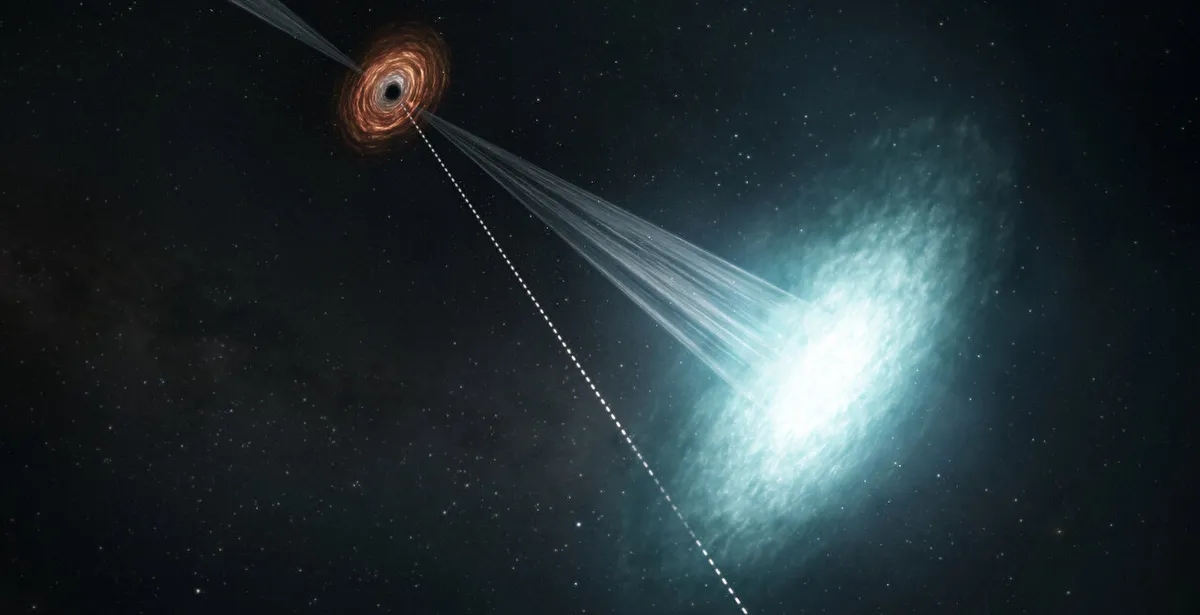
But here’s where it really decided to show off: its radio emissions. They were incredibly bright and lasted for ages, peaking a staggering 641 days after its optical discovery. This peak radio luminosity was ten times brighter than any other known FBOT or SLSN. The only thing it did resemble was a jetted TDE – a black hole meal with a side of incredibly powerful, focused energy beams.
Scientists figure this radio blast came from an “off-axis relativistic jet” that eventually pointed our way. This jet’s kinetic energy is estimated at a mind-boggling 700 sexdecillion ergs. Let that satisfying number sink in. It’s a lot. And it strongly suggests some kind of incredibly active, powerful engine at its heart.
A Black Hole's Dinner Party, Or Something Wilder?
The leading theory is that AT2019ijn is a jetted TDE involving an intermediate-mass black hole – one about 132,000 times the mass of our sun. Picture a black hole in the middle, casually ripping apart a star and then spitting out a super-energetic jet. Standard Tuesday for a black hole, perhaps, but a wild show for us.
However, they’re also considering it might be a jetted magnetar, which is a type of neutron star with an incredibly powerful magnetic field. Either way, it’s not your average stellar explosion.
Its unique combination of fast brightening, slow fading, and those utterly insane radio emissions has led the researchers to one conclusion: AT2019ijn might just be a whole new class of relativistic optical transient. A new cosmic category, just because this one explosion decided to be extra. Which, if you think about it, is both impressive and slightly terrifying. The universe, it seems, still has plenty of surprises up its sleeve.