
Light moves incredibly fast, which is great for sending lots of information. But this speed makes it hard for computers to hold onto, delay, or sync up light signals. Now, researchers from Seoul National University and the University of Seoul have created a programmable chip that can slow light down when needed.
This new technology allows light to be stored, delayed, and controlled all on one chip. This could be a big step for low-power optical computing in AI servers and future optical communication systems.
Professors Namkyoo Park and Sunkyu Yu from Seoul National University led the project. Professor Xianji Piao from the University of Seoul also contributed.
We're a new kind of news feed.
Regular news is designed to drain you. We're a non-profit built to restore you. Every story we publish is scored for impact, progress, and hope.
Start Your News DetoxWhy Slowing Light Matters
The rise of generative AI and large AI models means computers need to do more work. Traditional electronic chips use a lot of power and have limits on how fast they can move data. This has led to interest in optical computing, which uses light to process information quickly and with less energy.
However, light naturally travels at a constant speed. This makes it hard to create the memory and buffer functions that optical computing needs.
The researchers tackled this problem by building a programmable chip that controls both the speed and shape of light signals. Their method offers much more control over "slow light" than previous ideas. These findings were published in Advanced Science.
Overcoming Fixed Optical Delays
Photonic integrated circuits use light to process information. They are being developed for faster and more efficient computing. Data centers, communication networks, and computing systems need to do more than just send data quickly. They also need to coordinate when signals arrive and hold them briefly.
Scientists have looked at structures called coupled-resonator-induced transparency (CRIT). These use interference between several optical resonators to manage light signals. CRIT lets light within a specific frequency range pass through while slowing it down.
The issue with older CRIT devices is that their settings are fixed once they are made. If you wanted to change the frequency range or create a longer delay, you would need a completely new device.
 (From left) Sunkyu Yu (co-corresponding author), Department of Electrical and Computer Engineering, Seoul National University; Namkyoo Park (co-corresponding author), Department of Electrical and Computer Engineering, Seoul National University; Xianji Piao (co-corresponding author), School of Electrical and Computer Engineering, University of Seoul; Seungkyun Park (co-first author); Beomjoon Chae (co-first author); Hyungchul Park (co-author). Credit: Seoul National University College of Engineering
This lack of flexibility makes optical communication hardware and data centers more complicated and expensive. For AI servers and next-generation data centers that handle huge amounts of information in real time, fixed optical hardware has been a major roadblock.
How the New Chip Works
The researchers found a solution by treating two optical states in CRIT systems, called the bright mode and dark mode, as one unified element. They then added two adjustable loop couplers. This design allows the resonator structures to be changed after the chip is made, instead of being permanently fixed.
With this new CRIT structure, the researchers showed they could delay and control light as needed. By seeing the interference between bright and dark modes as a single design factor, they greatly increased the flexibility of photonic resonator circuits.
Their analysis showed that the two loop couplers could control the width and shape of the light's passband. They could also adjust the delay and transmission properties of signals moving through the circuit. This means the speed and behavior of light can be reconfigured across an entire system of linked resonators, not just in one device.
Simulations also showed that the speed of light pulses could be changed dynamically while the circuit was running. The researchers found they could adjust signal delay without losing processing power. Light could also be converted between frequencies without needing extra specialized parts.
Real-World Reliability
The team used 3D electromagnetic simulations to check if the CRIT device could be built using a silicon nitride (Si₃N₄) photonic integrated circuit platform. They also looked at potential problems during manufacturing and use, such as material loss, differences in resonator quality, and thermal crosstalk.
The results suggest the design would work reliably under real-world conditions for photonic circuits.
This new platform allows real-time adjustments to both the timing and frequency of optical signals. This solves the problem of fixed optical delay devices. One circuit could potentially combine signal synchronization, variable delay lines, optical buffers, and frequency conversion. All these are crucial for future optical connections.
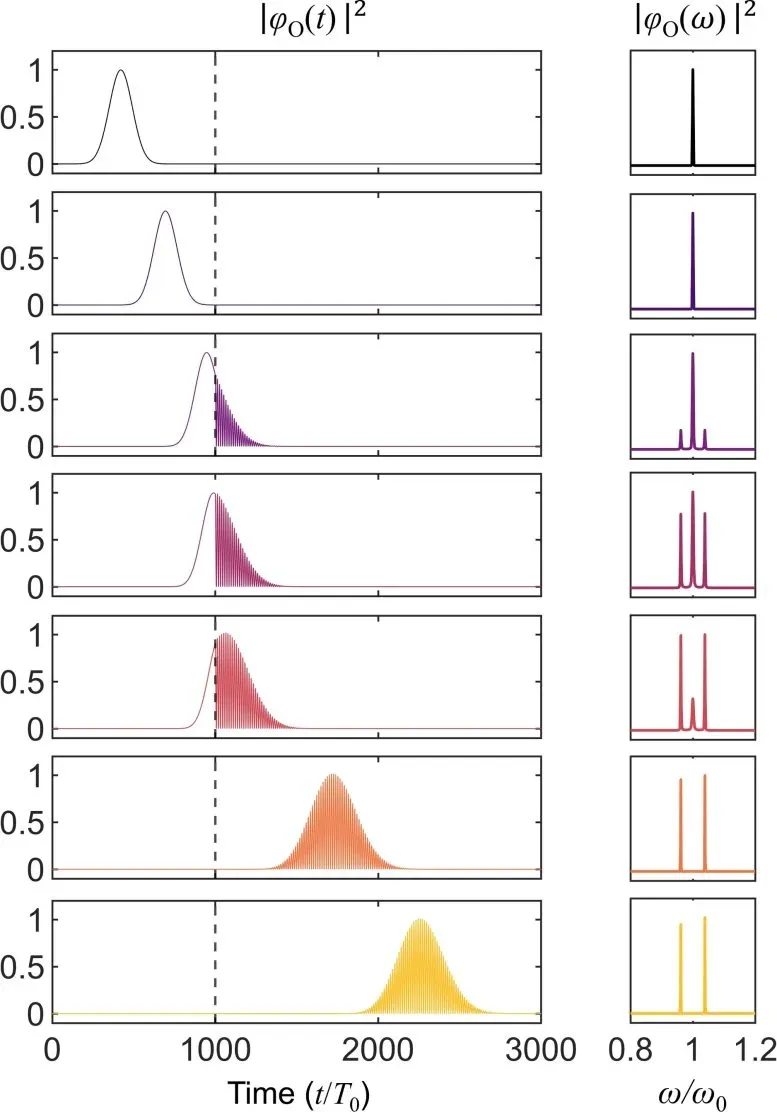 Optical signal delay and frequency conversion: demonstrates that optical pulses can be delayed and their frequency components modified depending on circuit control conditions. Credit: Advanced Science, originally published in Advanced Science
This design strategy could also be used for many other resonator-based photonic circuits beyond CRIT. This broad adaptability means the method could support future optical signal processing systems where light movement is designed and controlled more flexibly.
A Single Chip for Many Tasks
If this technology becomes widely used, one programmable optical chip could handle several tasks. It could change signal speed and switch between functions, much like software-defined systems. This flexibility could reduce energy use in data centers and AI servers while making data processing more efficient.
Putting several signal processing functions on one chip could also make optical communication equipment and sensors smaller and cheaper. Over time, this technology could help fields that need extremely fast information processing, like autonomous driving, next-generation communications, and quantum technologies.
Professor Namkyoo Park noted that this research offers a new design principle. It allows the flow of light within photonic integrated circuits to be reconfigured as needed, making designs much more flexible. The team plans to expand this technology to large-scale programmable photonic integrated circuits based on silicon photonics and photonic AI technologies.
Dr. Seungkyun Park and Ph.D. student Beomjoon Chae, who led the theoretical work, added that reinterpreting traditional photonic resonator physics from a new angle can lead to new functions in photonic integrated circuits. They plan to further develop this research towards practical devices and experimental testing.
Deep Dive & References
Fully Programmable Slow Light Based on a Spinor Representation of Generalized Coupled-Resonator-Induced Transparency - Advanced Science, 2026