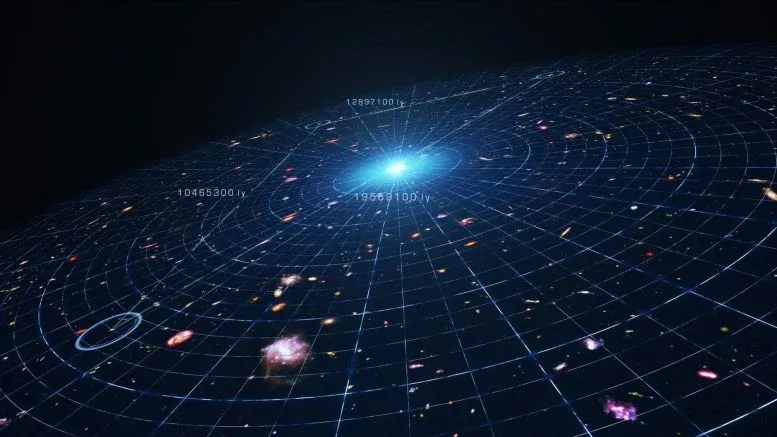
Good news, everyone: the universe is still expanding at an ever-increasing pace! This means dark energy, that mysterious cosmic accelerator, is still very much in charge, and your plans to eventually catch up to the edge of the cosmos are still doomed.
An international team of astrophysicists, including two Nobel laureates, just confirmed that the universe isn't hitting the brakes after all. They’ve decisively debunked a recent study that suggested cosmic expansion might be slowing down, which, let's be honest, would have been a bit of a letdown.
The Crisis That Wasn't
Turns out, the previous measurements were just fine. A South Korean study last year had everyone in a bit of a tizzy, claiming that dark energy might be weakening and the universe could be decelerating. It was like finding out your favorite roller coaster was suddenly going to become a gentle kiddie ride.
We're a new kind of news feed.
Regular news is designed to drain you. We're a non-profit built to restore you. Every story we publish is scored for impact, progress, and hope.
Start Your News DetoxDr. Phil Wiseman, lead author of the new study from the University of Southampton, summed it up perfectly: "Thankfully we have averted this crisis." Crisis averted, indeed. Our understanding of the universe's future, where everything just keeps getting further away, is still firmly intact. Now, if only we could figure out what dark energy actually is.
Nobel laureates Professor Adam Riess and Professor Brian Schmidt, who shared the 2011 Nobel Prize for their work on cosmic acceleration, were part of the team that put this whole debate to bed. They helped establish the idea of an accelerating universe by studying Type Ia supernovae—those spectacularly bright explosions of white dwarf stars.
Exploding Stars and Miscalculations
The previous study's hiccup came down to how they estimated the ages of these exploding stars. They apparently treated a galaxy's age as the same as the age of an individual star within it. Which, if you think about it, is like assuming your age is the same as the age of your entire family tree. Not quite right.
They also missed a standard correction for the mass of the galaxies hosting these supernovae, a detail that, in cosmology, is apparently a big deal. As Professor Riess sagely put it, "Extraordinary claims require especially careful testing." And when those supernovae are calibrated correctly, accounting for their different environments, the evidence for cosmic acceleration holds firm.
So, while the idea that the universe might be slowing down was an interesting thought experiment, it was ultimately incorrect. But hey, as Professor Mark Sullivan noted, questioning established theories is how science moves forward. Even if it just confirms what we already thought was happening. At least now we can all go back to wondering about dark energy with renewed confidence that it's still out there, pushing everything apart. Because apparently, that's where we are now.