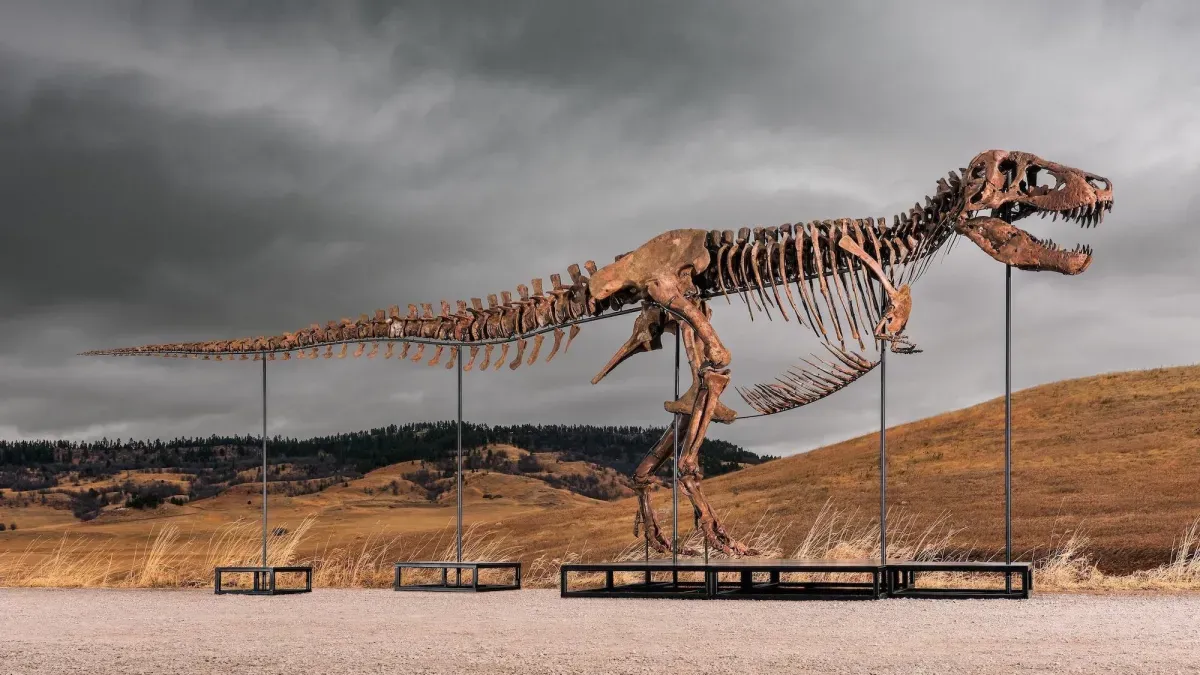
Ever wanted to own a piece of history, say, a 67-million-year-old apex predator? Well, if you've got a spare $30 million lying around, Sotheby's has just the thing for you: Gus, one of the largest and most complete Tyrannosaurus rex skeletons ever unearthed. Standing a majestic 12.5 feet tall, Gus is about to become the most expensive dinosaur ever offered at auction, with an estimated price tag that could make even a fossilized financier gasp.
The Discovery of a Lifetime
The story of Gus begins, as many good stories do, on a cattle ranch in South Dakota. Rancher Gary "Gus" Licking had a hunch. For years, he'd been finding stray teeth and bone fragments on his vast 6,500-acre property. He suspected something bigger was lurking beneath the surface. So, he called in Thomas Heitkamp and his team from Theropoda Expeditions.
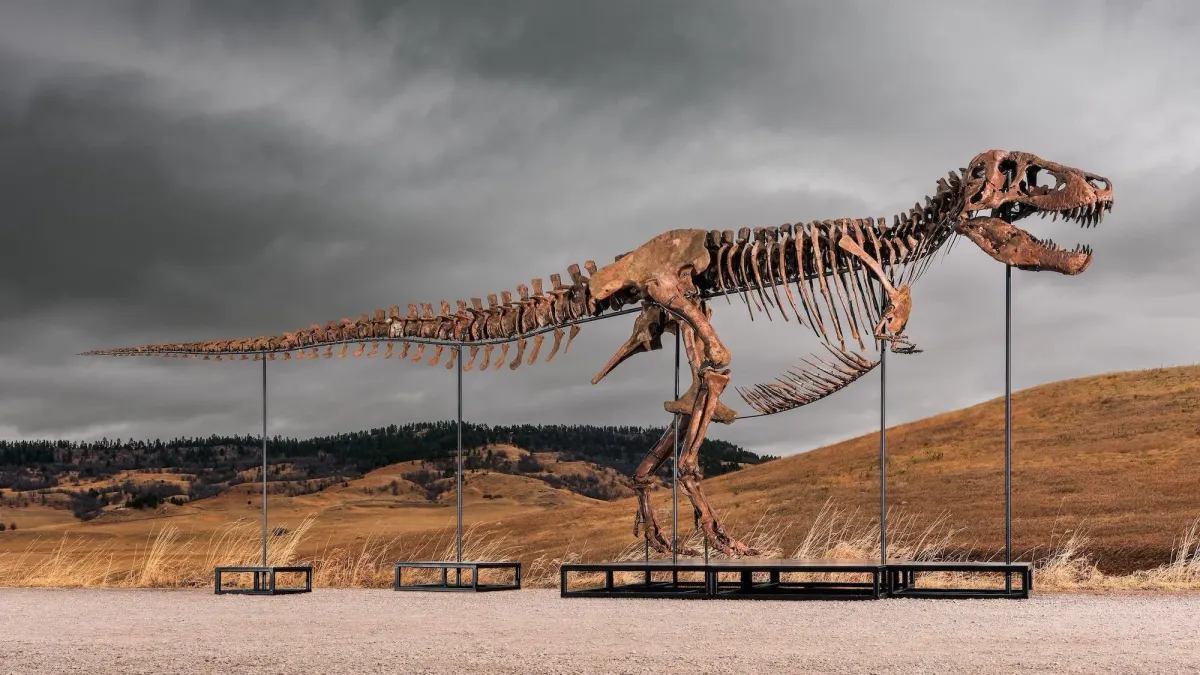
Licking pointed them to a specific spot, and in 2021, they found him: Gus. Sadly, Gary Licking passed away just a year into the dig, never seeing the full glory of his namesake T. rex. The team, clearly a sentimental bunch, named the dinosaur in his honor. The excavation itself was a three-year odyssey, with the team often working for weeks without a single bone to show for it. Heitkamp described the site as a complex Cretaceous-era puzzle, teeming with fossils of plants and animals. But their meticulous, painstaking work paid off, yielding a T. rex of truly epic proportions.
We're a new kind of news feed.
Regular news is designed to drain you. We're a non-profit built to restore you. Every story we publish is scored for impact, progress, and hope.
Start Your News DetoxAfter three summers in the field, the team then spent another three years in the lab, carefully freeing Gus from his rocky tomb, cleaning, preparing, and identifying each ancient bone. Because apparently that's how long it takes to solve the world's hardest, most ancient jigsaw puzzle.
A Specimen Worthy of Its Name
Gus is a remarkable specimen, boasting 183 fossil bones, which accounts for a staggering 82% of the entire skeleton. That includes a beautifully preserved skull (over four feet long, just for fun), a wishbone (yes, even T. rexes had them), and a complete pelvis. The entire body stretches about 38 feet long, which, if you think about it, is both impressive and slightly terrifying. Heitkamp noted the sheer satisfaction of fitting together bones that had been separated for 67 million years. Let that satisfying number sink in.
If you happen to be in New York City, Gus will be on public display at Sotheby's galleries starting July 1st, before going under the hammer on July 14th at their Natural History auction. Gary Licking's wife, Dana, expressed her excitement for others to enjoy this incredible discovery, calling Gus just one of many historical treasures hidden on their cherished land.
The Dino-Dollar Debate
Of course, selling a T. rex isn't without its controversies. The first T. rex to hit the auction block, Sue, fetched over $8 million in 1997 and now resides happily at the Field Museum in Chicago. But since then, private dinosaur auctions have sparked a heated debate. Critics worry that these magnificent fossils disappear into private collections, potentially becoming inaccessible to scientific research. They also fear that the lure of big money encourages a hunt for marketable specimens over a thorough scientific study, leading to incomplete research.
Then there's the question of who truly benefits. Private landowners can rake in massive fees, giving those with deep pockets better access to these scientific treasures than, say, a university with a limited budget. Some countries, like Canada, Brazil, and South Africa, have strict rules about fossils, regardless of where they're found. But in the U.S., if it's on your land, it's apparently fair game. So, if you're ready to put down a small fortune for a very, very large pet, Gus might just be your guy.