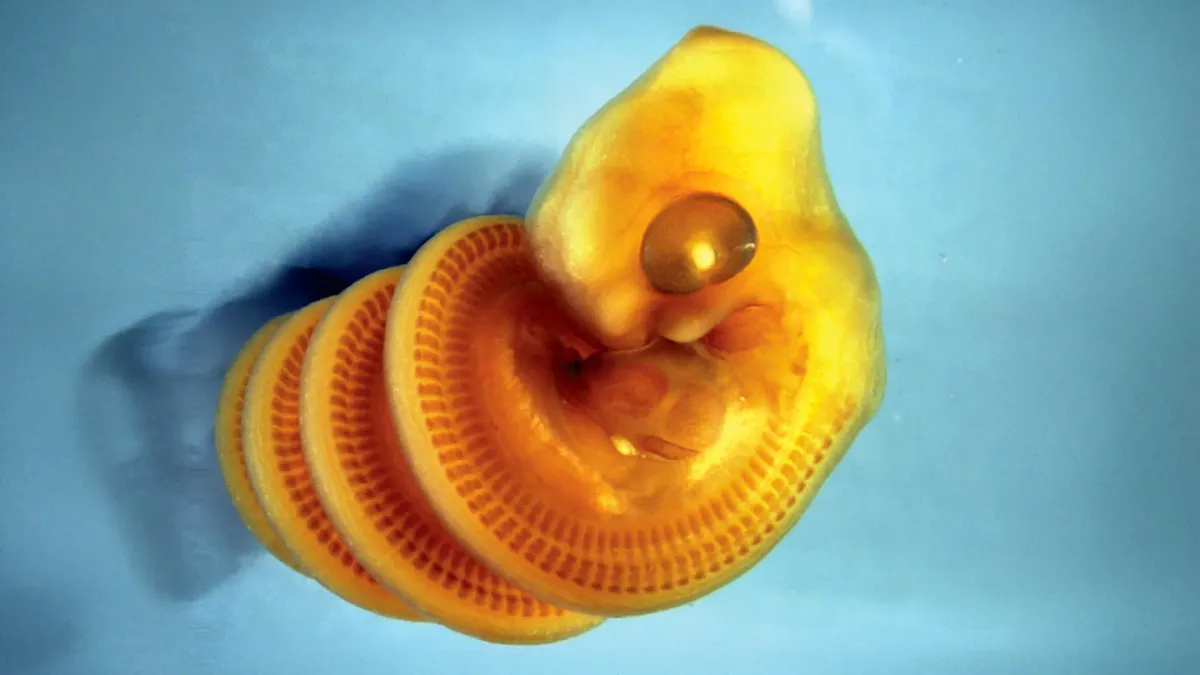
Ever wondered why a snake embryo starts its life curled into a neat, right-handed spiral inside its egg? Probably not. But scientists did, and their answer is delightfully simple: the snake's body grows much faster than its gut, creating a biological tether that forces the whole lengthening package to buckle and twist.
Think of it like adjusting a strap on a backpack. The longer side of the loop just naturally twists. That's essentially what's happening inside a snake egg, according to Dr. Tetsuto Miyashita, an evolutionary biologist at the Canadian Museum of Nature.
This discovery, published in Current Biology, explains a long-standing mystery about how these legless wonders manage to fit their incredibly long bodies into such a compact space. And it all started during the 2020 lockdown, when Miyashita needed a research question his students could tackle from home. His burning query? Do snake embryos coil right or left?
We're a new kind of news feed.
Regular news is designed to drain you. We're a non-profit built to restore you. Every story we publish is scored for impact, progress, and hope.
Start Your News DetoxThe Great Embryo Photo Hunt
Led by graduate student Alexandra Weber, the team embarked on an epic digital scavenger hunt. They scoured published research and museum databases, collecting over 900 photos of embryos from 39 different snake and limbless squamate species. A statistically robust sample, as Weber put it, which sounds a lot like "we looked at a lot of squiggly things."
What they found was a clear pattern: for the first few weeks, every single embryo coiled to the right. And since these tiny snakes don't have muscles to move on their own yet, something else had to be forcing the twist.
The crucial clue came from Dr. Raul Diaz at California State University Los Angeles, who used CT scans to peek inside the eggs. What his scans revealed was a structure nobody had seen before: a pillar of gut stretching through the spiral, detached from the body, surrounded by yolk-fed blood vessels.
Basically, the snake's body is in a hurry to get long, which is a pretty essential life goal for a snake. But its gut isn't in quite the same rush. This growth disparity creates a mechanical force. The slow-growing gut acts like an anchor, and as the body continues to lengthen, it's forced to buckle and twist into a right-handed spiral, growing away from the yolk that's always on its left.
A Simple Secret, Uncoiled
Now, this right-handed coil isn't permanent. As the embryo matures, the yolk shrinks, muscles develop, and they get a bit more wiggle room. Some stay right-handed, some recoil to the left. But the initial, involuntary twist is all about that body-to-gut growth differential.
Miyashita notes that scientists often dive into complex genetic research to understand snake forms. But this time, it was a surprisingly simple approach — looking at photos and anatomy — that uncoiled a biological secret. It also adds snake embryos to the long and intriguing list of natural spirals, from snail shells to looping intestines, that scientists are still trying to fully grasp. Which, if you think about it, is both impressive and slightly terrifying.